Fifteenth-Century Malacca and Its Maritime Code: A Reflection of the State Hierarchical Sociopolitical Structure and Order through the Lens of the Code

Journal: Social Evolution & History. Volume 25, Number 1 / March 2026
DOI: https://doi.org/10.30884/seh/2026.01.02
Nadyaa Afiqah Binti Azerin HSE University, Moscow, Russia
ABSTRACT
The Maritime Code is one of the most important surviving legal texts from the Malaccan Sultanate (1400–1511). Given Malacca's fame as a maritime powerhouse in the fifteenth century, the legal text pertaining to the governance of its waters provides a valuable insight into how its maritime society functioned during that time period. Here, the Maritime Code was used to analyse the hierarchical sociopolitical structure and order aboard ships operating under Malacca's jurisdiction. The emphasis on hierarchies and ranks aboard the ship paralleled the rigid sociopolitical structure and order within Malacca's royal court on land, where hierarchy-enhancing policies were strictly observed. Elements such as body politic and legitimizing myths were also prevalent within the legal text and were used to reinforce the hierarchical sociopolitical structure and order aboard the ship. Additionally, the Maritime Code was shown to be an extension of the main legal code, with its content not only reflecting the hierarchical sociopolitical structure and order on land, but also as an extension of the Sultanate's legitimacy and sovereignty into the maritime realm.
Keywords: pre-colonial Malaya, hierarchy, hierarchy-enhancing policies, body politic, the Malacca Sultanate.
INTRODUCTION
The Malacca Sultanate (1400–1511) was an economic powerhouse in the fifteenth century, with its port attracting merchants and traders from across the globe (Andaya 2011: 13–14). Its strategic geographical location and stable governance made it a suitable entrepot for merchants from Europe to reach resource- and market-rich locations such as the Indian subcontinent. This made Malacca a hub for social and intercultural interactions between the visiting merchants and the local subjects. Scholars have written works on the Malacca Sultanate during its golden years (Wilkinson 1935; De Jong and Van Wijk 1960; Andaya 2018; Al-Aboudi 2021; Borschberg 2022). Many of these scholars used surviving texts and reproduced transcriptions of pre-colonial manuscripts as their main source to provide valuable insights into the functioning of society in the Malacca Sultanate (Winstedt 1938; Raffles 1879; Yock and Ahmad 2003; Ahmad 2008; Nordin 2008; Wan Husain et al. 2018; Mustafa and Ibrahim 2023)
This interest has been sustained throughout the years, with increasing interest shown in the use of pre-colonial Malayan sources such as the Sulalatus Salatin (The Genealogy of Kings), Undang-Undang Melaka (Laws of Malacca), and the Undang-Undang Laut Melaka (The Maritime Code). In the past three decades, scholars have studied these texts as part of their research on various aspects of Malaccan society, either in general (Hashim 1998; Yock and Ahmad 2003; Ahmad 2008; Sayuti and Omar 2017; Abdullah, Zakaria and Hanapi 2023), or specifically regarding the economy, politics, and social activities in Malacca (Johan 1999; Wan Husain et al. 2018; Handayani 2020; Mustafa and Ibrahim 2023; Noor 2024)
Despite the increased use of pre-colonial sources in the research on the Malacca Sultanate, there are still areas of studies left underexplored, such as the dynamics of sociopolitical order and hierarchy within that society. There seems to be a higher concentration of studies on the main legal codes – the Laws of Malacca – which were codified during the reign of Sultan Muhammad Shah (1422–1444) and was expanded further during the reign of Sultan Muzaffar Shah (1445–1458), which remained in place until the end of the Malacca Sultanate in 1511 (Fang 2007: 86). However, there are fewer works that utilize the Maritime Code on its own, as there are very few surviving manuscripts of the Maritime Code that still exist as a standalone text. Many surviving variants of the Code existed as part of the Laws of Malacca and the contents are often included in the transcribed copies of the main legal code. In the Maxwell manuscripts, the MS 5 and MS 6, the Maritime Code was inserted as a sub-chapter in the manuscript of the Laws of Malacca. Standalone manuscripts, such as MS 128, do exist, but the handwritten transcriptions were less legible, rendering it less ideal as a main source. Most works using precolonial Malay manuscripts, such as the Genealogy of Kings and the Laws of Malacca, often would make use of many variants of their respective manuscripts to fill in incomplete or incomprehensible parts.
This article seeks to contribute to the discussion, by using the Maritime Code to analyse the hierarchical socio-political order and structure in fifteenth-century Malacca. The Maritime Code of Malacca entails the workings aboard a civilian ship, enabling us to delve into how society functions and what role hierarchy plays aboard the ship by analysing the sociopolitical structure and order aboard the ship in relation to existing order on land. The research aims to introduce a new perspective on how society functions aboard the ship and expand existing knowledge of how the Malacca Sultanate operated in the fifteenth century. The Code, with its emphasis on the hierarchy aboard the ship, serves as a reflection of the hierarchical socio-political structure and order in the Malacca Sultanate, since its contents acted as a manifestation of the status quo on land. In a sense, the hierarchical and socio-political order imposed aboard the ship served as an extension of the way society was ranked and hierarchized on land in Malacca.
MALACCA: A SULTANATE BUILT ON MARITIME DOMINANCE
Malacca's fame in its days was built upon its maritime trade, due to its strategic geographical location and the impeccable timing of its rise as a maritime power. At the time of Malacca's founding, the maritime activities in the Straits of Malacca were still dominated by Srivijaya, albeit it was already in decline (Borschberg 2020). This paved the way for Malacca to vie for maritime dominance in the region, catalysed by the Sultanate's political and economic relations with Ming China in the 1400s (Hall 2010). These relationships with China played a huge role in securing Malacca's status as an economic powerhouse in the Straits.
In the early 1400s, Malacca became a tributary state of Ming China, securing the backing of not only the court of Emperor Yongle (1402–1424), but also the support of his navy, emboldening Malacca to take a more militant stance in the region, with its own navy (Hall 2010). At that time, Malacca possessed at least forty war galleys and smaller support vessels, which were all docked in Temasek, present-day Singapore (Borschberg 2020: 275). This ensured support, however, ended in the 1430s, when China withdrew from the region, marking the end of Malacca's naval militancy and the beginning of its pivot towards a more diplomatic and mercantile approach (Hall 2017). The Sultanate lowered its port duties and attracted merchants from neighbouring areas, such as Java-based traders, who initially traded at a competing Samudra-Pasai port (Ibid.).
According to Gin (2022), the basis of Malacca's success as a preferred trading port lies in the ‘practical and visionary policies’ of its rulers, particularly regarding its relationship with its neighbours and the trading communities within the region. The maritime trade policy in Malacca was relatively progressive, as merchants were allowed to trade ‘on their own account’ (Gin 2022) and did not require royal ascents or appointments to do so. Both the upper and the lower classes of society were involved in maritime trade, albeit in different capacities. The nobles and the upper class owned ships, but did not venture asea themselves (Borschberg 2020: 272). Instead, ships were staffed mainly by free people, slaves, or debtors, as hinted throughout the Maritime Code (Raffles 1879). This liberalization of trading activities to include even the lowest classes of people i.e. the slaves made the port accessible to traders from all religions, this led to the port hosting traders from across the region, such as Arabia, Persia, India, Java, Sumatra, China, the Ryukyu Islands, and neighbouring coastal areas (Borschberg 2020: 279–280). The Port of Malacca was said to have accommodated up to 150 perahus and 100 junks at a time, with 20 of the latter belonging to local traders, implying that most of the ships anchored in the port were owned by foreign merchants (Borschberg 2020). These merchants traded spices, textiles, exotic jungle products, cotton cloth, pepper, silk, and porcelain (Lobato 2012; Hall 2010, 2017; Gin 2022). Most of these items only passed through the port, with exceptions of rice and Javanese spices that were traded for use within Malacca (Hall 2017). Malacca also traded its spices, jungle products, and sea produce with its East Asian partners, such as China and the Ryukyu Island, and with the Mediterranean and Europe via Arab and Indian traders who passed through its port (Gin 2022). This scale of maritime trade in Malacca also translated into the population at the port, with up to 100,000 people living in the area at the end of the Sultanate (Rusli 2012). Large trading communities amounting to hundreds of traders mainly from China also settled in Malacca, either seasonally or permanently in the area surrounding the port. These factors, along with the timely decision of the Malaccan rulers to switch from their aggressive naval policy to economic-based policies, ensured its success as a Sultanate built upon its maritime prowess in the Strait of Malacca.
The importance of maritime trade to Malacca renders the Maritime Code an important and relevant legal text, providing a record of how society functions aboard those ships that passed through the Port of Malacca. This manuscript offers an insight not only into the specific details of ranks and hierarchy aboard the ships but also the hierarchical socio-political order and structure of the Malacca Sultanate that produced the legal document.
THE NATURE OF PRECOLONIAL MALAY SOURCES
The interest in pre-colonial Malay texts is not new, as figures such as Stamford Raffles, William Maxwell, and William Farquhar, who were colonially adjacent, collected them as manuscripts. Scholars have also been analysing and translating the texts since the first part of the twentieth century (Winstedt 1953; Winstedt and De Jong 1956; Roolvink 1967; Fang 2007). Most of the works focused on the textual and source analysis of the texts. Recently, there has been a rise in interest in pre-colonial Malayan texts, mainly related to the Genealogy of Kings, the Laws of Malacca, and the Maritime Code of Malacca. Scholars who engage with these sources have delved into various aspects of the Malacca Sultanate, both in general (Manguin 1991; Hashim 1998; Nordin 2008; Borschberg 2022), or in specific aspects, such as governance (Harun 2016; Sayuti and Omar 2017; Abdullah, Zakaria, and Hanapi 2023), social behaviours (Johan 1999; Mustafa and Ibrahim 2023) and even literary traditions (Handayani 2020; Noor 2024).
Despite their use as a main source in academic works, the credibility of the sources remains disputable. The Sulalatus Salatin has been subjected to criticism for the factual reliability of its content. Chambert-Loir (2005; 2017) noted multiple exaggerations in the text, arguing that it is more of ‘a political myth’ than a fully-fledged historical source. This is exacerbated by the existence of different transcriptions of the manuscript, each with a slightly different content variation from the other (Roolvink 1967). The Malaccan legal codes also underwent similar scrutiny, but their validity was not questioned as much as the Malay Annals (Johan 1999: 131; Fang 2007). Instead, their variants were the results of constant changes and amendments that the legal codes underwent with the passage of time. Another problem is the dating of these sources. The Malay Peninsula was colonized by four different colonial powers for four centuries, complicating the provenance of these texts and making it more difficult to accurately date them.
THE MARITIME CODE OF MALACCA: ORIGINS AND RELEVANCE
Just like the Laws of Malacca, the Maritime Code has been transcribed, translated, and transliterated multiple times. Fortunately, the manuscripts exist in less contentious forms compared to some other surviving texts of pre-colonial manuscripts (Winstedt and De Jong 1956: 27). There seems to be a consensus when it comes to the Maritime Code, as it specifically referred to a legal code that was proposed by a group of nakhodas (translation: captain) to be brought before the Sultan for ratification (Raffles 1879; Winstedt and De Jong 1956; Halimi 1999; Mustafa and Ibrahim 2023). Its origin, however, was not as clear, as demonstrated by the disagreement surrounding its date of conception. Some scholars attributed the overhaul of the legal codes and system to Sultan Muzaffar Shah (1445–1458), who embarked on a series of reforms that saw the expansion of Malacca's legal system and the creation of new roles relevant to its maritime space (Borschberg 2020; Andaya 2011; Hall 2017). This saw the expansion of the Laws of Malacca to include regulations for conduct at the Port of Malacca. This includes the introduction of standardized tariffs and taxes, which vary according to the merchants' port of origin (Borschberg 2020: 279–280). The introduction of a secular law in the port as part of the Laws of Malacca effectively placed the area under the jurisdiction of the main legal code of Malacca. The legal reform also saw the creation of the role of laksamana, the equivalent of the modern-day admiral in a sea fleet (Borschberg 2020: 275). The inclusion of naval affairs and the regulation of maritime activities at the port further expanded the jurisdiction of the Laws of Malacca to include Malacca's maritime space.
However, this expansion of the main legal code did not include regulations aboard the ships when they were at sea. The conception of the Maritime Code could be attributed to the captains i.e. the nakhodas, who felt compelled to introduce a separate legal code that is autonomous from the main legal code (Winstedt and De Jong, 1956). The inclusion of naval matters into the Laws of Malacca made sense due to its significance to the overall security of the Sultanate. However, the matters on board ships were not entirely subject to the whim of the Sultan. Maritime trades and economic activities at the Port of Malacca were conducted by traders independently, without royal interference. These ships were private property and belonged to traders who may not be subjects of the Malaccan Sultan. Therefore, the Maritime Code served as a legal code that operated separately from the Laws of Malacca, albeit still retaining similar features of a hierarchical socio-political order and structure that will be discussed in the later parts of this article.
This judicial separation ensures the specificity of the Maritime Code. Unlike the more extensive ‘Laws of Malacca’ that existed under various names (Fang 2007), the Maritime Code refers exclusively to a particular document, making the analysis less affected by variations and amendments like those in the Laws of Malacca. Despite the existence of multiple versions, the content of the Code appears to be consistent, with minimal contradictions between its versions. A caveat to this would be the Macassar variant, which has a contradicting legal clause regarding the role of the nakhoda. Because of this, this variant will not be included in the general analysis of the Maritime Code. Apart from this variant, most of the texts remain consistent, contributing to its credibility and stability as a source. However, this ‘stability’ did not make it immune to the same scrutiny and criticism that other pre-colonial sources face – dating the sources.
There are two conflicting accounts of the date of the Maritime Code, as the Raffles and Maxwell manuscripts are inconsistent in whom they attribute to the ratification of the Maritime Code. The Maxwell MS 47 and Raffles MS 68 attributed Sultan Muhammad (1422–1444) to be the one who ratified the Maritime Code (Winstedt 1953: 31). But this is contradicted by Raffles MS 33, 34, and 74, and the Maxwell MS 128, presented by Winstedt in 1956, which all attributed Sultan Mahmud (ca. 1488–1530) to be the reigning monarch during the time when the Code was ratified. The attribution to Sultan Muhammad was deemed as anachronistic by Winstedt due to the usage of some terms that were of Bugis1 origin. He argued that during the reign of Sultan Muhammad, the Bugis had not yet begun to roam the waters of Malacca, making the use of Bugis terms out of place in the Maritime Code. Borschberg (2020) also attributed the Maritime Code to be conceived after the legal reform that took place during the reign of Sultan Muzaffar Shah. This placed the conception of the Code at least after 1445, which is in favour of those who attributed the document to Sultan Mahmud (1488–1530), whose reign followed the legal reform of 1445 by his predecessor. Winstedt (1953: 31) attributes this confusion to the ‘Malay copyists’ who incorrectly transcribed the manuscript. The confusion could also be caused by the written Jawi script used during the transcription process. Until Za’aba (1949) had introduced a comprehensive registry for the Jawi-Rumi orthography in the twentieth century, the Jawi spelling was not standardized, leading to variations in writing and reading the texts. This confusion could be caused by the names of the Sultans themselves, with the name Muhammad(محمد) and Mahmud(محمود) being derived from the same Arabic root word (حمد) with only one-letter difference (و) between them. Given the possible deterioration of the texts, along with the flourishing Jawi scripts used in them, it is possible that there was an error in dating the Maritime Code. According to the comprehensive collated texts of the Maritime Code by Winstedt and De Jong (1956), there are at least 13 variants of the manuscript, 14 including the Macassar variant. As most of the variants concur that the Maritime Code was ratified during the reign of Sultan Mahmud, along with the date of the legal reform taking place after 1445, this article will date the ratification of the Code to his reign (1488–1530).
As the Maritime Code of Malacca will be used to reflect on the socio-political order and hierarchy during the Malaccan Sultanate, this article will focus on analysing relevant parts of the text, especially concentrating on the first few pages of the Maritime Code that contain information about how crew members were ranked on ships. I will also make use of multiple variants of the Maritime Code, with some cited directly from the manuscripts while others cited from Raffles' (1879) translated work on the Code, and Winstedt and De Jong (1956) compilation of manuscripts. The nature of the Maritime Code that had minimal contradictions (with the exceptions of its date of conception) makes it possible to use multiple versions and conduct a broader analysis of the socio-political order and hierarchy in fifteenth-century Malacca.
LAW AND SOCIAL NORMS: AN ARGUMENT FOR THE USE OF LEGAL CODES AS A REFLECTION OF SOCIAL BEHAVIOURS
Laws and legal codes reflect the society they operate in. They serve as a regulating instrument and an indicator of how a society functions, including hierarchical sociopolitical order and structure. The Maritime Code documented how Malacca's maritime community operated and the dynamics of social relations between the members of that community. The use of legal-based sources to provide insight into how a society works is based upon two premises; first, there must be a clear causal relationship between law and social norms, and second, the roles and functions of law and social norm are interchangeable.
For the first premise, legal scholars, such as Posner (1998, 2000, 2002), posit that social norms predate the establishment of ‘political society’, implying a direct evolutionary and progressive relation between law and social norms. What was initially a set of social norms eventually developed into a more institutionalized and codified form of rules, i.e. laws or legal codes. Here, the law supplements or even substitutes social norms due to the lack of enforcement by norms alone. The precedence set by social norms often serves as the basis for law, as seen in the implementation of social sanctions for transgressions, which were then slowly codified into imposed law. This progression from social norms into codified law is elaborated by Elizabeth Scott (2000a), entailing the progression of marital traditions into legal requirements that countries imposed upon marital institutions today. Bernstein (1993) and Calliess and Renner (2009) also indicated that certain elements of laws within economic and commercial trade derived from a set of social norms that society was already practicing. Although this intertwined function of law and social norms is still a relatively new phenomenon (Ellickson 1998, 2001), the notion seems to have its own set of scholars that have diverted their focus to this relationship (Friedman 1967; Bernstein 1993; Sunstein 1996; Ellickson 1998; Cooter 2000; Scott 2000a, 2000b; Callies and Renner 2009; Kahan 2019).
Despite its recent popularity in the 1990s, the linking of social norms to codified law can be traced back to 1895 with Emile Durkheim's description of how society's behaviour is affected by various institutions, which help define the ‘law and custom’ in which people operate (Durkheim 1982). Nearly a century later, Clifford Geertz (1973) contributed to the discussion by elaborating on the relationship between social norms and how their ‘interpretations’ help define how society would behave and come to understand the world it inhabits. They helped set the stage for how the discourse would continue today. More recently, Axelrod (1986) and Licht (2008) also defined social norms in such a way that implied that they have similar functions to what legal codes have in our society. Axelrod's definition of a social norm as ‘a given setting to the extent that individuals usually act in a certain way and are often punished when seen not to be acting in this way’, is not dissimilar to how we define the enforcement of the rule of law when a crime is committed (Axelrod 1986: 1097). Axelrod's argument was corroborated by Licht (2001: 717), who specifically used the word ‘legitimate’ to describe social norms, indicating an element of codified legal elements that either predates the law or is already embedded within those norms. Friedman (1967) and Basu (1998) had the same idea, but operated from the opposite direction as they implied that the law can in turn affect how society behaves, denoting elements of ‘social control’ of the legal system and its ‘fortifying’ effect on social norms. The imposition of certain set of laws can ‘train’ members of the society to behave in a certain way approved by the law, thus inevitably altering social norms. This is echoed by Acemoglu and Jackson (2017: 246), who observed significant changes in social norms following the introduction of the law, with specific example of the abolition of slavery in the United States. This led to further changes in how Black people were treated, albeit it was still relatively unfavourable by modern standards. However, this fortifying effect only applies when the laws are in line with existing social norms. During the period of prevalence of colonialism in the nineteenth century, laws and legal codes were exported to the colonies, which contradicted the preexisting social norms there. Nevertheless, it is apparent that there is academic support for the idea of an interrelatedness between social norms and law, with extensive research by scholars from various disciplines (Zasu 2007; Kube and Traxler 2011; Nadler 2017; Nonet, Selznick, and Kagan 2017).
How does this relate to the use of legal codes to study hierarchical socio-political order and structure in a society? Cooter (2000) emphasized the process of internalisation that occurred when law interacted with social norms, eventually making the two indistinguishable. Here, the law both ‘substitutes and complements social norms’ (Posner 1997: 368). This sentiment is echoed by other scholars, who argued that social institutions are manifestations of codes of norms, which include social norms and rules in a society (Schotter 1981; Taylor 1985, 1993; North 1990, 1992).
These works indicate that the law reflects how society functions and supports the use of legal codes as a valuable means of ascertaining features of society, including socio-political order and hierarchy like the ones studied in this article. Therefore, the Maritime Code of Malacca is used to map the hierarchy of the maritime community in the Malacca Sultanate, as it provides a surviving account of how maritime life functioned in the fifteenth century. The Code was a manifestation of social norms in pre-colonial Malaya, which have changed since due to Malaya's rich and turbulent history with colonisation. As the maritime society that lived in that era no longer exists, the Maritime Code of Malacca provides one of the few indicators and records of that society for present-day historians.
THE SOCIAL HIERARCHY IN A MALACCAN VESSEL: A GENERAL OVERVIEW
There have been accounts of hierarchical rigidity in pre-colonial Malaya, with reference to the Sulalatus Salatin and the Hikayat Hang Tuah (Harun 2016; Wan Husain et al. 2018). The rigidity of this hierarchy during that period can also be understood through the lens of homoarchy, which is defined as:
the relation of elements to one another when they are rigidly ranked only in a single way, and thus possess no (or not more than very limited) potential for being unranked or ranked in another or a number of different ways, at least without fundamentally reshaping the whole sociopolitical order (Bon-darenko 2007: 187).
In this context, Malacca subscribed to the homoarchic model, where its socio-political order and structure were rigid and had very limited potential for change without significant reform of how the Sultanate functioned. This was especially evident among the upper echelons of society, where the Sultan's position was not only a permanent fixture, but also acted as an anchor that underpinning the formation of hierarchies within Malacca. The Sultan's role, legitimacy, and sovereignty served as the ‘set of values’ that the sociopolitical order and structure within the Sultanate were anchored upon (Dumont 1980: 87; Bondarenko 2007: 189). In this sense, members of the Malaccan society had very limited potential to be ranked without significantly changing the basis of their hierarchy, namely, the position of the Sultan. Any resulting hierarchies formed within Malacca were therefore anchored to the Sultan as the determining value, thus creating duplicates or copies of the existing ‘main’ hierarchy.
This was the case with the Maritime Code, as the rigidity of the socio-political order and structure on land was replicated aboard the ship. This high degree of interconnectivity between the ‘subsystems’, i.e. the maritime and the land meant that it is more likely that the system of ranking would be replicated across all subsystems rather than existing in its own isolated space with its respective form of stratification (Bondarenko 2007: 190). In short, the ranking system used on land was also used to establish socio-political order and structure on board a ship. It is within this context that the hierarchy mentioned in the Maritime Code will be analysed.
An analysis of the Maritime Code requires an understanding of the general hierarchy on board a maritime vessel. The Code, in all its variants, included a section that explicitly underlines the hierarchy on the ship, as well as the specific roles played by the sailors as crew members. Most of the manuscript versions included this section with minor discrepancies in the Macassar text, which relates to the role of the nakhoda and the owner of the vessel (Raffles 1879: 67). For this article, I will use the ranked hierarchy agreed upon by most of the texts as a reference point for further analysis.
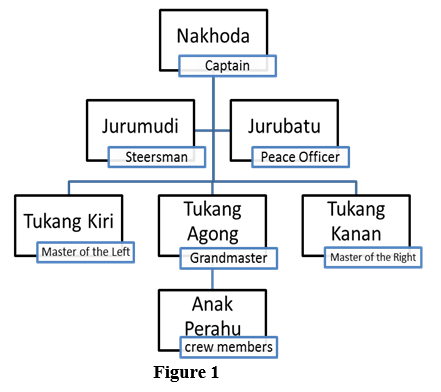
Figure 1 briefly represents how the hierarchy was structured according to ranks within the ship in accordance with the Maritime Code. It should be noted that the Code also went into more detail on roles below the tukang level, which assigned every member with responsibilities relating to the operation of the ship. This simplified figure, however, serves to demonstrate the shape of the hierarchical structure on board a ship, which has its own nuances.
Here, the nakhoda, i.e. the captain, held all the authority and was responsible for everyone on the ship. Next, the jurumudi and the jurubatu, served in the roles of the steersman and the ‘peace officer’ respectively (Raffles 1879: 65; Winstedt and De Jong 1956: 32). These positions sat directly below the nakhoda in the hierarchy, but they were not ranked in relation to one another. In the vertical structure, they functioned as equals but differed only in their duties. These top three figures served in administrative capacities, which differ from the three tukangs. Tukang in the Malay language refers to those who are experts or masters, referring to different aspects of ship running. However, the Maritime Code used a specific terminology to describe them, using the word ‘sida’ instead. According to the Dewan Bahasa dan Pustaka (2025), the word refers to a group of officers that served in the palace. Here, it is understood that they served as officers under the direct control of the nakhoda. In modern terms, their role can also be understood as a middle management who oversaw the crew members, i.e. the anak perahus. From this brief description, it appears that the hierarchical structure of the ship is more akin to a spider web with the nakhoda at its centre, rather than the typical top-down structure. For example, although the tukangs are technically ranked lower than the jurumudi and jurubatu, they would only answer directly to the nakhoda and not to anyone else.
HIERARCHY AT SEA AS A MIRROR TO THE HIERARCHY ON LAND
It is no surprise that there was an emphasis on the hierarchical structure embedded within the Maritime Code, as it was part of the Laws of Malacca. It was specifically emphasized in the Code that there should be no interference from the Laws of Malacca when it comes to the legal jurisdiction of the Maritime Code (Winstedt and De Jong 1956: 29). Despite this separation between these two jurisdictions, they are nevertheless intertwined spaces, with a high degree of interpenetrability. This led both to sharing a similar ranking system for members of their subsystems. Since the Laws of Malacca preceded the Maritime Code both in chronological order and in terms of importance, the ranking system featured within the Code recreated the socio-political order and structure practiced on land in Malacca.
This is apparent in the language used to describe the ranks and the authority of officers on a maritime vessel (Noor 2024). The Code intentionally used similes in describing the role of the nakhoda, the jurumudi, and the jurubatu. In the text, the roles and positions of these figures were mirrored with their counterparts on land, such as the Sultan, the Bendahara, the Temenggung and the sida-sida (Maxwell 1898, MS 5: 2; Maxwell 1898, MS 6; Winstedt and De Jong 1956: 32). The Code clearly states the significance of the role of the nakhoda, as all the rules on any form of ship vessels (re: hukum segala jong and balok) are all subject to his authority, giving him an absolute control over the ship (Winstedt and De Jong, 1956). This absolute authority could be the reason why the text specifically drew a parallel between the role of the nakhoda and that of a king. The parallel and use of similes continue to the jurumudi being comparable to the bendahara, while the jurubatu were compared to the role of the Temenggung. These parallels provide an insight into the nuances of how the hierarchical structure operated within the ship (Noor 2024).
In the texts, two ranks were explicitly mentioned; the nakhoda as the head of the ship and the anak perahu, who were under the tukang agung. Although it was hinted that the jurumudi and the jurubatu were ranked beneath the nakhoda, their ranks relative to each other and to the tukangs were not explicitly stated. The use of similes indicates the actual ranks of these positions, not only relative to the nakhoda, but also among themselves. From the similes and the parallel to the hierarchy on land that were used in the texts, we can infer that the second-highest ranked figure on a ship was the jurumudi. This was hinted in the text, as the phrase ‘bermula akan jurumudi itu’ (translation: ‘starting from the steersman’) follows the description of the nakhoda's position, implying that he is next-in-line after the nakhoda (Winstedt and De Jong 1956). This is also made clear to those familiar with the hierarchical structure in the Malaccan Sultanate, as he was described as ‘akin to the Bendahara’. Bendahara is a term used to describe ‘the head of the court ministers’ (Dewan Bahasa dan Pustaka 2025). In the Malay court hierarchy, the Bendahara serves as the right-hand man of the Sultan. Similarly, the use of the comparison ‘akin to a Bendahara’ to describe the role of the jurumudi serves to indicate their rank relative to the nakhoda and the rest of the officers on a ship.
The use of similes and the mirroring of the court hierarchy are even more important in determining the role of the jurubatu. In the Code, there were no explicit indications of whether the jurumudi would outrank the jurubatu, except for the order of roles mentioned in the text. However, the text mentions that the jurubatu's role is similar to that of a Temenggung. According to the Malay court structure, the Temenggung sits below the Bendahara, with one of the accepted definitions of the role including this hierarchical feature (Dewan Bahasa dan Pustaka 2025). According to the dictionary, Dewan Bahasa dan Pustaka (2025), the Temenggung is referred to as ‘pembesar Kerajaan Melayu di bawah Bendahara’ (translation: ‘minister of a Malay Kingdom beneath the Bendahara’). The term ‘di bawah’ directly translates to ‘beneath,’ indicating a clear rank distinction between the two roles in the ship's hierarchy.
According to Noor (2024: 244), the figurative expressions in these manuscripts provide a linguistic aid for the public to understand the complex legal concepts that they had to abide to. In short, it makes the text more ‘accessible and relatable’ to the masses. Relatability is important not only for understanding but also for engaging the public, thus increasing the retention of the content of the text among the masses (Zakaria et al. 2020; Noor 2024). This explicit use of similes in the section detailing the hierarchical structure of the ship can be seen as a tool to reinforce both their understanding and obedience to the established social order.
LIFE AT SEA AND THE ROLE OF HIERARCHY
According to the Code, the nakhoda held absolute power on board. Although seemingly despotic, such absoluteness in his role was derived from the perilous nature of life at sea, as well as how social life aboard a ship was structured. According to Aubert and Arner (1958: 200), the ship served as a form of ‘total institution’, where every aspect of life was melded together and any action, even the simplest one, required cooperation of almost every member of the crew. Due to this social dynamic, relationships and how people form identities aboard a ship were often affected by their positions and functions on the vessel. This created a unique situation where the crew members' identities are melded into the positions they held aboard the ship. The function-oriented ecosystem aboard the ship, as well as the division of spaces for personal and work-related activities, has blurred the boundaries between one's identity and their position at work. The isolated nature of the ship and its being a ‘total institution’ meant that everyone on board had a clearly defined work relationship, which extended into their personal lives, as both aspects occupied the same space (Aubert and Arner 1958: 201–202). It was not uncommon for crew members to go by their position aboard the ship instead of their names. Here, the crews ceased to be individuals but rather were parts of a larger ecosystem aboard the ship.
The perilous life at sea during that era, along with the way social and professional life was conducted aboard a ship, made it a perilous space to operate in. Individuals working in a group might have conflicting interests, which could be problematic when their survival depended on everyone working towards the same goal (Anderson and Brown 2010: 58). This potential conflict of interest might interfere with the running of the ship. According to functionalist theories of hierarchies, the concentration of power at the top and among those deemed most competent enables a greater control over the direction of group action and a better grasp of the situation (Driskell and Mullen 1990; Van Vugt et al. 2008; Anderson and Kilduff 2009; Anderson and Brown 2010). As the Maritime Code was drafted by a group of nakhodas, it is understandable why the Code placed such a high importance on establishing a working hierarchical structure very early on.
The essential role that hierarchy plays aboard a ship also explains why it is very well established and highly enforced upon everyone on board, with the added precaution in place for any challenges to the status quo. This precaution manifested itself through a hierarchy-enhancing mechanism geared towards ensuring that the hierarchical structure remains intact for the sake of maintaining the functioning of the ship throughout the entire voyage (Sidanius and Pratto 2001: 38). One of those precautions was explicitly mentioned in the Code, entailing a form of punishment for the crime of disobeying a superior. The Code states that if an anak perahu refuses to follow the orders of the tukang agong, then he is to be delivered to the jurubatu to receive the punishment of seven lashes (Winstedt and De Jong 1956: 32). The positioning of the sections in rank, along with the first mention of punishment related to the crime of disobedience, are indicators of how hierarchy and its maintenance hold a significant position within the Code. This severe punishment for disobedience constitutes a form of hierarchy-enhancing tendency, meant to create and maintain a greater level of group-based inequality, which in this case is manifested through the distribution of power and positions aboard the ship (Sidanius and Pratto 2001: 38).
BODY POLITIC AS A TOOL FOR HIERARCHY-ENHANCING POLICIES
In such a homoarchic structure as the Malay society during the Malaccan Sultanate, the presence of a hierarchy-enhancing force in its legal and domestic policies is not surprising. Homoarchy, by nature, limits the potential for change within its ranking system, where any change would require a significant reform of the sociopolitical order of a society. In the case of Malacca, the sociopolitical order and structure were upheld by the Sultan's legitimacy and sovereignty. Therefore, it is no surprise that maintaining such a homoarchic system requires enforcing a system that enhances and maintains this anchoring value.
This is apparent in the way the hierarchy-enhancing policy was implemented in the Maritime Code, which not only maintained the established hierarchy aboard the ship, but also inadvertently extended the legitimacy of the socio-political order already being practised within the Sultanate on land. There were few instances where the hierarchy-enhancing force manifested itself through the presence of the Sultan's body politic (Kantorowicz 1957: 9–10) that both served to legitimate the position of the nakhoda and to extend the Sultan's legitimacy into the maritime realm. In the Code, the role of the nakhoda was legitimized through the invocation of the Sultan's name and his position. In the text, the nakhoda is the ‘representative of the king at sea’ (Winstedt and De Jong 1956: 30). It was not stated that the nakhoda represented any specific king or even Sultan, but rather a more generic term ‘raja’ was used. Here, the Sultan's body politic manifested itself through the concept of kingship, a representation of the one occupying the highest position in a hierarchical order. The legitimacy of the nakhoda's position is not inherent, but lent to him through him being a representative of the raja. His position is not just legitimized but also reinforced by the reminder that, regardless of age and status, (phrase: even if he is a child or a slave), the nakhoda will still be considered as a king at sea as granted to him by the Sultan (Winstedt and De Jong 1956: 30). This parallel between the nakhoda and the ‘king at sea’ was repeated in other variants, using the word ‘umpama’ (translation: as a) instead of ‘ganti’ (translation: replacement, representation). Because the nakhoda's legitimacy depended on the concept of kingship, his authority heavily relied on the legitimacy of the Sultan's position in Malacca. Therefore, the impact of the body politic was dependent on whose body it was derived from (Kantorowicz 1957: 7–9). Due to this dependence, it is no surprise that the body politic of the Sultan in the Maritime Code also served to reinforce and extend his legitimacy into the maritime realm.
There were multiple references to the Sultan's body politic scattered throughout the Code. Many versions of the Maritime Code were prefaced by a section detailing its concept, with references to the magnanimity of the Sultan. One section specifically mentioned how the Sultan enacted the law, using the term ‘menitahkan’. This is a very specific verb, as it does not just mean ‘to order’, but also only used when the order came from a royal or religious source, reserved for Kings and God to use (Dewan Bahasa dan Pustaka 2025). Therefore, this particular use of the verb was meant to legitimize the Code and everything contained within it. The Sultan was also portrayed as a figure capable of enacting laws that would outlast his reign. The phrase ‘turun kepada anak chuchunya’ (translation: passed down to his children and grandchildren) refers to how the Maritime Code would still be used by future generations. Here, the Sultan's body politic transcends his mortality as the verb ‘to order’ here refers not to Sultan Mahmud but rather to what he symbolized – an unchallenged position of power (Kantorowicz 1957: 13). This representation of the Sultan, along with its connection to the Maritime Code, provided a powerful tool for hierarchy-enhancing force to take place. Any form of established hierarchical structure contained in the Maritime Code was enhanced by this unchallengeable royal decree.
The body politic was a powerful tool for reiterating the Sultan's power, and it was reinforced by using the legitimising myth to extend its legitimacy (Sidanius and Pratto 2001: 45–46). In the Maritime Code, the myth of the lineage and genealogy of the Sultans was mentioned alongside the name of the reigning Sultan Mahmud (Winstedt and De Jong 1956). Here, Sang Purba2 and Siguntang Mahameru were cited in relation to Sultan Mahmud (Maxwell 5 1898: 1; Winstedt and De Jong 1956: 28). According to the Sulalatus Salatin, Sang Purba was the progenitor of the Malay Kings and Siguntang Mahameru was the name of the hill from which he allegedly descended (Ahmad 2008: 19, 22–23). In the Code, Sultan Mahmud's name was extended with the word ‘ibni’ (translation: son of), followed by the name Sang Purba, which reiterates that he shared a common clan with the mythical figure. The invocation of Sang Purba was meant to legitimise not only Sultan Mahmud's position as the rightful ruler of Malacca but also to indicate the legitimacy of all Malay rulers descended from him. The legitimising myth of Malacca's Sultans having descended from Sang Purba transcended individual rulers, and instead was extended towards the concept of Malay kingship on the Malayan Peninsula.
The body politic paired with the legitimising myth was meant to ensure the maintenance of any established hierarchy in the Maritime Code. The legitimising myth alone would not suffice to ensure the le-gitimacy of the Code to extend beyond the lifetime of a specific Sultan. Therefore, the invocation of the Sultan as a symbol of the rightful heir to Sang Purba served as a form of body politic that was intended to transcend the mortality of the body natural of the specific Sultan who initially ratified the Maritime Code, thus ensuring the longevity of the Code itself for years to come.
The parts entailing the Sultan's legitimacy played a very important role. Earlier, we have established that the Maritime Code had its own jurisdiction separate from the influence of legal norms on land. This included its own hierarchy that explicitly excluded the Sultan. Instead, the nakhoda was designated as the Sultan's replacement. Although it was understood that the simile was meant to establish the parameters of the nakhoda's power aboard the ship, it was still necessary for the main structure, i.e. the hierarchy on land, to be reiterated for the seamen. This is perhaps the reason why in many transcriptions of the Maritime Code, the Sultan, both his body natural and body politic, were omnipresent, reminding the reader that his sovereignty extended to the sea, beyond his own physical presence.
CONCLUSION
The Maritime Code provides valuable insights into how society functioned in pre-colonial Malaya, highlighting the significant role of hierarchy and socio-political order played in the Malacca Sultanate in the fifteenth century. Although the Code was intended for use at sea, it also serves a reflection of sociopolitical order and hierarchy in fifteenth century Malacca. The most apparent aspect is how hierarchy was established in the Maritime Code, albeit though it existed in a separate jurisdiction, still mirrored the existing hierarchy on land. Aspects of language and terminology used in the manuscript provide an insight into the importance of hierarchy in pre-colonial Malaya and how the sociopolitical order was reinforced through different tools and mechanisms both on land and at sea.
It was apparent that hierarchy played a significant role in the Maritime Code. The position of the section on hierarchy had precedence before any legal provisions were discussed in the text. Additionally, crimes and punishments appeared to be dependent on the hierarchy and were created to maintain the established ranks on board a ship. It could be said that hierarchy served as the basis for legal provision in the Maritime Code. Due to the importance of hierarchy, hierarchy-enhancing features were scattered throughout the text, as it was deemed important enough to protect and maintain this hierarchy. The threat of legal repercussions was also used to reinforce existing social norms, i.e. established sociopolitical order and hierarchy (Zasu 2007; Acemoglu and Jackson 2017). Meanwhile, existing social norms, such as the position of the Sultans and the preexisting hierarchy on land were used to legitimise the laws enforced by the Maritime Code. Therefore, there was a self-feeding loop between legal and social norms that worked in tandem to reinforce the form of hierarchy perpetuated by the Maritime Code. Additionally, semblances of the body politic and legitimising myth were used to lend legitimacy not only to the Maritime Code but also serve as a tool for reinforcing existing legitimacy of the sociopolitical order and hierarchy that existed on land in Malacca. The founding myth of Sang Purba and Siguntang Mahameru, mentioned in the Sulalatus Salatin, served as a reminder of the Sultan's position as the rightful ruler of the Malaccan kingdom. This was used to reinforce the Sultan's sovereignty and body politic, which in turn lent the Maritime Code its legitimacy to exercise its power at sea. These mechanisms that were in place to maintain and reinforce the existing hierarchical sociopolitical order and structure in Malacca contribute further to the homoarchic tendency shown within the Malacca Sultanate. The existing ranking system was not only rigid, but had its potential for change severely limited by hierarchy-enhancing forces, such as the aforementioned use of the threat of punishment, the legitimizing myth, and the body politic.
The Maritime Code's emphasis on hierarchy, along with its role in extending the reach and influence of Malacca's main sociopolitical order and structure to the maritime realm, indicates that there was a parallel between how society functions on land and at sea. The constant emphasis on hierarchy, especially regarding the role of the Sultan, indicated how the hierarchy embedded in the Code paralleled the sociopolitical order and structure practiced within the upper echelons of Malacca's society. In essence, the hierarchy established aboard the ship was a mirror image of how the upper echelons were ranked in the Malaccan Sultanate.
The Maritime Code was more than just a source of legislation to regulate life aboard ships as it was also an extension of the Laws of Malacca, especially regarding the main hierarchy that existed in the Sultanate. The ranking system established by the Code was created to parallel the status quo on land, with the same mechanisms being used to reinforce the sociopolitical order and structure. In this sense, the Maritime Code, or more specifically, the hierarchical sociopolitical order and structure it promoted, reflected those being practiced in Malacca in general. Therefore, the Maritime Code is a valuable piece of pre-colonial document that not only supplements the Laws of Malacca to understand how society functioned in fifteenth-century Malacca, but also provides an insight into how sociopolitical features, such as order and structure, were propagated and enforced in pre-colonial Malaya.
NOTES
1 The Bugis refers to an ethnic group of people originating from South Sulawesi, who were also known to roam the seas.
2 Sang Purba is also sometimes written as Sang Sapurba in other texts.
REFERENCES
Abdullah, S., Zakaria, N., and Hanapi, M. H. 2023. Leaderships of Leaders in Sulalatus Salatin Text. In Rahim, M., Ab Aziz, A., Saja, I., Kamaru-din, N., Chong, C. L., Zaini, N., Bidin, A., Mohamad Ayob, N., Mohd Sulaiman, Z., Chan, Y. S., and Mohd Saad, N. H., (eds), Embracing Change: Emancipating the Landscape of Research in Linguistic, Language and Literature (pp. 300–308). Melaka, Malaysia: European Publisher.
Acemoglu, D., and Jackson, M. 2017. Social Norms and the Enforcement of Laws. Journal of the European Economic Association 15 (2): 245–295.
Ahmad, A. S. 2008. Sulalatus Salatin: Sejarah Melayu. Malaysia: Dewan Bahasa dan Pustaka Malaysia.
Al-Aboudi, N. K. M. 2021. The Islamic Sultanate of Malacca: A Study of Its Inception and the Factors of Its Development into a Global Trade Center in the First Half of the 15th Century. PalArch's Journal of Archaeology of Egypt/Egyptology 18 (5): 491–510.
Andaya, B. W. 2011. The Dark Passage: History, Piracy and the Melaka Strait. In Edmond, J., Johnson, H., and Leckie, J. (eds.), Recentring Asia: Histories, Encounters, Identities (pp. 13–32). Boston: Global Oriental.
Andaya, B. W. 2018. Malacca: Cosmopolitan Trading Port of the Early Modern World (1400–1824). In Mackinnon, A., and Mackinnon, E. (eds.), Places of Encounter: Time, Place, and Connectivity in World History (pp. 227–250). New York: Routledge.
Anderson, C., and Brown, C. E. 2010. The Functions and Dysfunctions of Hierarchy. Research in Organizational Behavior 30: 55–89.
Anderson, C., and Kilduff, G. J. 2009. Why do Dominant Personalities Attain Influence in Face-to-Face Groups? The Competence-Signaling Effects of Trait Dominance. Journal of Personality and Social Psychology 96: 491–503.
Aubert, V., and Arner, O. 1958. On the Social Structure of the Ship. Acta sociologica 3 (1): 200–219.
Axelrod, R. 1986. An Evolutionary Approach to Norms. American Political Science Review 80 (4): 1095–1111.
Basu, K. 1998. Social Norms and the Law. In Newman, P. (ed.), The New Palgrave Dictionary of Economics and the Law (pp. 1876–1881). London: Palgrave Macmillan.
Bernstein, L. 1993. Social Norms and Default Rules Analysis. Southern California Interdisciplinary Law Journal 3: 59–90.
Borschberg, P. 2020. The Melaka Empire c. 1400–1528. In Strootman, R., van den Eijnde, F. and van Wijk, R. (eds.), Empires of the Sea: Maritime Power Networks in World History (pp. 263–293). Leiden; Boston: Brill.
Borschberg, P. 2022. The Melaka Sultanate, c. 1400–1528. Journal of the Economic and Social History of the Orient 65 (3): 344–377.
Bondarenko, D.M. 2007. Homoarchy as a Principle of Sociopolitical Organization. An Introduction. Anthropos 102(1): 187–199.
Calliess, G. and Renner M. 2009. Between Law and Social Norms: The Evolution of Global Governance. Ratio Juris 22 (2): 260–280.
Chambert-Loir, H. 2005. The Sulalat al-Salatin as a Political Myth. Indonesia 79: 131–160.
Chambert-Loir, H. 2017. The History of a History: The Variant Versions of the Sulalat Al-Salatin. Indonesia 104: 121–177.
Cooter, R. D. 2000. Three Effects of Social Norms on Law: Expression, Deterrence, and Internalization. Oregon Law. Review 79: 1–22.
De Jong, D. J., Edward, P., and Van Wijk, H. L. A. 1960. The Malacca Sultanate. Journal of Southeast Asian History 1 (2): 20–29.
Dewan Bahasa dan Pustaka. 2025. Pusat Rujukan Persuratan Melayu. URL: https://prpm.dbp.gov.my/.
Driskell, J. E., and Mullen, B. 1990. Status, Expectations, and Behavior: A Meta-Analytic Review and Test of the Theory. Personality and Social Psychology Bulletin 16: 541–553.
Dumont, L. 1980. Homo Hierarchicus: The Caste System and its Implications. University of Chicago Press.
Durkheim, É. 1982. The Rules of Sociological Method. Trans. W. D. Halls. New York: The Free Press.
Ellickson, R. C. 1998. Law and Economics Discovers Social Norms. The Journal of Legal Studies 27 (2): 537–552.
Ellickson, R. C. 2001. The Evolution of Social Norms: A Perspective from the Legal Academy. In Hecter, M., and Opp, K. (eds.), Social Norms (pp. 35–75). New York: Russell Sage Foundation.
Fang, L. Y. 2007. Naskah Undang-Undang Melaka: Suatu Tinjauan. Sari 25: 85–94.
Friedman, L. M. 1967. Legal Rules and the Process of Social Change. Stanford Law Review 19 (4): 786–840.
Geertz, C. 1973. The Interpretation of Cultures: Selected Essays. New York: Basic Books.
Gin, O. K. 2022. ‘Bridge’ to ‘Fence’ A Maritime History of the Straits of Malacca. Journal of Maritime Studies and National Integration 6 (1): 1–19.
Halimi, A. J. 1999. Perdagangan dan perkapalan Melayu di Selat Melaka Dari abad ke-15 hingga abad ke-18. Doctoral dissertation. Kuala Lumpur: University of Malaya.
Hall, K. 2010. Coastal Cities in an Age of Transition: Upstream-Downstream Networking and Societal Development in 15th and 16th Century Maritime Southeast Asia. Secondary Cities and Urban Networking in the Indian Ocean Realm: 1–21.
Hall, K. R., 2017. Maritime Trade and Societal Transitions in the Western Indonesian Archipelago: Samudra-Pasai at the Dawn of the European Age (c. 1200–1500). Asian Review of World Histories 5 (1): 31–69.
Handayani, R. 2020. Sastra, Perempuan, dan Istana Dalam Kronik Melayu Sulalatus Salatin. Buletin Al-Turas 26 (1): 103–120.
Harun, J. 2016. Sulalatus Salatin and Tun Perak's Charisma in the Practice of the Laws of Nusantara Multiethnic Society. Malay Literature 29 (1): 42–72.
Hashim, M. Y. 1998. Hikayat Melayu atau Sulalat'us-Salatin. Malaysia: Institut Kajian Sejarah dan Patriotisme (IKSEP).
Johan, K. 1999. The ‘Undang-Undang Melaka’: Reflections on Malay Society in the Fifteenth-Century. Journal of the Malaysian Branch of the Royal Asiatic Society 72 (2): 131–150.
Kahan, D. M. 2019. Social Influence, Social Meaning, and Deterrence. In Morawetz, T. (ed.), Criminal Law (pp. 429–476). Routledge.
Kantorowicz, E. H. 1957. The King's Two Bodies: A Study in Mediaeval Political Theology. Princeton University Press.
Kube, S., and Traxler, C. 2011. The Interaction of Legal and Social Norm Enforcement. Journal of Public Economic Theory 13 (5): 639–660.
Licht, A. N. 2008. Social Norms and the Law: Why Peoples Obey the Law. Review of Law & Economics 4 (3): 715–750.
Lobato, M. 2012. ‘Melaka is like a Cropping Field’ Trade Management in the Strait of Melaka during the Sultanate and the Portuguese Period. Journal of Asian History 46 (2): 225–251.
Manguin, P. 1991. The Merchant and the King: Political Myths of Southeast Asian Coastal Polities. Indonesia 52: 41–54.
Maxwell, W. (bequest) 1898. MS 6: Undang-Undang Melaka. Royal Asiatic Society of Great Britain and Ireland Online Collections.
Maxwell, W. (bequest) 1898. MS 5: Undang-Undang Melaka. Royal Asiatic Society of Great Britain and Ireland Online Collections.
Mustafa, H., and Ibrahim, M. I. 2023. Self-Correction, Control and Accountability in the Ancient Melaka Kingdom (1401–1511 AD). Accounting, Auditing & Accountability Journal 36 (5): 1396–1416.
Nadler, J. 2017. Expressive Law, Social Norms, and Social Groups. Law & Social Inquiry 42 (1): 60–75.
Nonet, P., Selznick, P., and Kagan, R. A. 2017. Law and Society in Transition: Toward Responsive Law. London: Routledge.
Noor, N. 2024. Figurative Expressions in Undang-Undang Melaka and Undang-Undang Laut: A Reflection of Malay Intellectual Tradition. Malay Literature 37 (2): 229–250.
Nordin, M. 2008. Undang-Undang Laut Melaka: A Note on Malay Maritime Law in the 15th Century, Memory and Knowledge of the Sea in Southeast Asia. Kuala Lumpur: Institute of Ocean and Earth Sciences (IOES), University of Malaya.
North, D. C. 1990. Institutions, Institutional Change and Economic Performance. New York: Cambridge University Press.
North, D. C. 1992. Transaction Costs, Institutions, and Economic Performance. San Francisco: ICS Press.
Posner, E. A. 1998. Symbols, Signals, and Social Norms in Politics and the Law. The Journal of Legal Studies 27 (2): 765–797.
Posner, E. A. 2000. Law and Social Norms: The Case of Tax Compliance. Virginia Law Review 86 (8): 1781–1819.
Posner, E. A. 2002. Law and Social Norms. Cambridge, MA: Harvard University Press.
Posner, R. A. 1997. Social Norms and the Law: An Economic Approach. The American Economic Review 87 (2): 365–369.
Raffles, S. 1879. The Maritime Code of the Malays. Journal of the Straits Branch of the Royal Asiatic Society 3: 62–84.
Roolvink, R. 1967. The Variant Versions of the Malay Annals. Bijdragen tot de Taal-, Land-en Volkenkunde 123 (3): 301–324.
Rusli, M. H. M. 2012. Straits of Malacca and Singapore: Pride of the Malay Archipelago, Priceless Maritime Heritage of the World. Jurnal Hadhari Special Edition: 109–127.
Sayuti, M. S. M., and Omar, J. 2017. Nilai kepimpinan pembesar empayar Melayu Melaka: Kajian berasaskan teks Sulalatus Salatin. Rumpun Jurnal Persuratan Melayu 5 (1): 171–192.
Schotter, A. 1981. The Economic Theory of Social Institutions. Cambridge: Cambridge University Press.
Scott, E. S. 2000a. Social Norms and the Legal Regulation of Marriage. Virginia Law Review 86 (8): 1901–1970.
Scott, R. E. 2000b. The Limits of Behavioral Theories of Law and Social Norms. Virginia Law Review 86: 1603–1647.
Sidanius, J. and Pratto, F. 2001. Social Dominance: An Intergroup Theory of Social Hierarchy and Oppression. Cambridge, UK: Cambridge University Press.
Sunstein, C. R. 1996. Social Norms and Social Roles. Columbia Law Review 96: 939–968.
Taylor, Ch. 1985. Philosophical Papers, Vol. 2. Philosophy and the Human Sciences. Cambridge: Cambridge University Press.
Taylor, Ch. 1993. Institutions in National Life. In Taylor, C. and Laforest, G. (eds.), Reconciling the Solitudes: Essays in Canadian Federalism and Nationalism (pp. 120–134). Montreal; Kingston: McGill-Queens University Press.
Van Vugt, M., Hogan, R., and Kaiser, R. B. 2008. Leadership, Followership, and Evolution: Some Lessons from the Past. American Psychologist 63: 182–196.
Wan Husain, W. A. F., Che Ngah, A., and Omar Din, M. A. 2018. Konsep Kedaulatan dalam Hukum Kanun Melaka. Malaysian Journal of Law & Society 22: 61–74.
Wilkinson, R. J. 1935. The Malacca Sultanate. Journal of the Malayan Branch of the Royal Asiatic Society 13, no. 2 (122): 22–67.
Winstedt, R. O. 1938. The Malay Annals of Sejarah Melayu. Journal of the Malayan Branch of the Royal Asiatic Society 16, no. 3 (132): 1–226.
Winstedt, R. O. 1953. The Date of the Malacca Legal Codes. Journal of the Royal Asiatic Society 85, 1 (2): 31–33.
Winstedt, R. O., and De Jong, P. E. D. J. 1956. The Maritime Laws of Malacca. Journal of the Malayan Branch of the Royal Asiatic Society 29 (3) (175): 22–59.
Yock, F. L. and Ahmad, H. 2003. Undang-Undang Melaka dan Undang-Undang Laut. Kuala Lumpur, Malaysia: Yayasan Karyawan.
Za’aba (Zainal Abidin Ahmad). 1949. Pelita Bahasa Melayu: Penggal 3. Macmillan and Company.
Zakaria, N., Hanapi, M. H. M., Rosli, N. F. M., Wahid, A., and Omar, A. 2020. Malay Authors Strategies in Displaying the Intelligence of the Figures and its Effects in Traditional Malay Literary Texts. International Journal of Innovation, Creativity and Change 11 (5): 655–672.
Zasu, Y. 2007. Sanctions by Social Norms and the Law: Substitutes or Complements? The Journal of Legal Studies 36 (2): 379–396.