The Evolution of Well-Being in Russia / USSR (19th – 21st Centuries)

Journal: Social Evolution & History. Volume 25, Number 1 / March 2026
DOI: https://doi.org/10.30884/seh/2026.01.04
Dmitry Didenko Russian Presidential Academy of National Economy and Public Administration, Moscow, Russia
ABSTRACT
In theoretical aspects, this study relies primarily on the augmented concept of well-being as it was coined in welfare economics and happiness economics. It has a multidisciplinary nature, bridging history, economics, and sociology together. Much of the literature within this stream stresses the importance of subjective criteria for appraisal. The author's basic contribution to the literature consists in operationalization of the selected aspects of non-material well-being, discovery and interpretation of relevant new empirical evidence over a long time span of Russia's history (more than two centuries with changing borders). The article discusses the estimates of human development dynamics and highlights the trend pattern in time series of personal security (as captured by the homicide rate) available from published sources and research literature. The author also tracks public interest in the environmental quality and perception of happiness. To identify these patterns, the author employs content analysis method by extracting relevant concepts from texts of the two samples of digitized Google Books in Russian. The author compares fluctuations in public sentiment with incidents of historical events and processes which could have causal relationships with the fluctuations. The principal finding of the study supports the suggestion that, to some extent, the so-called ‘Easterlin paradox’ has been revealed in Russia. Using similar methods for inquiry into other aspects of well-being would subsequently allow researchers to illuminate the relevant evidence and identify the historical trends.
Keywords: welfare economics, happiness economics, quality of life, human development, education, health, personal security, environment, content analysis.
1. INTRODUCTION
Modernization involved the transition from the ‘Malthusian’ to ‘modern’ regime of economic growth (Galor 2011), which is based on certain changes in the structure of economic activities. Consequently, they led to the shifts both in production and consumption. Overall, the share of knowledge-intensive industries and services has tended to increase over the past one or two centuries. The corresponding changes in consumption meant a move from subsistence to an expanding variety of goods for a larger part of society, as well as a shift towards immaterial goods.
These economic processes went alongside with changes in people's values. The shift from material goods to immaterial ones occurred even before the shift from ‘materialist’ to ‘post-materialist’ values, formulated within the revised modernization theory (Inglehart and Welzel 2011 [2005]: 31–78). The revised version argues that these developments may reverse if economic conditions deteriorate. Thus, modernizing changes appear to be non-linear, and their patterns resemble waves rather than linear trends.
These complex and often contradictory structural changes affected the evolution of various aspects of human well-being. The traditional concept of well-being is based on conventional economic metrics, such as gross domestic product (GDP). Over recent decades, both academic research and political discourse have increasingly recognized that traditional income indicators, such as GDP, fail to fully capture the complexities of well-being. Thus, the augmented concept of well-being goes beyond GDP and emphasizes diverse immaterial factors like education, health, personal security, and environmental quality, which are highlighted in the present article. These factors showcase their role in enhancing the quality of life over time. The latter concept, in its turn, presumes the primary role of subjective well-being and life satisfaction (Inglehart and Welzel 2011 [2005]: 207–211). The latter is represented by happiness which captures both material and immaterial factors. However, Richard Easterlin (1974) highlighted somewhat paradoxical evidence that people's income and happiness change in tandem only up to a certain level of saturation: as income reaches this level, happiness tends to change little, even if income continues to grow.
This more holistic approach to the sustainability of development has inspired initiatives such as the adoption of the United Nations' Resolutions 65/309 (19.07.2011)1 and 66/291 (28.06.2012)2, and claims of the high-level meeting thereafter to include happiness and well-being for all peoples into a new economic paradigm.3 The critics have pointed out difficulties in quantifying subjective well-being and potential discrepancies between national averages and individual experiences.
The objective of this study is to highlight relevant empirical evidence illuminating the historical trends in the selected immaterial aspects of well-being in Russia over a long period of time under modernization processes (including the Soviet period). Specifically, the author tests the hypothesis that ‘Easterlin paradox’ can be revealed there. This article contributes to the literature both by analyzing the existing data on human well-being and by constructing novel data which may be useful for further research.
The quantitative methods employed in this work are consistent with the digital turn in the humanities that significantly affects research practices. The data-driven approach is a new feature of research in the digital age, requiring quantification, computer processing, visualization, and narrative interpretation (Volodin 2016, 2019).
All these dimensions of well-being have some quantitative empirical evidence in Russia/USSR that the author assesses to be more or less reliable. The data include material, immaterial, and perception-based indicators. Although happiness is a profoundly personal, culturally specific, and inherently multifaceted notion, it can be quantified in meaningful ways, as a composite perception-based measure.
While we cannot conduct a survey by directly asking people in the past about what they thought about our matters of interest, we can rely on samples of their texts to extract necessary information. Through quantitative history methods, happiness changes from an elusive concept to a measurable aspect of human experience, thus opening up new avenues for understanding and improving well-being. The samples of published books are assessed as relevant sources of the kind and are used in socio-cultural studies. No similar samples of Russian mass media are available yet over such a long period of time. The limitations on the exploration of the published books content arise from the origins of the source, which directly expressed the views of the upper strata of the educated society only. (Self)-censorship has also affected the sentiment expressed especially during the Soviet period.
The findings of this article extend our understanding of the long-term evolution of well-being in Russia and highlight the need for nuanced approaches to capturing the multidimensional nature of economic and social development. Additionally, non-linear links between objective statistical data and subjective perceptions may be important in explaining such phenomena as social disturbances, even after long periods of income growth.
This article consists of five sections, including the introduction. The next Section 2 reviews literature and provides a theoretical background for the study. Section 3 deals with the data sources and methods for extracting data. Section 4, in five subsections, highlights conventional measures of human development, personal security, environmental quality, happiness, and combined patterns related to three historical periods. Finally, Section 5 concludes the article.
2.
LITERATURE REVIEW AND THEORETICAL
BACKGROUND
A transition to mature stages of industrial development in the first half of the twentieth century entailed a shift in economic consciousness, despite the fact that knowledge-intensive production of intangible goods still remained subordinate to physical capital-intensive production of material goods. The concept of gross national product (GNP, subsequently transformed to gross domestic product, GDP) developed in the 1930–1950s, included education, health care, as well as other services, into consumption of intangible goods. However, GNP and GDP include such components as capital accumulation and government consumption that have an intermediate relation to well-being, at best.
The tools of neoclassical welfare economics developed by Arthur Pigou (1985 [1924]) (the theory of diminishing marginal utility, the subjective psychological approach to assessing goods using such categories as ‘needs’, ‘utility’, ‘satisfaction’, ‘quality of life’) were adopted by the American school of welfare economics, which emphasizes the priority of subjective criteria (Giovannini and Rondinella 2018: 12). They rely on measuring the categories by means of survey research over space and time, in addition to objective measures from statistical offices. Thus, the concept of well-being was augmented with immaterial dimensions.
Eventually, this strand of literature resulted in the development of happiness economics (e.g., Layard 2012 [2005]). The emergence of the discussion over the so-called ‘Easterlin paradox’ appeared to be an important milestone. Easterlin (1974) found that, before a certain point in time, happiness was positively correlated with income. However, over time, happiness did not trend upward as income continued to grow, both among and within nations. At the micro-level, he found an explanation in the fact that people were more concerned about the relationship between their own income and that of the others. Therefore people do not get happier as they get richer, especially when-and-if the perceived inequality increases. However, some authors (e.g., Frey and Stutzer 2002) argue that this relationship (the lack of link between increases in income and increases in happiness) extends only above a certain threshold of GDP per capita level. That is, one has to meet his or her basic needs to become relatively happy and insensitive to further income increases, namely to those dimensions of well-being that are accounted for in the concept of GDP per capita.
As another alternative, the concept of human development was put forward by Amartya Sen (1985) and Mahbub ul-Haq (1995). This paradigm treats various economic resources as independent values for final consumption, and they are not reduced to factors of production. It is based on the capabilities approach, operationalized in various concepts under the label ‘human potential’.5 While the theory of human capital considers education and healthcare from the point of view of an investor (as the ability to produce goods with added value), the concept of human development considers it from the perspective of a consumer (in terms of goods in themselves). As the concept of human development recognizes the centrality of human capital in increasing labor productivity, it emphasizes the creation of such an economic and political environment that would ensure maximum and appropriate use of human capabilities. Anyway, this goes far beyond the traditional (materialistic) concept of well-being. In the human development concept, education and length of (healthy) life occupy a unique place among intangible benefits.
Economic historians have investigated various aspects of well-being and human development from a broad chronological perspective (e.g., Broadberry and O’Rourke 2013). However, Russia has received rather a modest coverage in most of their works.
When analyzing world macro-regions and countries, the co-authors of a distinctive work (Van Zanden et al. 2014, 2021a) employed a broad concept of well-being, close to the abovementioned concept of human development, to systematically compare measures of non-material well-being across space and over time. These measures include a wide range of tangible and intangible aspects of well-being: GDP per capita, real wages, education (literacy and numeracy, enrollment and average years of schooling), life expectancy, height, personal security, political institutions, environmental quality, income inequality, and gender inequality. These measures were then brought together into a new composite measure of augmented well-being
(a simplified version of the OECD Better Life Index).6 These studies found an increase in well-being starting from ca. 1900 onwards, with the exception of sub-Saharan Africa. Aspects of well-being other than GDP did improve significantly. Russia was also included in this sample and was somewhat better represented than in previous comparative literature. Data on the education system were presented to a greater extent. In chronological terms, the period of the Russian Empire was covered to a minimal extent, while the Soviet and post-Soviet periods appeared to be more represented. However, only since the 1970s a composite indicator of well-being could be estimated with reasonable reliability.
Some proponents of the concept of human development draw attention to the ambiguity of concepts that feature various aspects of well-being, such as ‘quality of life’, ‘happiness’, ‘standard of living’, ‘utility’ and to the lack of consensus on their meanings (e.g., McGillivray and Clarke 2003: 3, 8–9). Therefore, the present author's important research task is to operationalize the concepts.
The concept of human development can be interpreted in various ways, such as materially, immaterially, and based on perception. The latter serve as valuable complements to objective measures. These indices not only correlate with GDP, but also reflect social and environmental dynamics that are central to the lived experiences of individuals and communities. Ultimately, they highlight the need for nuanced approaches to capturing the multidimensional nature of human development. They underline that a society's progress cannot be fully measured by economic performance alone, but must consider the broader context of human satisfaction, equality, and sustainability over time.
3. DATA AND METHODS
Leonardo Prados de la Escosura (2015) created a database on the Historical Human Development Index (HIHD) with global coverage. His education index was based on the UNDP methodology that was in effect from 1990 to 2010, i.e. on literacy rate measures (for Russia, from Mironov 1991). Boris Mironov (2012: 400; 2018, vol. 3: 337) presented his estimates of HDI for the Russian Empire, in which the education index was calculated using the latest methodology adopted by the UNDP, i.e. on average years of schooling.
Happiness can be considered a composite measure of both material and immaterial well-being, similar to HDI. However, unlike HDI, happiness is a completely subjective concept that captures overall life satisfaction and is available for both direct and indirect measurement.
The theoretical background of happiness economics has resulted in a number of reports and datasets. The author of this study borrows some data on Russia for the period of the 2000s–2010s from the World Database of Happiness, Erasmus University Rotterdam (Veenhoven 2022)8 and from the annual World Happiness Report published since 2012 (since 2024 by the Oxford Wellbeing Research Centre9).
For the first topic (human development), we employ a comparative analysis of the findings in literature, namely, which points are in consensus and which are not, and therefore are subject to further investigation to show greater robustness. For the second topic (personal security), we combine the series from different sources and identify trends and patterns over time. For the other two topics (environmental quality and happiness), we apply a simplified version of content analysis10 to capture public interest in the issue over a long time span (more than two centuries).
Content analysis involves systematic observation of texts, when labels are assigned to indicate the presence of the meaningful pieces of content. The simplest and most objective form of conceptual content analysis considers such unambiguous characteristics as the existence and frequency of concepts in a text.
By employing content analysis, I identify public interest in the topic of environmental quality and construct my Happiness Index for Russia. I quantify and analyze the presence of the words associated with specific concepts (i.e. environment and happiness) in Russian-lan-guage books selected by the Google Books. The frequency index of environmental issues is the proportion of books containing synonymous words for these issues. The Happiness Index is a ratio of the sum of books containing the synonymic words for happiness to the sum of those with the opposite sentiment. For happiness one of the two samples used is Google Books proper, and the other is Google Books Ngram Viewer, which is a subordinate sample.11 By comparing the dynamics of these two samples (on an annual basis, also with 5-year smoothing), trends are cross-checked. I also compare some points to other surveys to confirm the recent public sentiment pattern. I propose my own interpretation of the content patterns behind the fluctuations of labels.
4. RESULTS AND DISCUSSION
4.1. Conventional Human Development Measures
It follows from the estimates in Prados de la Escosura (2015) that human development in Russia has been quite remarkable from an international perspective. The late Russian Empire and the USSR succeeded in catching-up with the core OECD countries to some extent.12 His estimates suggest a significant catch-up in human development before 1900, and between 1913 and1950, but after the 1970s, the USSR and Russia began to fall behind.
Post-Soviet Russia lagged behind these countries not only during the deep recession of the 1990s associated with the systemic transformation into an open market economy but also during the 2000s. It then succeeded only in income convergence resulting from inflows from natural resource extraction industries but not from outperforming human capital development (Didenko 2020: 68–69).
The most successful periods for education were the 1880s–1890s, 1920s–1930s and 1950–1960s, while the most successful outcomes in healthcare were achieved in the 1910s–1920s and in the 1940s.13 In light of external challenges, the late Russian Empire and the USSR witnessed a fast growth by catching up with Europe in terms of average years of education, but probably not in terms of cost- or income-based human capital (Didenko et al. 2013: 131). By the mid-1960s, the USSR managed to achieve roughly the First World level in social indicators, particularly education and healthcare (Ellman 2004: 849). However, this was followed by a relative decline, especially in hea-lthcare (since the 1950s) and education (since the 1970s), i.e. the decline occurred long before the collapse of the Soviet Union.
Table 1 shows the rates of annual change in the alternative estimates of Russia's Human Development Index during the period of launching modern regime of economic growth (1870–1913) covered by both Prados de la Escosura (2015) and Mironov (2012). Mironov's estimates for the 1890s are more optimistic than those of Prados de la Escosura. On the contrary, for the period of 1901–1913, the improvements in education and especially in life expectancy are estimated more significantly than in income by Mironov, while Prados de la Escosura put his estimate of the income component growth above the other two. For the early period of 1871–1880, Prados de la Escosura (2015) estimated the relative rate of life expectancy change to be negative, while Mironov (2012) estimated it to be very positive. It follows from Johansson and Lindgren (2024) that this was basically stable in absolute terms at that time.
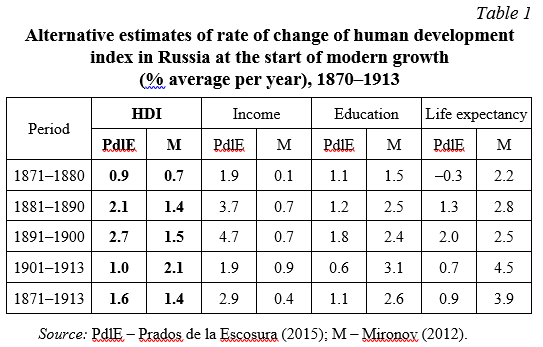
Anyway, the consensus point of the two estimates is related to the entire HDI change over the whole period from 1871 to 1913, while those of its components need further investigation.
Turning to the long-run dynamics of HDI components, other evidence shows that education outcomes have been gained in terms of enrollment (Figure 1). The accumulation of people with a certain level of education has led to higher attainment in terms of years of schooling (Figure 2). Although the available estimates for the latter vary somewhat in size, they all demonstrate an upward trend similar to that of GDP per capita. Moreover, educational attainment is somewhat more sustainable than GDP per capita.
Universal primary education (ISCED level 1) was achieved in the early 1930s, which allowed launching a take-off in secondary enrollment. Junior secondary school (ISCED level 2) became universal and compulsory from 1937 in urban areas. Much due to the wartime repercussions, in rural areas it was introduced only by 1956. Universal secondary enrollment (ISCED level 3) was achieved only by the mid-1970s. Russia now approaches almost universal higher education but with evidently low amounts of time devoted to classes and, hence, low quality. Therefore, the official data on tertiary enrollment may be overestimated and requires some correction, which was effected by Van Leeuwen and Van Leeuwen-Li (2015). Their estimates of educational attainment in the 2000s assume that a high share of part-time and correspondence study forms are taken into account.
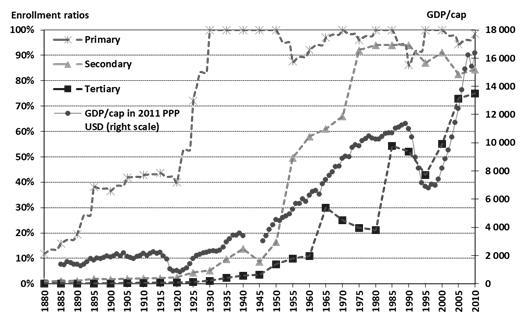
Fig. 1. Educational enrollment and GDP/cap in Russia / USSR,
1880–2010
Note: Hereinafter, the Russian Empire prior to 1917, the USSR in 1918–1991, and the Russian Federation since 1992.
Source: Enrollment: Lee and Lee (2016: data set); GDP/cap in 2011 PPP USD: Broadberry and Korchmina (2024); Didenko et al. (2013); Maddison Project Database (2020).
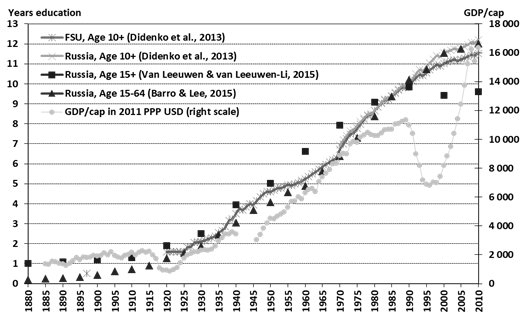
Fig. 2. Educational attainment and GDP/cap in Russia / USSR,
1880–2010
Note: Russian Empire prior to 1917, the USSR in 1923–1991, and the Russian Federation after 1992.
Source: Years of education: Barro and Lee (2015: Data set); Didenko et al. (2013: Supplementary data); Van Leeuwen and Van Leeuwen-Li (2015); GDP/cap in 2011 PPP USD: Broadberry and Korchmina (2024); Cheremukhin et al. (2017); Didenko et al. (2013); Maddison Project Database (2020).
Gender gaps in education enrollment were steadily bridged during the inter-war period, with parity achieved by 1940 in the USSR on average (Figure 3). However, male predominance persisted at the highest ISCED 6 postgraduate level.
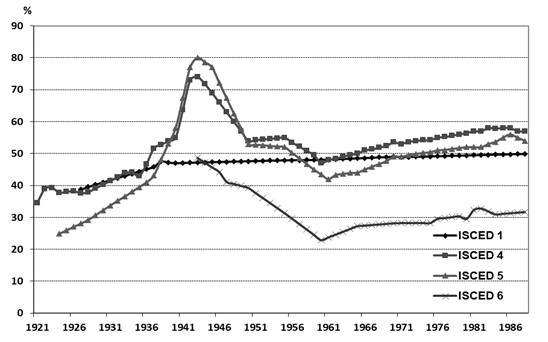
Fig. 3. The share of female
students at various levels of education
in the USSR, 1921–1988 (%)
Source: Didenko et al. (2013).
Life expectancy (Figure 4) improved significantly in the long run, most remarkably in the 1920s–1950s, despite excesses caused by the famines (1921, 1933, and 1947), and the Great Patriotic War, the Eastern Front of the Second World War (1941–1945). It failed to improve between the late 1920s and the late 1940s but the progress made in the 1920s and 1950s was far enough to overcome negative corrections.
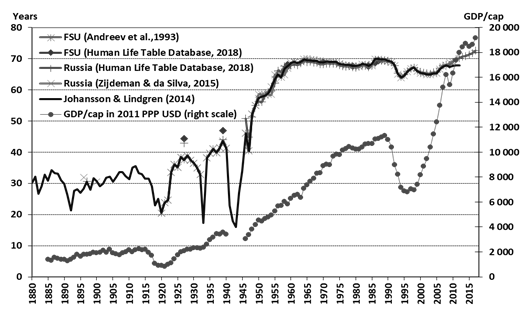
Fig. 4. Life Expectancy at
Birth and GDP/cap in Russia / USSR,
1880–2018
Source: Life expectancy at birth: Andreev et al. (1993); HLTD (2018); Johansson and Lindgren (2014) based on Kumo et al. (2007), Andreev et al. (1992), Andreev (1994); Zijdeman and da Silva (2015); GDP/cap in 2011 PPP USD: Broadberry and Korchmina (2024); Cheremukhin et al. (2017); Didenko et al. (2013); Maddison Project Database (2020).
The Soviet healthcare system was organized in the 1920s on the basis of universal access to free healthcare at outpatient points. This system put its emphasis on prevention and primary care at the local level. It proved reasonably effective in the control of communicable diseases, but ineffective in treating non-communicable diseases or relying heavily on inpatient care (Didenko 2020: 76–78).
In the 1960s, life expectancy ceased to improve and deteriorated in the 1970s – mid-1980s. In the 2000s, life expectancy recovered in response to better financing of healthcare and socio-economic improvements. Several large-scale public healthcare programs improved the accessibility of medical services and drug provision for the population (Didenko 2020: 79–80). During 2022–2024, life expectancy fluctuated between 72.73 and 73.41 years, slightly above the level of about 70 years reached in the mid-1960s and the late 1980s (Fedstat 2025). But HDI transformed it into a relative position between the global minimum and maximum. Therefore, Russia's index value worsened as the world progressed over time. Overall, Russia's latest available official HDI (UNDP 2024: 279) in 2022 (0.821) was almost the same as in 2015 (0.823).
By augmenting the HIHD with political and civil liberties components, Prados de la Escosura (2021) arrived at the Augmented Human Development Index (AHDI). Both the HIHD and AHDI were estimated including and excluding the income dimension. Thus, the latter can be treated as a purely immaterial aspect of well-being. All four measures are plotted in Figure 5.
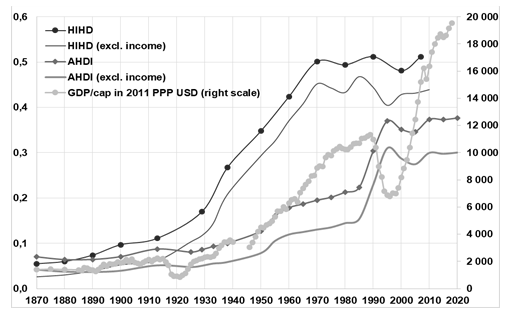
Fig. 5. Historical Human Development
Index (HIHD) and Augmented
Human Development Index (AHDI) for Russia / USSR, 1850–2020
Source: HIHD, AHDI: Prados de la Escosura (2015, 2021); GDP/cap in 2011 PPP USD: Broadberry and Korchmina (2024); Cheremukhin et al. (2017); Didenko et al. (2013); Maddison Project Database (2020).
The most striking difference is the performance of HIHD and AHDI in the 1990s, even more discernible when comparing the indices without the income dimension. This is attributed to the substantial improvement of political and civil liberties (present in AHDI only) which contributed positively in the 1990s but somewhat negatively in the 2000s–2010s. However, the changes in their relative importance for Russians and other countries at a similar level of development have not been explicitly discussed.
4.2. Personal Security
Personal security is a crucial dimension of the well-being concept, augmented with quality of life indicators, regardless of political regime. One of the dimensions of personal security is the probability of becoming a victim of criminal activities. Due to the high level of registration and the extreme nature of violations of commonly accepted rules, homicide rates have become a conventional measure employed in historical research on people's immaterial well-being (Van Zanden et al. 2014: 140–144). It is also an important proxy indicator for measuring the historical institutional environment and state capacity (Popov 2014: 36–40).
Figure 6 shows long-run trends in police-recorded homicide rates (including attempts) in Russia and the USSR. First of all, ups and downs in homicide rates were caused by underlying cycles of deterioration and subsequent recovery in the institutional environment and state capacity. Two increases in homicide rate are associated with later state failures: the Russian Empire in 1917 and the Soviet Union in 1991. The negative trend in the 1990s in the Russian Federation was reversed after the double peak and the rate fell by 4.7 times. However, it remains above historically low levels recorded both in the Russian Empire (in the early 1870s) and in the USSR (in the mid-1950s), as well as above Western Europe (but not the US) and China in the 2000s (Popov 2014: 40, 86, 94–95).
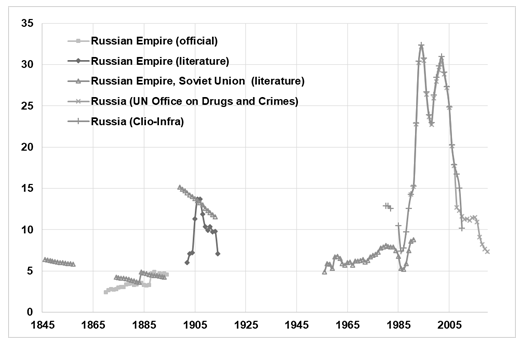
Fig. 6. Homicide rates in Russia/USSR,
per 100,000 population
(1846–2018)
Source: Homicides: 1846–1913: Mironov (2018, vol. 3: 129); TsSk (1894, 1897); CJRC (2010) citing Stickley (2006); 1956–1991: Luneev (2005: 413–414); Population: 1846–1914: (TsSK 1918: 5), 1956–1991: Didenko et al. (2013) based on the official statistics; Homicide rates in Russia in 1980–2018: Fink-Jensen (2015) for Clio-Infra; UNODC (2023).
As it follows from Luneev (2005), the upward trends in homicide rate in the late USSR and the Russian Federation in the 1990s were associated with violent felonies, as well as with crimes against property and other economic offenses, such as robbery, plunder, theft, racketeering, bribery, or fraud (even if they were highly latent). Fluctuations in alcohol consumption (generally high) appeared to be an important determinant of homicide rates in Russia. The government-initiated measures to curb its retail sales resulted in a drop in homicide rates (1985–1987; since the mid-2000s). These measures proved effective because most homicides caused by excessive alcohol consumption were domestic crimes, often casual. Another cause of rising homicide rates was economic, – i.e. violent fighting over acquisition and redistribution of control over state property subject to privatization. The growth of government economic activities has had its positive external effect, as the government agents' grip on competing criminal gangs has curtailed their violent powers (Latov 2001: 174–179).
4.3. Environmental Quality
The environmental issues were strongly voiced in literature on immaterial well-being, including a long-run historical perspective (Van Zanden et al. 2014: 179–198). Due to the lack of objective data on pollutant emissions with any reasonable degree of reliability, the public discussion of this issue can only express society's concerns of the issue in an indirect way. The Google Books Ngram Viewer sample provides a reasonable opportunity to capture such perceptions.
Figure 7 shows that in the Russian Empire, the USSR and the Russian Federation, environmental thinking paved its way in the second half of the nineteenth century, as the national economy was industrialized and society felt it had not only benefits, but also some deprivations and dissatisfactions caused by the associated processes.
In Russia, environmental thinking and policies began to emerge during the process of railroad construction (Konchakov 2012). In the 1830s–1840s, nature was perceived as the main obstacle to the development of this mode of transportation. Their opponents appealed to a sense of affection to ‘pure nature’, to the land, as an argument against the profitability of this enterprise for society.
In the period of launching modern economic growth, the railways became the first large-scale challenge to the environment in the agrarian regions of Russia, preceding the industrial take-off. In contrast to factory enterprises, railways to a much greater extent retained their dependence on natural resources. The destruction of forests caused by railway construction and operation was the most pronounced damage to the environment. Due to the lack of coal, forests were frequently used as fuel. To address this problem, the supreme power adopted ‘Regulations on Forest preservation’ (1888).14 Therefore, the Ministry of Railways had to develop a policy aimed at protecting forests and water resources. This was possible because most of the forests in the Russian Empire were the government property. The problem of the sanitary condition of stations was taken very seriously by the Ministry of Railways, especially since a number of cholera epidemics had resulted in a significant volume of circulars and decrees regulating various sanitary standards for maintaining station buildings.
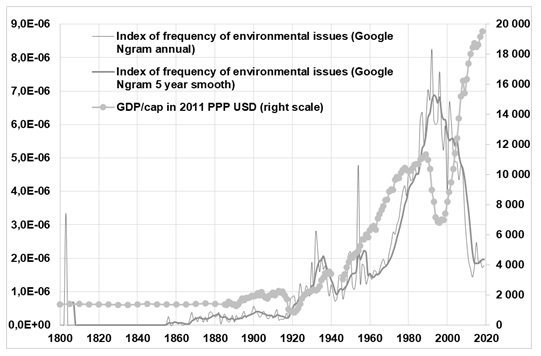
Fig. 7. Index of frequency
of environmental issues in the books published
in Russian, 1800–2020
Note: the labels are synonyms (including outdated) for environmental pollution: ‘санитарное состояние+экология+окружающая среда’ (sanitary condition+ecology+environment); the outcomes are reproducible through the query in hyperlink below.
Source: Google Ngram annual; GDP/cap in 2011 PPP USD: Broadberry and Korchmina (2024); Cheremukhin et al. (2017); Didenko et al. (2013); Maddison Project Database (2020).
However, environmental thinking emerged due to the work of conservative writers. These writers, who claimed to express progressive public opinion, often did not understand the importance of environmental protection measures. Consumer attitudes towards nature dominated in the context of the industrial development (Konchakov 2012).
The plot in Figure 7 confirms that public interest in the issue emerged somewhere around the mid-nineteenth century, as modernizing reforms under Alexander II were launched. In the second half of the nineteenth and early twentieth centuries, public interest focused on improving environmental sanitation in urban areas. Growing interest can be observed after the Russian Revolution of 1917. However, it decreased in the course of the Soviet industrialization campaign in the 1930s.
The interest revived in the mid-1950s. By that time, a moderately developed industrial society had evolved in the Soviet Union, which was recognized as an industrialized nation. At the same time, much of the public was concerned about environmental pollution and other negative consequences of industrial growth. As the Soviet censorship grip on printed matter eased slightly, compared to the extremely strict period of the 1930s – mid-1950s, these concerns were voiced by both fiction writers and scholars, who became prominent public figures at the time. The problem was also perceived at the official level. It was somewhat addressed at the legal level, as in 1957–1963, the republics of the USSR adopted their own subnational laws on nature protection, (where pollution was considered among other threats to the environment).15 In 1982, Russian Soviet Federative Socialist Republic (as a constituent of the Soviet Union) adopted additional Law on Air Pollution Prevention.16 The topic became hot after the accident at the Chernobyl nuclear power station in 1986, which led to radioactive pollution of northern Ukraine, large part of Belarus and several regions of the Russian Republic south-west of its capital city (Moscow). Combined with the rapid easing and the abandonment of censorship under the policies of Transparency (Glasnost’) and Restructuring (Perestroika), this led to an increase in the frequency of discussion of the topic, with a peak in 1992 (the texts were mostly written a little earlier, at the turn of the 1980s and 1990s). However, later, deindustrialization in the 1990s, due to economic decline, made pollution less acute among many other problems. The downturn on the right-hand side of Figure 7 reflects the change in public sentiment.
Summing up the dynamics of public interest in environmental quality, as expressed in Russian-language books, we can conclude that, in general, the dynamics are similar to those of industrialized nations, with the notable difference that even during the last two decades, despite industrial recovery, the pollution issue has lost its appeal and position among other issues in public opinion.
4.4. Happiness
When explaining the dynamics of the Happiness index for Russia (Figure 8), we should take into account the official discourse that prevailed in books published in Russian. Not only in political, but also in ‘public moral’ issues. By cross-checking the smoothed series extracted from Google Ngram Viewer with those from Google Books using five-year groups, we find that trends are generally similar.
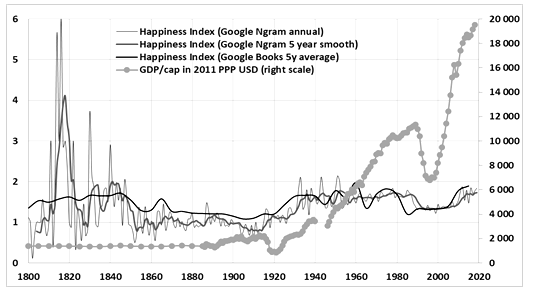
Fig. 8. The happiness index
as represented by books in Russian
(1800–2019)
Note: happiness is labeled as ‘радостный OR счастливый’ (‘joyful OR happy’); the opposite sentiment is expressed as ‘грустный OR печальный’ (‘sad OR gloomy’); the outcomes are reproducible through the queries in the hyperlinks below.
Source: Google Ngram annual; Happiness index (Google Books 5y average query) is a ratio of the queries for happiness and the opposite sentiment; GDP/cap in 2011 PPP USD: Broadberry and Korchmina (2024); Cheremukhin et al. (2017); Didenko et al. (2013); Maddison Project Database (2020).
For the late 1800s–1815, it is most likely the effect of the Napoleonic Wars, which Russia eventually won with a coalition of major European powers. In the summer of 1812, French Emperor Napoleon I invaded Russia, which had been participating in several campaigns against France since the late eighteenth century, although not very successfully. His army occupied Moscow, but was defeated and fled in December. This campaign (the ‘Patriotic War’ in Russia) was rather successful in reviving the coalition against France, as the allies occupied Paris in 1814 and restored the old royal regime. Unsurprisingly, the Happiness index was low in 1808 (following the defeat of the Russian army together with the Prussian army in 1807 and the unpopular Treaty of Tilsit), and in 1812 (invasion, occupation, and destruction of Moscow), but rose in 1813–1815 (after the French army's defeat).
The Russian government's censorship of books was not so strict in the 1860s–1905, when it was finally abolished temporarily. Yet, after the Revolution of 1917, it was re-introduced in much stricter forms. In the 1920s, the official discourse dominated, although alternative views were somewhat tolerated. But the 1930s – mid-1950s were the period of total government control over publishing and active propaganda. We can see that in Figure 8 that the period of 1941–1945 (the ‘Great Patriotic War’ for the USSR) was not as prominent as the period between the 1800s and 1810s (with strong swings depending on losing or winning). In the mid-1950s to late 1980s, the official discourse dominance eased somewhat, similar to its tsarist predecessor, despite the fact that total censorship remained not only in political, but also in cultural topics. Neither should the decrease in the Happiness index be surprising from the mid-1980s to the early 2000s, if we compare it with the negative GDP/cap dynamics, while rapid easing and the abandonment of censorship occurred in the 1990s. Nor can its increase in the 2000s be surprising during economic recovery. In the 2010s, despite intensified regulation of mass media activities, book publishing deserved much less attention from the Russian government, at least there were no well-known cases of direct involvement at the time. And the increase in the Happiness index in the 2010s relative to the 2000s is generally supported by the results of other surveys (VCIOM 2024; Veenhoven 2022: m_bw11_ru; World Happiness Report, 2012–2024). However, Gallup International reported a decline from 2019 to 2021 (GIA 2021: 17).
4.5. Patterns of Evolution of Well-Being
Taking all the measures together, we trace the trends and oscillating patterns of the evolution of well-being in Russia/the USSR. The conventional view of national history identifies three major consecutive periods: the pre-revolutionary (the late Imperial), the Soviet, and the post-Soviet periods.
During the late Imperial period, Russia embarked on a path of modern economic growth, which was interrupted by World War I and the Civil War. The rise of education from a low base was impressive but it lagged behind rival nations. Its structure was biased towards the elite education and did not fit the needs of early industrialization (Popov et al. 2024a, 2024b). Improvements in healthcare and related aspects (life expectancy and infant mortality) were rather modest and were mainly related to the urban population. As income, they were set back by hardships associated with war. During that period, environment concerns emerged along with industrialization. We discover the decrease in happiness perceptions as social problems and conflicts related to the transition to modernity became more acute and remained resolved. These were expressed even more loudly by book writers as restrictions on public expression were eased.
During the Soviet period, income, education, and health were on the rise despite the fact that all three components would greatly deteriorate during the Civil War and World War II, and also decelerate in the last 15–25 years of that period. The increase in education in the 1920s–1950s preceded economic growth and demographic changes, as expected by the unified growth theory (Galor 2011). This was clearly different from other components of well-being. Unsurprisingly, environmental concern mounted over the course of massive industrialization drive. Even though we do not have reliable and comparable data on personal safety, we have some grounds to presume its great deterioration during the first decades of the Soviet period. However, in the 1950s–1960s, the state acquired enough capacity to bring it back to historically low levels recorded under the previous regime in the 1870s–1880s. The Happiness index was somewhat higher at the end of the period compared to the beginning, despite fluctuations and swings throughout the period associated with major historical turning points.
The current post-Soviet period began with a dramatic decline in all HDI components, followed by their gradual recovery. The decline and recovery proved to be relatively short for education, but rather prolonged for income and life expectancy. In 2022–2024, the latter was only slightly higher than its absolute level in the mid-1960s and late 1980s. The situation with the education is much better due to the widespread availability of tertiary education. However, there is an almost unanimous view that the increase in the average years of schooling did not go hand in hand with the quality. The only component which has improved radically is environmental concern, on the wave of premature deindustrialization. The overall improvement in political and civil liberties (a component of the AHDI in Prados de la Escosura 2021) can be attributed to the reduction in social costs from the previous period. The great deterioration in personal security and its return to late Soviet times hint at comparable cyclical swings, which partially remain undocumented. The same pattern is observed in the Happiness index. Currently, most dimensions of well-being show somewhat positive short-term trends. However, the overall pattern is still subject to various structural changes: some components may accelerate, while others may deteriorate, and this may happen rather unexpectedly.
Overall, growth of income and education was the highest during the Soviet period. Health improvements were much less impressive, if any, during the pre-revolutionary and post-Soviet periods. Environmental concerns emerged during the Imperial period, and increased in the Soviet one, but significantly moderated in the post-Soviet period. Other immaterial aspects of well-being (personal security and happiness perception) oscillated throughout all periods and overall. The transition from one period to another was associated with a downturn in most measures of well-being. They were the most acute in life expectancy and personal security, while education was least affected as flows were primarily impacted, rather than stocks.
5. CONCLUSION
By combining alternative estimates based on the data from the national statistical offices with objective measures of public perception, this study arrived at new quantitative evidence on certain aspects of non-material well-being in Russia / USSR17 over a long time span. This evidence shows that all three HDI components have moved basically in one direction over time. However, the process of human development has been uneven and non-linear. Strong variation in growth rates and fluctuations frequently occurred in income and health components. The growth of the education component was relatively steady and less dependent on income fluctuations than the health component. Despite significant growth in the income and education components of the HDI, it was less impressive for the health component, which is measured in the simplest way (life expectancy) and is less subject to distortion than the other two components (income and education).
Personal security strongly depends on the institutional environment and the capacity of the state with cyclical oscillations. It has occurred twice that growth in homicide rates has preceded a state failure. Russia still underperforms China and Western Europe in terms of homicide rates.
Our comparisons, discussions, and results of content analysis show that short- and medium-term fluctuations in non-monetary me-asures of well-being are of complementary significance in explaining underlying patterns. Strong short-term swings may coincide with those of HDI and GDP, especially when GDP falls. Many other grand historical events and processes (as well as short-lived circumstances) seem to affect public sentiment reflected in the Google Books samples.
We document that the Happiness index tends to cyclical oscillations. In recent years, it has recovered and is closer to its historically high levels. Also, a significant fall of the public concern with environmental quality issues has occurred. The main finding is that the so-called ‘Easterlin paradox’ also manifests itself in the case of Russia/ USSR: the level of happiness has almost stopped growing while GDP per capita continues to increase. However, the threshold for Russia appears to be relatively low. The pattern of lack of gains in happiness despite an increase in income may arise from people's concerns with non-materialistic issues, as expected by the revised version of the modernization paradigm (Inglehart and Welzel 2011 [2005]).
The employment of similar methods of content analysis on samples of digitized texts could be a promising solution for illuminating the relevant empirical evidence and identifying historical trends relating to other aspects of non-material well-being.
ACKNOWLEDGEMENTS
The author thanks Bas van Leeuwen, Matteo Calabrese, and Meimei Wang for the original ideas and productive discussions, including advice on comparative historical evidence. The author of the article is fully responsible for the final research decisions and their possible shortcomings.
FUNDING
The article has been prepared as a part of the research work under the Russian government assignment of the Russian Presidential Academy of National Economy and Public Administration ‘Economic statistics and the Russian state: historical experience of interaction (mid-19th – the first third of the 20th century)’ (10.9-2025-1).
NOTES
1 https://documents.un.org/doc/undoc/gen/n11/420/70/pdf/n1142070.pdf.
2 https://documents.un.org/doc/undoc/gen/n11/475/68/pdf/n1147568.pdf.
3 https://sustainabledevelopment.un.org/index.php?page=view&type=400&nr=617&menu=35.
4 The English economists Alfred Marshall and his disciple Arthur Pigou, who used the heritage of the utilitarian tradition of economic thought (Jeremy Bentham and John Stuart Mill), are recognized as the founders of welfare economics.
5 The development of the concept of ‘human potential’ in the literature was outlined and discussed in (Ovcharova, Anikin, and Sorokin 2023: 9–39, 143–184).
6 http://www.oecdbetterlifeindex.org.
7 http://hdr.undp.org/en/reports.
8 https://worlddatabaseofhappiness.eur.nl.
9 https://wellbeing.hmc.ox.ac.uk/.
10 The most comprehensive studies on methods of content analysis are compiled in Neuendorf (2017), Kuckartz and Rädiker (2023).
11 The Google Books contains more than 40 mln books in a number of languages, including Russian. Approximately 30 % of all titles published prior to 2010 (https://en.wikipedia.org/wiki/Google_Books). Google Books Ngram Corpus (https://books.google.com/ngrams/info) is a selection of books with the best character recognition. It aggregates data from at least 6 % of all books ever published, in 2010 totally more than 8.1 mln books, among them 0.6 mln in Russian (Lin et al. 2012).
12 Australia, Austria, Belgium, Canada, Denmark, Finland, France, Germany, Greece, Ireland, Italy, Japan, Netherlands, New Zealand, Norway, Portugal, Spain, Sweden, Switzerland, UK, and USA.
13 It is somewhat surprising, as these were periods associated with severe demographic losses caused by large-scale wars that occurred during these periods. There is uncertainty about how accurately the statistical task was performed to calculate the number of deaths from natural causes and those caused by warfare (not only on battlefields but also from starvation and epidemic diseases).
14 Polnoe sobranie zakonov Rossiyskoy imperii [Complete Collection of the Laws of the Russian Empire]. 3rd ed. Vol. VIII. 1888. № 5120. P. 148–156. https://nlr.ru/e-res/law_r/search.php?part=1525&regim=3.
15 https://www.consultant.ru/cons/cgi/online.cgi?req=doc&base=ESU&n=8501.
16 https://www.consultant.ru/document/cons_doc_LAW_14650/.
17 Precisely, the country in changing borders as regards statistical data and the Russian-speaking world as regards perceptions of environmental quality and happiness. Only an insignificant part of books in Russian were published abroad before the collapse of the Soviet Union (1991).
REFERENCES
Andreev, E. M. 1994. Life Expectancy and Causes of Death in the USSR. In Lutz W., Scherbov, S., and Volkov, A. (eds.), Demographic Trends and Patterns in the Soviet Union before 1991 (pp. 279–293). New York.
Andreev, E. M., Darskij, L., Kharkova, T. 1992. L’histoire de la population de l’URSS 1920–1959. In: Annales de démographie historique 1: 61–150. URL: https://www.persee.fr/doc/adh_0066-2062_1992_num_1992_1_1816.
Andreev, E. M., Darskii, L. E., Khar’kova, T. L. 1993. Naselenie Sovetskogo Soiuza (1922–1991) [Population of the Soviet Union (1922–1991)]. Moscow: Nauka. In Russian.
Barro, R. J., Lee, J.-W. 2015. Education Matters: Global Schooling Gains from the 19th to the 21st Century. New York, Oxford University Press. Data set retrieved from URL: http://barrolee.com/data/oup_download_b.htm.
Broadberry, S., Korchmina, E. 2024. Catching-up and Falling Behind: Russian Economic Growth, 1960s–1880s. Journal of Economic History 84 (4): 997–1028. URL: https://doi.org/10.1017/s0022050724000287.
Broadberry, S., O’Rourke, K. H. (eds.). 2013. The Cambridge Economic History of Modern Europe. 2 vols. Moscow: Gaidar Institute Publishers.
CJRC. – Criminal Justice Research Center, Ohio State University. 2010. Historical
Violence Database. URL: https://cjrc.osu.edu/sites/cjrc.osu.edu/
files/Russia-and-theEuropean-nations-of-the-formerUSSR5-2010.XLS.
Didenko, D., Földvári, P., Van Leeuwen, B.
2013. The Spread of Human Capital in the Former Soviet Union Area in a Comparative
Perspective: Exploring a New Dataset. Journal
of Eurasian Studies 4 (2): 123–135. Supplementary
data. URL: https://www.sciencedirect.com/science/article/
pii/S1879366513000122.
Didenko, D. V. 2020. Trends and Institutional Sources of Financing
Russia's Human Capital Formation (Late Nineteenth–Early Twenty-first Centuries). In Hanes, C., Wolcott, S. (eds.), Research in Economic History 36.
Bingley: Emerald Publishing Limited, 45–107. DOI: 10.1108/S0363-3268
20200000036002.
Easterlin, R. A. 1974. Does Economic Growth Improve the Human Lot? Some Empirical Evidence. In David, P. A., Reder, M. W. (eds.), Nations and Households in Economic Growth: Essays in Honor of Moses Abra-movitz (pp. 89–125). New York: Academic Press, Inc.
Ellman, M. 2004. Soviet Industrialization: A Remarkable Success? Slavic Review 63 (4): 841–849.
Fedstat. 2025. Life Expectancy at Birth, Russian Federation Official Statistics (EMISS). URL: https://fedstat.ru/indicator/31293.
Fink-Jensen, J. 2015. Homicide Rates, 1800–2010.
https://hdl.handle.net/106
22/FMI6L9. URL: http://www.clio-infra.eu.
Frey, B. S., and Stutzer, A. 2002. Happiness and Economics: How the Economy and Institutions Affect Human Well-Being. Princeton, NJ: Princeton University Press.
Galor, O. 2011. Unified Growth Theory. Princeton, N.J.: Princeton University Press.
GIA. – Gallup International Association. 2021. Less Hope and
Happiness in the World. URL: https://www.gallup-international.com/fileadmin/user_up
load/surveys_and_news/2021/GIA_EoY_2021_PR1_Q1_Q2_Q3.pdf.
Giovannini, E., Rondinella, T. 2018. Going beyond GDP: Theoretical Approaches. In D’Ambrosio, C. (ed.), Handbook of Research on Economic and Social Well-Being (pp. 1–51). Northampton, MA: Edward Elgar Publishing, Inc.
Haq, M. ul. 1995. Reflections on Human Development. New York: Oxford University Press.
HLTD. – Human Life Table Database. 2018. Max Planck Institute for Demographic Research. URL: https://www.lifetable.de/Country/Country?cntr= RUS.
Inglehart, R., Welzel, C. 2011 [2005]. Modernization, Cultural Change, and Democracy: The Human Development Sequence. Moscow: Novoe Pub-lishing.
Johansson, K., Lindgren,
M. 2024. Life Expectancy at Birth.
Version 14. The Gapminder Foundation. URL: https://www.gapminder.org/data/document
ation/gd004/.
Konchakov, R. B. 2012. Ekologicheskie aspekty zheleznodorozhnogo stro-itel'stva v 1860–1900-e gg. (na materiale Tambovskoi gubernii) [Environmental Aspects of Railway Construction in the 1860−1900s (based on materials from Tambov Province)]. RUDN, Journal of Russian History 1: 110–125. In Russian.
Kuckartz, U., Rädiker, S. 2023. Qualitative Content Analysis: Methods, Practice and Software. 2nd ed. Thousand Oaks, CA: Sage Publications.
Kumo, K., Morinaga, T., Shida, Y. 2007. Long-Term Population Statistics for Russia, 1867–2002. RRC Working Paper Series No. 2. URL: https:// www.ier.hit-u.ac.jp/rrc/English/pdf/RRC_WP_No2.pdf.
Latov, Iu. V. 2001. Osobennosti natsional'nogo reketa: Istoriia i sovremennost’ [Peculiarities of the national racket activities: History and Present]. Mir Rossii = Universe of Russia, 10 (3): 153–182. In Russian.
Layard, R. 2012 [2005]. Happiness: Lessons from a New Science. Moscow: Gaidar Institute Publishing.
Lee, J.-W., Lee, H. 2016. Human Capital in the Long Run. Journal of Development Economics 122: 147–169. Dataset retrieved from http://www.bar rolee.com/Lee_Lee_LRdata.htm.
Lin Y., Michel J.-B., Aiden E. L., Orwant J., Brockman W., Petrov S. 2012. Syntactic Annotations for the Google Books Ngram Corpus. In: Proceedings of the 50th Annual Meeting of the Association for Computational Linguistics, Jeju, Republic of Korea, 8–14 July (pp. 169–174). URL: https:// aclanthology.org/P12-3029.pdf.
Luneev, V. V. 2005. Prestupnost’ XX veka: mirovye, regional’nye i rossiiskie tendentsii [Criminality of the 20th Century: Global, Regional, and Russian Trends]. Moscow: Wolters Kluwer. In Russian.
Maddison Project Database, version 2020. Bolt, J., Van Zanden, J. L. Maddison style estimates of the evolution of the world economy. A new 2020 update. URL: https://www.rug.nl/ggdc/historicaldevelopment/maddison/rele-ases/maddison-project-database-2020?lang....
McGillivray, M., Clarke, M. (eds.). 2003. Understanding Human Well-Being. Tokyo: United Nations University Press.
Mironov, B. N. 2018. Rossiiskaia imperiia: ot traditsii k modernu [The Russian Empire: from Tradition to Modernity]. 3 vols. 2nd ed. St Petersburg: Dmitrii Bulanin. In Russian.
Mironov, B. N. 1991. The Development of Literacy in Russia and the USSR from the Tenth to the Twentieth Centuries. History of Education Quarterly 31 (2): 229–252.
Mironov, B. N. 2012. The Standard of Living and Revolutions in Russia, 1700–1917. Abingdon, UK: Routledge.
Ovcharova, L. N, Anikin, V. A., Sorokin, P. N. (eds.). 2023. Chelovecheskii potentsial: sovremennye traktovki i rezul'taty issledovanii [Human potential: modern interpretations and research findings]. Moscow: VCIOM (Russian Public Opinion Research Center).
Neuendorf, K. A. 2017. The Content Analysis Guidebook. 2nd ed. Thousand Oaks, CA: Sage Publications.
Pigou, A. C. 1985 [1924]. The Economics of Welfare. 2 vols. Moscow: Progress.
Popov, V. 2014. Mixed Fortunes: An Economic History of China, Russia, and the West. Oxford University Press.
Popov, V. V., Konchakov, R. B., and Didenko, D. V. 2024a. Human Capital in the Regions of the Russian Empire and Inequality in Land Distribution at the Turn of the 20th Century (February 12, 2024). http://dx.doi.org/10. 2139/ssrn.4694578.
Popov, V. V., Konchakov, R. B., and Didenko, D. V. 2024b. Growth of Human Capital in the Regions of the Russian Empire in 1897–1913: The Role of Local Self-Government Bodies (zemstva) Financing (September 22, 2024). http://dx.doi.org/10.2139/ssrn.4967274.
Prados de la Escosura, L. 2015. World Human Development, 1870–2007. Review of Income and Wealth 61 (2): 220–247. DOI: 10.1111/roiw.12104, supplementary data retrieved from http://espacioinvestiga.com/inicio hihd/, accessed via http://www.frdelpino.es/.
Prados de la Escosura, L. 2021. Augmented Human Development in the Age of Globalization. Economic History Review 74 (4): 946–975. DOI: 10.1111/ehr.13064, supplementary data retrieved from http://espacioinves tiga.com/inicio-hihd/. URL: http://www.frdelpino.es/.
Sen, A. 1985. Commodities and Capabilities. Amsterdam: North-Holland.
Stickley, A. 2006. On Interpersonal Violence in Russia in the Present and the Past: A Sociological Study. Ph.D. thesis: Stockholm University.
TsSk – Tsentral’nyi Statisticheskii Komitet [Central Statistical Committee]. 1894. Vremennik Tsentral'nogo statisticheskogo komiteta Ministerstva vnutrennikh del. No 35. Umershie nasil'stvenno i vnezapno v Evropeiskoi Rossii v 1875-1887 gg. [Central Statistical Committee of the Ministry of Internal Affairs. Abstract No. 35. Those who died violently and suddenly in European Russia in 1875–1887]. Saint Petersburg.
TsSk. – Tsentral’nyi Statisticheskii Komitet [Central Statistical Committee]. 1897. Vremennik Tsentral'nogo statisticheskogo komiteta Ministerstva vnutrennikh del. No 41. Umershie nasil'stvenno i vnezapno v Evropeiskoi Rossii v 1888-1893 gg. [Central Statistical Committee of the Ministry of Internal Affairs. Abstract No. 41. Those who died violently and suddenly in the Russian Empire in 1888-1893]. Saint Petersburg.
TsSK – Tsentral’nyi Statisticheskii Komitet [Central Statistical Committee]. 1918. Statisticheskii ezhegodnik Rossii 1916 g. (god trinadtsatyi). [Statistical Yearbook of Russia 1916 (year thirteenth)]. Vol. 1. Petrograd. In Russian.
UNDP. – United Nations Development Programme. Reimagining cooperation in a Polarized World. New York. URL: https://hdr.undp.org/system/files/
documents/global-report-document/hdr2023-24reporten.pdf.
UNODC. – United Nations Office on Drugs and Crimes. 2023. https://datau-nodc.un.org/sites/dataunodc.un.org/files/data_cts_intentional_homicide.xlsx.
Van Leeuwen, B., Van Leeuwen-Li, J. Average Years of Education. 2015. http://hdl.handle.net/10622/KCBMKI, accessed via http://www.clio-infra.eu.
Van Zanden, J. L. et al. (eds.). 2014. How Was Life?: Global Well-being since 1820. OECD Publishing. DOI: 10.1787/9789264214262-en/.
Van Zanden, J. L. et al. (eds.). 2021a. How Was Life? Vol. II: New Perspectives on Well-being and Global Inequality since 1820. OECD Publishing. DOI: 10.1787/3d96efc5-en/.
Van Zanden, J. L., Van Leeuwen, B., Xu, Y. 2021b. Consequences of Growth:
Living Standards and Inequality, In Broadberry,
S., Fukao, K., (eds.), The Cambridge Economic History of the Modern World. Vol. I
(pp. 391–411). Cambridge: Cambridge University Press.
VCIOM. 2024. Happiness Index. Russian Public Opinion Research Center. URL: https://wciom.com/our-news/ratings/happiness-index.
Veenhoven, R. 2022. Trends in Nations. Data file to be used for the Longitudinal Analysis of Societal Conditions for Happiness. World Database of Hap-piness. Erasmus University Rotterdam, Netherlands. URL: https:// world databaseofhappiness.eur.nl/wp-content/uploads/TrendsInNations_2022b.xlsx.
Volodin, A. Yu. 2019. Shifry tsifry: poisk otvetov na trudnye voprosy [Codes of the Digit: Answers to Difficult Questions]. Istoricheskaya Informatika 3: 43–56. DOI: 10.7256/2585-7797.2019.3.30992. In Russian.
Volodin, A. Yu. 2016. Tsifrovoi povorot v istoricheskoi nauke: veroyatnoe i neochevidnoe [The digital turn in historical research: plausible and unevident]. Elektronnyi nauchno-obrazovatel'nyi zhurnal ‘Istoriia’ [History], 7 (7). URL: https://history.jes.su/s207987840001647-0-1/. In Russian.
World Happiness Report. Appendices & Data, 2012–2024. URL: https:// worldhappiness.report/data/.
Zijdeman, R., da Silva, F. R. 2015. Life Expectancy at birth (total). URL: http:// hdl.handle.net/10622/LKYT53. Accessed via http://www.clio-infra.eu.