Immigration in the United States of America: A Historical and Political Review

Journal: Social Evolution & History. Volume 25, Number 1 / March 2026
DOI: https://doi.org/10.30884/seh/2026.01.06
Süha Atatüre Istanbul Gedik University, Istanbul, Turkey
ABSTRACT
This article focuses on two main interconnected subjects. The first subject examines the nearly four-hundred-year history of immigration in the United States. The second evaluates how this remarkable phenomenon of immigration experienced by the United States has become a global threat not only to the United States but all nation-states in the twenty-first century. Since the adoption of its Constitution in 1791, the United States has welcomed immigrants from various parts of the world. However, this process has been subject to certain restrictions and conditions. In this frame at times, the United States has made agreements with neighboring countries to accept large numbers of immigrants. Conversely, at other times, they have deported to different countries the previously accepted immigrants or completely banned their entry. Despite extensive experience with both positive and negative results, illegal immigration remains a primary concern for U.S. leaders. Today, immigration and the problems of immigrants continue to be unresolved issues. In the twenty-first century, immigration has emerged as a worldwide issue affecting not only the United States, but all countries due to a multitude of reasons. The challenges of immigration we face today are just one aspect of a larger set of issues that I refer to as the ‘Integrated Threat,’ which encompasses numerous global challenges. In this article, I will begin by outlining the history of immigration in the United States and the perspectives of three recent presidents on this issue. Furthermore, the worldwide challenge of immigration will be assessed alongside the Integrated Threat.
Keywords: immigration, Ellis Island, integrated threat, wetback, Bracero.
A HISTORICAL AND POLITICAL REVIEW
First Wave of Migration to the USA: A Brief Look
Georgia, the 13th and final British colony of European peoples who migrated to the east coast of North America starting in the sixteenth century, was established in 1735. Following the Seven Years' War between England and France from 1756 to 1763, the King of England imposed heavy taxes on the colonies to compensate for the war losses. The introduction of ‘Intolerable Acts’ that had a severe impact on the lives of the colonies, fueled their struggle for independence. The colonies declared independence in 1774, and the American Constitution was adopted in 1791 (Atatüre 2022: 74). The country's population was 3.9 million in 1790, with 81 % of the population being white Europeans (English, Scottish, Scotch-Irish, Irish and Welsh, German, Dutch, French, Swedish, Norwegian and Danish, and 98 % of them were Protestant and 2 % were Catholic). Blacks made up 19 % of the population (Lavender 1989: 40–41).
By 1775, an American society had emerged with its own distinctive social, economic and political lines. The first major wave of immigration consisted of the English, while New England and the plains of the South remained entirely English. After the 1700s, the real wave of immigration began with the Germans. The number of Germans and Swiss reached thousands within a year, and in 1739, they published a German newspaper in Germantown. The Scots and the Irish, who were more daring and combative races, also fled from religious oppression in their own countries. In the Shenandoah and other valleys, the English, Germans, Dutch and others quickly mixed their blood in the rich melting pot of the new American nation (Nevins and Commager 2017). The notion of America being a ‘melting pot’ in which immigrants were transformed into ‘Anglo-Protestant Americans’ really refers to a Yankee solution intimately tied to the folkways of a covenanted, utopia-building people who were themselves almost entirely English in origin (Thornton 2012).
Between 1620 and 1770, these first settlers became what we call White Americans today, thanks to intermarriage and religious unity. They formed the White Anglo-Saxon Protestant (WASP) majority. Dominant in politics and business, the WASPs became the core of American nation. With the adoption of the Constitution, Congress passed the Naturalization Act of 1790, which established the rules for naturalization under Article 1, section 8 of the Constitution, but did not impose any restrictions on immigration. Citizenship was limited to white people, and the law emphasized the importance of being an American. While not restricting immigration, the law did define requirements for naturalization (voting and holding office). These limitations were enacted for various reasons and were reduced over time, but as the country's territory expanded westward, the issue was always on the agenda (Crenshaw 2024).
Following revisions approved by Congress in 1795 and 1798, the Naturalization Acts of 1802 laid the groundwork for naturalization process, many of which remain in place today. Prospective citizens must submit the following during a five-year residence waiting period: (1) a ‘declaration of intent,’ (2) an oath of allegiance (renouncing all former allegiances and aristocratic titles two years before naturalization), and two citizen witnesses attesting to their moral character (Shneider 2021: 52). This law was important in terms of the status of immigrants, as future developments will depend on this law.
On the other hand, one of the important forces that shaped American life from the beginning was the ‘Frontier’. Frontier immigrants can be divided into three groups. At the forefront of migration were hunters and fur trappers. The second group consisted of hunters and farmers, and the third group included not only farmers, but also doctors, lawyers, publishers, preachers, artists, politicians, and land speculators. In short, all elements that would form the structure of a solid society were present. New roads, such as the Cumberland, Santa Fe and Oregon Trails, which opened from the East to the West, allowed for mass migration and enabled both the development of trade and the formation of new cities (Nevins and Commager 2017).
After 1820, the government's distribution of land at low prices led to a serious expansion to the east and the creation of new borders. Journalist John O'Sullivan wrote in 1845 that ‘the westward expansion of the country and the possession of the entire continent is a God-given right of the American people’ (Klein 1996). During this expansion process, the traffic between California and Mexico City was also extremely low. The Mexican government had only a shadowy sovereignty over the region. Moreover, it was understood that the region would be sold to England (Nevins and Commager 2017).
Motivated by these realities and this spirit of expansion and American nationalism, the United States declared war on Mexico on May 13, 1846, with the aim of seizing the territories of California and New Mexico and establishing the boundaries of Texas. At the end of the war, the Treaty of Guadalupe Hidalgo in 1848* required Mexico to cede about half of its territory to its northern neighbor. This treaty formalized the United States' annexation of a large portion of northern Mexico (El Norte), and citizenship was also granted to Mexicans who chose to remain in the region (Klein 1996). While citizenship was granted to Mexicans in 1848, the Great Famine that began in Ireland led to the largest wave of immigration in U.S. history between 1845 and 1854, during which a total of 2,939,000 Irish immigrants settled in the country (Potter 2011).
The Homestead Act of 1862 provided free parcels of land in the West for both immigrant and native-born settlers who promised to live on and develop the land for at least five years. The law gave 160 acres of free land to any settler who was twenty-one years of age or older, or the head of a family, who was a citizen of the US or had declared their intention to become one. In 1872, an amendment was added to the Homestead Act to benefit sailors and soldiers who had served in the United States (Anderson 2011).
Following the conclusion of the Civil War in 1865, considerable numbers of immigrants from southeastern Europe (Italy, Greece, Russia, Poland, Austria-Hungary, and the Balkan countries) and China began arriving in the United States to capitalize on these new opportunities. These prospects included finding work in the railroad, steel, oil, and other industries (Schneider 2001). However, anti-immigrant sentiment was not a new phenomenon. Abraham Lincoln also criticized the saying ‘all men are created equal’ in practice, ‘all men are created equal except negroes’ but if the nationalist ‘Know-Nothing’ party took control, they would say ‘all men are created equal, except for negroes, foreigners, and Catholics.’ However, 12 million new immigrants entered the country between 1870 and 1900 and contributed to the industrial development of the country by doing so economically (Grant 2012: 223).
The Naturalization Act of 1870 explicitly expanded the rights of naturalization for white immigrants already have to ‘aliens and persons of African descent.’ Because of these surges in migration, some saw it as an issue, and different authorities tackled it on a daily basis with temporary measures. In Henderson v. Mayor of New York, 92 U.S. 259 (1875), the US Supreme Court clarified Congress's role in regulating immigration and granted Congress complete authority to do so (Wasem 2018). In early 1882, Congress passed legislation mandating the inspection of all foreign nationals entering the United States and detailing the grounds for exclusion. Congress authorized the Treasury to designate immigration control agents under the 1882 Act (Ibid.: 7). With this Immigration Act, Congress broadened the definition of excludable foreigners to include other undesirable individuals as well as qualifications such as ‘prisoners,’ ‘lunatics,’ and ‘persons likely to become public offences.’ Criminals, prostitutes, and Chinese indentured laborers were among the first categories of immigration to be rejected in 1875. In 1882, all Chinese labor immigration was banned (Ewing 2012). The Chinese immigrant population in 1882 was 39,579, but once the law was passed it dropped to 8,031 and 279 in 1883 (Chen 2015: 301).
The Second Wave of Migration
When the United States was founded, there were philosophical differences between the founding fathers. These differences were especially known between Alexander Hamilton and Thomas Jefferson. However, the two founding leaders agreed that immigrants should come to the country. This was an ‘Open Immigration’ policy implemented to ensure a sufficient population and to counter the recolonization policies of England and France (LeMay 2011).
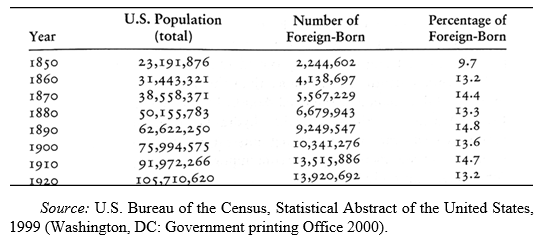
The second wave of immigration lasted from 1870 to 1920. Although immigration from British, German, and Scandinavian countries continued during these years, the concentration switched to Catholic and Orthodox Europeans and Asians. Many Chinese immigrants came to America to take advantage of these new opportunities (Ewing 2012). In reality, in the 24-year period between 1869 and 1892, roughly 10 million immigrants came to America: 8,808,454 from 29 different European nations, 237,367 from seven different Asian countries, 904,427 from 25 American countries, and 31,129 thousand from all other countries (Lavender 1989: 40). The values of foreign-born Americans relative to the total American population between 1850 and 1920 are shown in the table below.
Table 1
Because of this intensity, Congress immediately recognized the challenges of preserving immigrants' data in many agencies and opted to designate and fund a special immigration office tasked with both processing legal immigrants and enforcing immigration limits. The Bureau of Immigration was founded in 1891 to serve this objective, and the government decided it needed to step in to handle the ever-increasing influx of newcomers. In 1890, President Benjamin Harrison (1833–1901) designated Ellis Island, located in New York Harbor near the Statue of Liberty, as a federal immigration station (Miller 2014).
From 1892 to 1954, approximately 12 million immigrants entered the United States via Ellis Island, a small island in New York Harbor. Ellis Island is located in the upper harbor right off the New Jersey shore, in the shadow of the Statue of Liberty. This gateway to the new world increased over time from its original 3.3 acres to 27.5 acres, largely due to landfill collected from ship ballast and potentially extra soil from the construction of the New York City subway system (Save Ellis Island 2023). Following the fire on June 15, 1897, the original station building was reconstructed as a fire-resistant hospital, dining hall, 600-bed dormitory, and open-air promenade on the terrace (Tyler 1996).
Immigrants landed on the island by ship. In the building, immigrants encountered another physician, possibly older than the first one, who promptly examined each eyelid for trachoma. The doctors used chalk to designate each immigrant suspected of being sick or disable (Yew 1980). Of those who arrived, 2 % were turned away due to various diseases. Among the questions asked were the identities of first-time visitors and the amount of money they had, both of which were recorded (Ibid.). Built with federal funds between 1890 and 1892, the Ellis Island Immigration Station responded to recent changes in the U.S. Immigration Act. In 1891, the management of rapidly increasing immigration was expressly transferred to the federal government. Among others, the Immigration Act of March 3, 1891, gave institutional status to the United States Immigration Department and stipulated the structure for the examining and processing international immigrants applying for ‘official permission’ to reside in the country (Sossai 2020). Since nearly all newcomers to New York came by boat and were processed through Ellis Island, they had no way to avoid immigration inspections intended to weed out those who were unhealthy or undesirable. Even before that, steamship companies conducted their own examinations in the ports of origin; immigration legislation made these companies responsible for returning deportees to their home countries and for providing food and accommodation while they were detained in the United States (Foner 2000: 158).
Between 1882 and 1924, during the peak of European immigration, officials at Ellis Island rejected 250,000 immigrants or fewer than two percent. A center called ‘West of Ellis’ was also opened on Angel Island in San Francisco Bay, California, to perform the same functions as Ellis Island. Comparing the two, authorities processed 340,000 Asian immigrants from 1910 to 1940 on Angel Island but they detained and deported at a much higher rate than at Ellis Island. This comparison suggests a significantly racialized nature of inspection, detention, and deportation during times when mass immigration was at its peak (Ibid.).
Indeed, in 1921, Congress passed emergency legislation to restrict the number of immigrants from Southern and Eastern Europe and then engaged in debates over the desirability of permanent restrictions. The Immigration Act of 1924 imposed a lower limit on these permanent restrictions. During the same period, the issue of ‘eugenical sterilization’ was debated. Several states already had laws allowing for involuntary sterilization. More than 60,000 Americans were sterilized under this program (Grant 2012: 293). After 1970 immigration once again increased, following the passage of the Immigration and Nationality Act (1965) which abolished the National Origins Quota System that had operated since 1924 (Ibid.: 373).
By 1924, Ellis Island had changed from being a place where immigrants were welcomed to America into a place where illegal immigrants were held until they could be deported back to their home countries. After serving as a detention center for illegal immigrants and various detention and service activities during World War II, Ellis Island was eventually decommissioned from all operations in November of 1954 (Administrator 2010). After the war ended, it was opened as a public museum in 1976. It became a place of history and research visited by millions of people. Today, nearly 40% of the total population of the United States can find records of their ancestors among the millions held in this museum (Heidelberg 2023).
Illegal Immigration and the Core Problem
During the economic and political crises of the 1920s and 1930s, illegal Mexican immigration increased. To prevent this, the border patrol launched several campaigns to detain Mexicans, including some U.S.-born citizens, and deport them across the border. For this purpose, Congress passed the ‘Undesirable Aliens Act (Blease Act)’ in 1929. The Blease Act made it a criminal offense to cross the border outside an official port of entry. Designed primarily to restrict Mexican immigration, the law made it a misdemeanor to ‘enter the country illegally’ and a felony to return after having been deported (Fish 2019).
Consensual Migration Operation; ‘Bracero’
‘Brasero’ has different meanings in Spanish-speaking countries, but it refers to a person who works in the coal or iron mining industry. This is how it is used here (Content Authority). During World War II, the United States faced a severe agricultural labor shortage due to the demands of wartime production and the need for military registration. In short, the United States signed an agreement with Mexico in 1942 that provided for the recruitment of ‘bracero’ laborers to work under contract in the Southwest. Although braceros were hailed as heroes for relieving famines during World War II, their positive wartime image short-lived (Zolberg 2006).
As Hernandez (2017) has shown, the aggressive measures of detention and deportation, the Bracero Program, continued until 1964, despite its modification. Nevertheless, undocumented immigrants continued to enter the United States with braceros. By 1947, the practice of contracting labor from the Mexican interior had largely been abandoned in favor of legalizing undocumented workers already in the United States. Manufacturers strongly pressed the government to allow this practice, because it was much easier and cheaper than hiring workers from the Mexican interior (Astor 2009). However, the costs of legalizing undocumented immigrants through illegal practices encouraged a large influx of undocumented immigrants into the United States (President's Commission on Migrant Labor 1951).
Truman's 1951 ‘President's Commission’ documented how the Bracero Program had increased unauthorized immigration, provided a detailed description of the deplorable working and living conditions of immigrant workers, and emphasizing the extent to which illegal immigration undermined wages and collective bargaining efforts. When the results of the report were made public in 1951, unauthorized immigration became the focus of public debate not only in the Southwest, but nationwide (Astor 2009: 5–29).
Reverse Migration, ‘Operation Wetback’
In 1954, three years into his presidency, President Dwight Eisenhower decided to change immigration law enforcement in a radically new direction. That year, the Eisenhower Administration decided to close six detention facilities for immigrants, most notably at Ellis Island. Mexican immigrants were ensnared in Operation Wetback, which was the largest mass deportation of undocumented workers in US history. ‘Wetback’ was a derogatory term for Mexican immigrants, which referred to the Rio Grande River at the border between the countries (Longly 2018).
While the Bracero program was still underway, in May of 1954, the U.S. Attorney General Swing and former convict and National Rifle Association president Harlon Carter, issued a press statement announcing Operation Wetback. During the Eisenhower era, up to 1.3 million people were affected by a racist campaign aimed at alienating undocumented Mexicans from American society (OnTheIssues 2022). The short-lived operation used military-style tactics to remove Mexican immigrants, some of whom were American citizens, from the United States. Although millions of Mexicans entered the country legally through joint immigration programs in the first half of the twentieth century, Operation Wetback was designed to send them back to Mexico. With the help of the Mexican government, which wanted the return of Mexican citizens to ease their own labor shortage, border patrol troops and local authorities used military techniques and embarked on a coordinated, tactical operation to remove the migrants. Meanwhile, they used widespread racist stereotypes to justify their sometimes-brutal treatment of immigrants (Smith 1992: 84–85).
Soon, they promised an unprecedented paramilitary surge of Border Patrol officers to sweep across the southwestern United States to find, detain and deport unauthorized Mexican immigrants. As Carter explained to the Los Angeles Times, ‘an army of Border Patrol officers complete with jeeps, trucks, and seven aircraft’ would soon unleash an ‘all-out war to hurl… Mexican wetbacks back into Mexico’ (Hernandez 2017). During Operation Wetback, tens of thousands of immigrants were loaded on buses, boats, and planes and sent to often unfamiliar parts of Mexico where they struggled to rebuild their lives. Three planes a week were filled with immigrants in Chicago and flown to Mexico. In Texas, 25 per cent of deported immigrants were crammed on boats while others died from sunstroke, disease, and other causes during their detention (Stevens 2024).
Carter told the newspaper that it would be ‘the largest attack on illegal aliens in history.’ News of the raid horrified Latinos in the United States, many of whom recalled the wave of forced deportations in the 1930s (Hernandez 2017). The century-old National Rifle Association was taken over by the Second Amendment Foundation, a white nationalist organization that was founded in 1974 by Harlon Carter, who was the border chief of the 1950s mass deportation of Mexicans during ‘Operation Wetback.’ This is when the Second Amendment became a cause for white nationalists, relying on the right-wing ideology of originalism – that is, interpreting the original meaning of the US Constitution (Ortiz 2021).
Historians have documented the behind-the-scenes that led to the United States carrying out Operation Wetback, along with agreements that were not made public at the time. Some south Texas employers resorted to hiring armed guards to ward off increased raids threatened by Border Patrol agents. Immigration officials combined these threats with offers of watered-down versions of the Bracero Program, allowing workers to obtain documents without making any commitments. As a result, the number of immigrants in the Bracero Program increased as undocumented workers were deported (Fernandez 2014).
Operation Wetback was ‘unlawful; it was arbitrary; It was very much based on xenophobia,’ historian Kelly Lytle Hernandez said on CNN in 2016. ‘And it has resulted in large-scale human rights violations, including the forcible deportation of U.S. citizens’ (Hernandez 2017).
THE TWENTY-FIRST CENTURY AND IMMIGRATION POLICIES OF THE US PRESIDENTS
All the information provided in this article up to this point, and America's immigration practices have developed in accordance with the nineteenth and twentieth centuries and the characteristics of a nation-state. The twenty-first century, however, is developing under the influence of globalization, which has different characteristics from the nineteenth and twentieth centuries. The distinctive characteristics of this difference are the developments in which many issues, such as the rule of law, human rights, the environment and climate change, are on the agenda. For this reason, it is expected that the immigration policies of American Presidents will also be parallel to global developments. However, the last three American presidents did not meet this expectation. In addition, they also could not find a solution to the immigration problem that is suitable for the age.
Even setting aside the experiences of the United States that I discuss in this article, there is a significant literature on immigration in the twenty-first century. However, much of this work has been influenced by the characteristics, values, and capabilities of the nation-state as it was understood in the twentieth century. However, the ‘nation-state’ of the twentieth century is different from the ‘democratic state’ of the twenty-first century. Democratic states have different values, characteristics, and capabilities, and all of these define the structure of a democratic state. Nevertheless, the transition from a nation-state to a democratic one has not been fully realized. Unfortunately, in the twenty-first century, we live in an outdated era dominated by the nation-states of the twentieth century. Many nation-states in the world have collapsed or lost their sovereignty, impoverished their people, or plunged them into civil war. Therefore, there are three main reasons for the mass migrations in the twenty-first century:
(1) the collapse of nation-states;
(2) the lack of regulatory and authoritative institutions to address global problems; and
(3) the failure to shift the concept of national interest to broader ideas of optimal or global interests.
In short, these three factors lead to global hunger, migration, and conflicts, as well as to both local and global instability.
The issue of immigration has been one of the constant issues for the US governments and presidents, due to the nature of the country's founding. As a result, in the United States, presidential candidates from the Democratic or Republican parties make promises to the public when they are elected president at the National Party Conference prior to the presidential election. These plans, known as the Party Platform, address a wide range of themes. They explain the values and intentions of the President before the presidential election. In this context, immigration is one of the important issues addressed in party programs, among other issues. Immigration in America should be considered not only as an economic and sociological issue, but also as a political issue. The following pages present different perspectives on immigration from Presidents Obama, Trump, and Biden.
President Barack Obama's Immigration Policy
President Obama gave great importance to the issue of immigration in his 2008 presidential election party program. He explained his basic philosophy with the following words: ‘America has always been a country of immigrants. Millions of people have come here over the years, with the hope that “If you try in America, you can make it.”’ These thoughts were for immigrants. Obama also stated how important immigrants are to America with the following words: ‘Each wave of immigrants has contributed to the rich culture, economy, and spirit of our country. Like immigrants before them, today's immigrants will shape their own destinies and enrich our country.’ President Obama also stated that this positive understanding would not allow lawlessness and disorder to take root. In short, the only way to solve the immigration problem is to ensure that immigrants enter America in a documented, approved, and controlled manner. The President has decided that any other attitude is unacceptable (Obama 2014).
However, the construction of the Mexican border wall continued to be built in a haphazard manner without public attention. It is clear that this has caused frustration among people in the Lower Rio Grande Valley. Indeed, the following statement from Brownsville Mayor Pat Ahumada is very meaningful.
They will kill our communities along the border to appease the people in Central America. The rest of America has no idea how we live our lives here. We are connected by the Rio Grande, not separated by it. Our history, our families, our neighbors are connected on both sides of the river (Garret 2010: 129–133).
The truth is that, as Obama stated, the current immigration system needs to be reformed. Due to the complexity of the problem and lack of solutions, Obama had to take serious measures regarding immigration during his second term. In 2014, Obama issued new immigration regulation through an ‘Executive Order.’ This new order was based on the 2012 executive order known as DACA (Deferred Action for Childhood Arrivals). The 2012 executive order provided benefits to immigrants. To qualify for temporary deportation protection for undocumented immigrants, individuals had to meet the following criteria (Schmid 2013):
(1) They came to the USA before the age of 16.
(2) They had continuously resided in the USA for at least five years prior to June 15, 2012.
(3) They should be currently enrolled in school or have graduated from high school and obtained a General Education Development (GED) certificate or were honorably discharged from veterans of the Coast Guard or the Armed forces of the USA.
(4) They should not be convicted of a felony offense, a significant misdemeanor offense, multiple misdemeanor offenses or otherwise poses a threat to national security or public safety; and
(5) They should not be above the age of thirty years.
On November 21, 2014, President Obama issued another executive order that would postpone the deportation of millions of people without legal status in the United States. To qualify for deferred action under this executive order, a person must meet the following requirements:
(1) have been in the United States for at least 5 years;
(2) have at least one child who is a US citizen or legal resident;
(3) be registered;
(4) pass a criminal background check; and
(5) pay taxes (Peltz 2015).
Undoubtedly, President Obama's approach to immigration reflected the views and policies of the Democratic Party expressed in the party platform. Despite Republican opposition in Congress, Obama's executive order remained in effect until 2016, when Donald Trump took office. Trump immediately reversed this with his own executive order.
President Donald Trump's Immigration Policy
President Trump, both in his party program and in his speeches at various times, has stated that he is completely against the immigration policies of Democratic presidents. Trump has also taken a stance against Obama's executive order on immigration. In fact, President Trump's basic ideas stated in his 2016 party platform are as follows:
Illegal immigration endangers everyone, exploits taxpayers, and degrades anyone who seeks to enter America legally. We oppose any amnesty for those who break the law and disadvantage law-abiding people. Executive amnesty in 2012 and 2014 is a direct violation of federal law and usurps the powers of Congress as set forth in Article I of the Constitution (Republican Party Platform 2016).
With this approach, President Trump, at first glance, is right and argues that the presence of millions of undocumented people in this country is unacceptable, especially in an era where terrorism, drug cartels, human trafficking, and criminal gangs prevail. In fact, Trump argues that Obama's 2014 executive order poses serious risks to the security and sovereignty of the United States.
With these basic views, President Trump rescinded President Obama's executive order after taking office and replaced it with his own restrictive immigration policies. These can be summarized as follows:
1. Building a wall along the entire Mexican border.
2. Restricting Muslim immigration.
3. Eliminating DACA (Obama-era Deferred Action for Childhood Arrivals program).
4. Ending Temporary Protected Status and deporting those with it.
5. Adding restrictive conditions for international students.
These decisions were implemented immediately. Trump convinced Congress to prioritize building a wall along the southern border and covering the entire southern border, and Congress allocated funds for the border wall, and construction began (Morin 2019). It was made more difficult for Muslims to enter the country in general; Entry from Syria, Iraq, Iran, Libya, Somalia, Sudan, and Yemen has been completely blocked (Pierce and Selee 2017). All undocumented immigrants have been detained, rather than released to the United States with a court order. More controversially, children of immigrants have been separated from their parents at the border without adequate records to reunite them; in some cases, these separations have continued beyond the Trump administration. However, politicians have always had a gap between their narrative and the actual policies they implement. In Trump's case, during the 2017–2020 period, he failed to fulfill his campaign promises: (1) there were no mass deportations, and (2) Mexican enforcement was comparable to that under Obama's and Biden's administrations. Moreover, despite Trump's narrative to curb legal immigration, it is still evident that there is a stable flow of highly skilled migrants coming to the United States (Luna 2024).
Donald Trump won the 2024 presidential election for his second term. As of January 20, 2025, he implemented the immigration policies that promised during his campaign. Trump issued eight major executive orders on immigration. These executive orders are:
(1) Clarifying the Role of the Military in Protecting the Territorial Integrity of the United States,
(2) Restoring the United States Refugee Admissions Program,
(3) Protecting the Meaning and Value of American Citizenship,
(4) Securing U.S. Borders,
(5) Protecting the American People from Invasion,
(6) Protecting the United States from Foreign Terrorists and Other National Security and Public Safety Threats,
(7) Ending Taxpayer Subsidization of Open Borders, and
(8) Protecting American Communities from Criminal Aliens (Ballotpedia 2025).
President Biden's Immigration Policy
Biden, like other presidents, has articulated his approach to immigration in his party platform. His views on immigration are almost the exact opposite of Trump's. In fact, Biden, like Trump, immediately dismantled Trump's practices as soon as he stepped into the White House. He soon enacted his own policies. In this context, on the first day of his presidency, President Biden signed the ‘Ending Discriminatory Bans on Entry to the United States’ Act, repealing the travel bans enacted by Trump's Executive Order 13780 and subsequent proclamations (The White House 2021). Thus, Biden ended the Trump Administration's discriminatory travel and immigration bans that disproportionately affected Muslims, Arabs, and Africans. Biden also stated that they would encourage people whose visas were denied due to Trump's xenophobic and anti-American policies to reapply to come to the United States (Bryant and Babcock).
He
announced that he would support legislation to ensure that no president could
ever impose discriminatory bans again (Ries 2020).
In addition, President Biden shifted his official statements on immigration to
a more humanitarian channel. His Executive Orders, which aimed to reverse many
of the anti-immigrant policies established by Trump, were in line with this and
introduced significant structural changes. Indeed, his Executive Order issued
on January 20, 2021, Preserving and Strengthening Deferred Action for Childhood
Arrivals (DACA). DACA and related regulations allow eligible individuals who
pass background checks to seek temporary relief from deportation and apply for
temporary work permits. DACA reflects a judgment that, on humanitarian and
other grounds, deporting these immigrants should not be a priority, and that
work permits would allow them to support themselves and their families and
contribute to our economy while they are here. (The White House 2021) Instead
of taking a sensible, humane, and responsible approach that would strengthen
the United States, the Biden administration criticized the Trump Administration's
immigration practices as extremely insensitive, cruel, and reckless. According to Biden, Trump's immigration
policies made communities less safe, weakened the economy, and damaged
America's image in the world.
As Biden sets his own agenda, he issued sixteen executive orders, first lifting the Muslim ban. Not only did he lift the ban, which he described as ‘a stain on our conscience,’ he also sought to limit presidential authority to re-impose such discriminatory bans (New York Times 2024). Biden's decision was met by both American Muslims and other religious leaders with great joy. In sharp contrast to Trump, Biden describes immigrants in his comments as the engines of the US economy, job creators, entrepreneurs, innovators, and contributors to the arts, culture, and American industry. He emphasized that Trump's policies have damaged the US image as the ‘land of opportunity,’ and that he aims to repair it during his presidency.
He has repeatedly emphasized that immigration is the building block of the U.S. nation. During his presidential campaign, Biden opposed Trump's wall construction. Along with many other Democrats, Biden voiced conciliatory support for a ‘virtual wall’ and ‘smart borders,’ using surveillance technologies that are more covert in their abuses. The executive branch created new tensions by suspending the construction of the wall in January 2021, after critics called for its demolition, and Republican leaders saw a significant increase in immigration apprehensions at the border since early 2021 (Mizue et al. 2021). In summary, Biden has restored family reunification programs that were terminated by the Trump administration. As a Democrat, he has supported policies and programs that would make it easier for qualified immigrants and their families to become full and equal citizens. These include cultural appropriate immigrant inclusion and citizenship services, legal assistance, English language classes, and bilingual education, and increased funding for workforce development and adult education.
CONCLUSION
The migration issue is a phenomenon that concerns the entire world in the twenty-first century and affects all states. The United States is the only country among these states that has experienced and is still experiencing all aspects of the migration issue for more than four centuries. Based on this fundamental reason, I have examined the migration problem of the United States in this study. First, I examined historical developments since its establishment. What is interesting is that in the United States, no matter what major or shocking event occurs, administrations, together with the Congress, resolve them by taking the Constitution as a guide. The migration issue has also been resolved based on this understanding.
The United States has been the world's most powerful state since the second quarter of the twentieth century. The concept and practice of immigration reflect America's founding process, which began in 1620, and has persisted for four centuries. Despite significant challenges, the early immigrants were able to unite the colonies and establish an independent state through the development of concepts, norms, and successful governments. The early settlers who founded the state also admitted new immigrants into their countries based on valid rules, concepts, and laws.
Congress passed the Naturalization Act of 1790, which established rules for naturalization under Article 1, Section 8 of the Constitution, but did not impose any restrictions on immigration. Following revisions approved by Congress in 1795 and 1798, the Naturalization Acts of 1802 laid the groundwork for the naturalization process, many of which remain in place today. Following the Civil War, the Naturalization Act of 1870 explicitly expanded the naturalization rights that white immigrants already have to ‘aliens and persons of African descent.’ Because of these surges in migration, some saw it as an issue and different authorities tackled it on a daily basis with temporary measures.
In early 1882, Congress passed legislation mandating the inspection of all foreign nationals entering the United States and detailing the grounds for exclusion. Congress authorized the Treasury to designate immigration control agents under the 1882 Act. With this Immigration Act, Congress broadened the definition of excludable foreigners to include other undesirable individuals as well as qualifications such as ‘prisoners,’ ‘lunatics,’ and ‘persons likely to become public offenses.’ Criminals, prostitutes, and Chinese indentured laborers were among the first immigration categories to be rejected in 1875. In 1882, all Chinese labor immigration was banned.
Following the first wave of immigration that began in the 1620s, the second wave of immigration lasted from 1870 to 1920. In fact, approximately 10 million immigrants came to America in the 24-year period between 1869 and 1892.
Because of this density, Congress designated and funded a special immigration office to preserve immigrant data in a single agency rather than in multiple agencies and to be responsible for both processing legal immigrants and enforcing immigration limits. The Immigration Bureau was established in 1891 to serve this purpose, and in 1890, President Benjamin Harrison (1833–1901) designated Ellis Island, located in New York Harbor near the Statue of Liberty, as a federal immigration station.
From 1892 to 1954, approximately twelve million immigrants entered the United States through Ellis Island in New York Harbor. Two percent of those who arrived were turned away because of various diseases. The questions asked included the identities of first-time visitors and the amount of money they had, both of which were recorded. Between 1882 and 1924, during the peak of European immigration, a center called ‘West of Ellis’ was opened on Angel Island in San Francisco Bay, California, to serve the same function as Ellis Island.
Immigration in the United States should be addressed not only as an economic and sociological issue but, more importantly, as a political one. This is because immigration, particularly the influx of migrants from Mexico after World War II, has been perceived as a significant problem leading to controversial decisions by presidents and triggering opposing political actions. For instance, Bracero was an agreement between the US government and the Mexican government to address labor shortages in the United States. This agreement was signed in 1942 and was an effective program to meet the labor needs of the southern region. However, this program ended in 1954 with the implementation of ‘Operation Wetback’, which involved the repatriation of workers using military tactics. Operation Wetback was ‘illegal; arbitrary; and largely xenophobic. Relations became significantly strained after this.
The difference in immigration policies between Republican and Democratic presidents stems from their perspectives on immigration. Thus, democratic presidents, like Barack Obama and Joseph Biden, view immigration and immigrants as integral parts of American culture and argue that it is a source of wealth. Undoubtedly, they believe this wealth can be achieved through registered and orderly immigrants.
On the other hand, Republican President Donald Trump believes that immigration does not create wealth; rather, he argues that it exploits American workers by taking their jobs. Therefore, Trump has sought to secure all open borders with walls to prevent illegal immigration. He also advocates for the deportation of undocumented immigrants. However, Trump pursued this stance more consistently and institutionally in his second term. In contrast, Democratic presidents favor registering current undocumented immigrants and allowing them to remain in the country.
Even though immigration brings some prosperity to America and is widely accepted as part of its cultural heritage, both Democrats and Republicans agree that it remains a challenge to be resolved. The issue has persisted for many years, and no party or administration has been able to provide a definitive solution on its own. When we analyze the process of constitution-making in the United States, it becomes evident that the foundational principle was ‘consensus,’ which has kept the Constitution effective to this day. Considering this reality, addressing immigration issues in Congress through the same strategy of ‘consensus’ and adopting the most suitable solution appears to be the only viable option again.
However, the issue of migration is a much larger problem in the global age than it was in the twentieth century. Internal wars within nation-states, conflicts between nation-states, and failed states that are unable to adapt to the process of globalization are not only sources of migration, but also many other problems. Consequently, migration is a significant issue of our era, but it is not our only problem.
What I define as the ‘Integrated Threat’ refers to a situation where hunger, drought, lack of education, authoritarianism, climate change, women's rights, children's rights and many other issues are waiting to be addressed.
At the root of these problems lies the inability of nation-states to transform into democratic structures that meet the requirements of the twenty-first century and the concept of ‘national interest,’ which acts as a barrier blocking the paths to solutions. In short, the current world order lacks equality and justice, and it is built on a system that hypocritically ignores these deficiencies. Thus, a community of nation-states, cloaked in the rhetoric of religion and nationalism, cannot resolve any issues peacefully. The only known and practiced solution is war, yet, war has become an outdated and anachronistic method that has lost its meaning. Therefore, the only way and responsibility of the great powers is to establish a new global order based on equality, justice, and humanity.
NOTE
* Some consider the Treaty of Hidalgo to be a kind of Magna Carta for the Mexican people. For a detailed analysis, see: The Legacy of the Treaty of Guadalupe Hidalgo, Donald C. Cutter. URL: https://digitalrepository.unm.edu/cgi/viewcontent.cgi?article=2262&context=nmhr.
REFERENCES
Administrator. 2010. Famous Ellis Island Immigrants. The Historical Archive, August 31. URL: https://www.thehistoricalarchive.com/happenings/448/famous-ellis-island-immigrants/.
Anderson, H. 2011. That Settles It: The Debate and Consequences of the Homestead Act of 1862. Thomas Edison Charter School, North Logan, Utah, Junior Division Historical Paper, National History Day 2011 Competition. URL: https://societyforhistoryeducation.org/pdfs/N11_NHD_An-derson_Junior.pdf.
Astor, A. 2009. Unauthorized Immigration, Securitization and the Making of Operation Wetback. Latino Studies 7: 5–29. doi.org/10.1057/lst.2008.56. URL: https://link.springer.com/article/10.1057/lst.2008.56.
Atatüre, S. 2022. Amerika Birleşik Devletlerinin Siyasi Yapısı [Political Structure of the United States of America]. 2nd edition. İstanbul: Beta Publisher.
Ballotpedia. 2025. With These Executive Orders, President Trump Issued Comprehensive Executive Orders about Immigration to Ensure the Effectiveness of all Relevant Institutions, rather than Issuing one-on-one Solutions as in his first Term. URL: https://ballotpedia.org/Donald_Trump%27s_executive_orders_on_immigration, _2025.
Bryant, C., and C. Babcock. 2024. ‘How Biden and Trump Compare on Border Crossings and Immigration,’ The Christian Science Monitor, April 16. URL: https://www.csmonitor.com/USA/2024/0416/biden-trump-immigration-border-crossings.
Crenshaw, B. R. 2024. Early American Immigration Law & Policy, 1790– July 31, 2024, The Largest Mass Deportation in American History. Updated August 20, 2024. URL: https://www.history.com/news/operation-wetback-eisenhower-1954-deportation.
Chen, J. 2015. The Impact of Skill-Based Immigration Restrictions: The Chinese Exclusion Act of 1882. Journal of Human Capital 9 (3): 298–328. URL: https://www.jstor.org/stable/10.1086/683186.
Ewing, W. 2012. Opportunity and Exclusion: A Brief History of U.S. Immigration Policy. Immigration Policy Center. 2012. 1. URL: https://www.americanimmigrationcouncil.org/sites/default/files/research/opportunity_ex clusion_011312.pdf.
Fernandez, D. 2014. Immigrant
Deportations Today and the Continuing Legacy of Operation Wetback Origins.
URL: https://origins.osu.edu/mile
stones/may-2014-immigrant-deportations-today-and-continuing-legacy-ope
ration-wetback.
Fish, E. 2021. Race, History, and Immigration Crimes. University of California, Davis – School of Law, April 15, 2021. Oiwa Law Review 107: 1051. URL: https://papers.ssrn.com/sol3/papers.cfm?abstract_id=3827488.
Foner, N. 2000. From Ellis Island to JFK: New York's Two Great Waves of Immigration. New York: Yale University Press. https://epdf.tips/from-ellis-island-to-jfk-new-yorks-two-great-waves-of-immigration.html.
Garrett, T. 2010. The Border Fence, Immigration Policy, and the Obama Administration: A Cautionary Note. Administrative Theory & Praxis 32 (1): 129–133. DOI: 10.2753/ATP1084-1806320109.
Grant, S. M. 2012. A Concise History of the United States of America. Cambridge: Cambridge University Press.
Heidelberg, A. 2023. ‘Scary Firsthand Accounts of Immigrants Entering Ellis Island. History Collection, July 21. URL: https://historycollection.com/scary- firsthand-accounts-of-immigrants-entering-ellis-island/.
Hernandez, K. 2017. Largest Deportation Campaign in US History is no Match for Trump's Plan. March 16, 2017, Yubanet.com. URL: https:// yubanet.com/opinions/kelly-lytle-hernandez-largest-deportation-campaign-in-us-history-is-no-match-for-trumps-plan/.
Klein, C. 1996. Treaties of Conquest: Property Rights, Indian Treaties, and the Treaty of Guadalupe Hidalgo. 26 N.M. L. Rev. 201 (1996): 208. URL: https://digitalrepository.unm.edu/nmlr/vol26/iss2/6.
Lavender, A. 1989. United States Ethnic Groups in 1790: Given Names as Suggestions of Ethnic Identity. Journal of American Ethnic History 9 (1): 36–66. University of Illinois Press on behalf of the Immigration & Ethnic History Society. URL: https://www.jstor.org/stable/27500717?seq=1&cid= pdfreference#references_tab_contents. You may need to log in to JSTOR to access the linked references.
LeMay, M. 2012. Transforming
America: Perspectives on U.S. Immigration Bloomsbury Publishing USA. URL:
https://www.bloomsbury.com/us/
transforming-america-9780313396441/.
Longly, R. 2018. Operation Wetback: The Largest Mass Deportation in U.S. History. URL: www.thoughtco.com/operation-wetback-4174984. Acces-sed February 25, 2026.
Luna, V. M. 2024. Migration Perspectives during Trump's Second Term in Office. Committee for the Abolition of Illegitimate Debt. URL: https:// www.cadtm.org/Migration-perspectives-during-Trump-s-second-term-in-of fice.
Miller, H. 2014. Keeping a Nation's Gates: William Williams, Ellis Island, and Immigration Regulation in Early Twentieth Century America. Department of History, Georgetown University. Thesis. The Pesky Lınes. URL: georgetown.edu.
Mizue, A., Boyce, G., Miller, T., Nevins, J. and Ticktin, M. 2021. Smart Borders or a Humane World? The Immigrant Defense Project’s Surveillance, Tech & Immigration Policing Project, and the Transnational Institute, October 2021. URL: https://www.immigrantdefenseproject.org/wp-content/up loads/smart_borders_humane_world_2021.pdf.
Morin, R. 2019. A Quick History Of Trump's Evolving Justifications
for a Border Wall. Politico. URL: https://www.politico.com/story/2019/01/08/
trumps-evolving-reasons-border-wall-1088046.
Nevins, A., Commager, H. S. 2017. The Pocket History of the United States. New York: Pocket Books. Tran, Halil İnalcık, Amerika Birleşik Devletleri Tarihi, Ankara.
New York Times. 2024. Full Transcript of the Democrats' 2020 Platform
on Immigration. New York Times, February 7. URL: https://www.nytimes.com/ 2024/02/07/briefing/democrats-immigration-platform-2020.html?ysclid=m
078zuu38o353492013.
Obama, B. 2014. In an Address to the Nation, President Obama Lays out the Executive Action He is Taking to Fix Our Nation's Broken Immigration System. November 20. https://www.youtube.com/watch?v=6Q_Xk66gsRU.
OnTheIssues. 2022. Dwight Eisenhower on Immigration. URL: https://www. ontheissues.org/celeb/Dwight_Eisenhower_Immigration.htm.
Ortiz, R. D. 2021. The United States is Not a Nation of Immigrants. Boston Review, August 16. URL: https://www.bostonreview.net/articles/the-united- states-is-not-a-nation-of-immigrants/.
Peltz, J. 2015. Immigration, Executive Order, Immigration Reform,
President Obama, DACA. URL: https://www.aaalawyer.com/en/blog/posts/presi-dent-obama-s-2014-immigration-executive-order/; https://www.aaalawyer.
com/en/blog/.
Pierce, S., and Selee, A. 2017. Immigration under Trump: A Review of Policy Shifts in the Year since
the Election. MPI Policy Brief, December 2017. URL: https://www.migrationpolicy.org/sites/default/files/publications/Trum
patOne_FINAL.pdf.
Potter, M. D. 2011. The Impending Crisis America Before the Civil War, 1848–1861. New York: Harper Collins.
President's Commission on Migrant Labor. 1951. Digital History. The Bracero Program and Undocumented Workers. Digital History ID 599. URL: https://www.digitalhistory.uh.edu/disp_textbook.cfm?psid=599&smtID=3.
Ries, L. 2020. President Trump and Joe Biden: Comparing Immigration Policies. The Heritage Foundation, Center for Technology Policy No. 3547, October 21. URL: https://www.heritage.org/sites/default/files/2020-10/BG 3547.pdf.
Republican Party Platform. 2016. RPP, Republican Party Platform. URL: https:// www.presidency.ucsb.edu/documents/2016-republican-party-platform.
Save Ellis Island. 2023. Ellis
Island History. URL: https://www.saveellis
island.org/about-us/blog/item/50-ellis-island%E2%80%99s-history.html.
Schmid, C. 2013. Undocumented Childhood Immigrants, the Dream Act
and Deferred Action for Childhood Arrivals in the USA. International Journal of Sociology and Social Policy 609. URL:
https://www.academia.edu/
28190379/Undocumented_childhood_immigrants_the_Dream_Act_and_De
ferred_Action_for_Childhood_Arrivals_in_the_USA.
Schneider, D. 2000. Naturalization and United States Citizenship in Two Periods of Mass Migration: 1894–1930, 1965–2000. Journal of American Ethnic History (Fall): 52–53.
Smith, J. 1992. Celebrating Immigration History at Ellis Island. American Quarterly 44 (1): 82–100. doi.org/10.2307/2713181.
Sossai, F. 2020. Ellis Island, a UNESCO World Heritage Site? Norteamérica 15 (2): 287–300. DOI: 10.22201/cisan.24487228e.2020.2.463.
Stevens, B. 2024. Operation Wetback. America Furthest Rights. URL: amerika.org. Accessed May 3, 2024.
The White House. 2021. Preserving and Fortifying Deferred Action for Childhood Arrivals (DACA). URL: https://www.whitehouse.gov/briefing-room/presidential-actions/2021/01/20/preserving-and-fortifying-d... tion-for-childhood-arrivals-daca/.
Thornton, B. 2012. America's
Problem of Assimilation Are we a Melting Pot or a Salad Bowl? Hoower Institution.
URL: https://www.hoover.org/
research/americas-problem-assimilation.
Tyler F, J. 1996. The History of Ellis Island: A Historical Perspective. Americans All, Library of Congress 91-091030, No. 5, 2. 1996. 882-ELLIS ISLAND.book. URL: americansall.org.
Wasem, E. 2018. Immigration Governance for the Twenty-First Century. JMHS 6 (1): 97–120. doi: 10.14240/jmhs.v6i1.114.
White House. 2021. Proclamation,
20 January 2021. URL: https://www.
whitehouse.gov/briefing-room/presidential-actions/2021/01/20/proclamati
on-ending-discriminatory-bans-on-entry-to-the-united-states/.
Yew, E. 1980. Medical Inspection of Immigrants at Ellis Island, 1891–1924. Vol. 56, No. 5, (June 1980). New York: Department of Medicine Cabrini Medical Center. URL: https://www.ncbi.nlm.nih.gov/pmc/articles/PMC18 05119/pdf/bullnyacadmed00114-0060.pdf.
Zolberg, A. 2006. A Nation by Design: Immigration Policy in the Fashioning of America. New York: Russell Sage Foundation with Harvard University Press.