Israeli-Palestinian Conflict: Analytical Reflections

Journal: Social Evolution & History. Volume 25, Number 1 / March 2026
DOI: https://doi.org/10.30884/seh/2026.01.07
Abiola A. Isikalu, Goodnews Osah, Adewumi Eyitayo, Uzzibi Irmiya and Jesusikemi Olaleye Babcock University, Nigeria
ABSTRACT
This study provides a critical analysis of the complexities of the Israeli-Palestinian conflict through the lens of international law and liberal institutionalism. Focusing on the principles of jus ad bellum and jus in bello under International Humanitarian Law (IHL), the paper examines how both sides invoke the right to self-defense while simultaneously violating principles of conduct during conflict. It highlights the ambiguity surrounding terms like proportionality and aggression within IHL, which impedes the enforcement of justice by liberal institutions like the United Nations (UN). The study explores the role of powerful nations, particularly the United States, in influencing the dynamics of conflict through diplomatic maneuvers and military support. By analysing historical events and contemporary political strategies, the paper argues that the failure of liberal institutions like the UN to resolve the Israeli-Palestinian conflict stems from inherent biases, power imbalances, and loopholes in international law. In light of these findings, the paper proposes recommendations aimed at clarifying the definitions within IHL, promoting a more balanced distribution of power within the UN Security Council, and enhancing mechanisms for enforcing resolutions. Ultimately, it calls for a more nuanced approach to conflict resolution that acknowledges the complexities and dynamics of the conflict.
Keywords: Human Security, Israel/Palestine, Jus in Bello, Right to War.
1. INTRODUCTION
The Israeli-Palestinian conflict is one of the most intense and protracted conflicts in history, having existed since the nineteenth century (BBC 2008). However, tensions, which led to clashes, between the Jews and the Arabs (Zionist-Arab antagonism) have existed since the 1920s, following the emigration of Jews to the British Mandate Palestine and the subsequent public assertion of the Jews' right to a homeland in Palestine, as expressed in the Balfour Declaration (Ibid.). This escalated to the Arab-Israeli war in 1948, when the Arab League, consisting of five Arab states, on behalf of the Palestinian Arabs, fought against Israel after the State of Israel declared independence (Alfonseca 2023). The region was divided into three – the Gaza Strip, the West Bank of the Jordan River, and the State of Israel – at the end of the war in 1949, with Israel controlling majority (78 %) of the region (Al Jazeera 2023a; BBC 2023; CPA 2023). The West Bank was controlled by Egypt, and the Gaza Strip by Jordan. This began the decades-long con-flict over the ownership of the territory between the Jordan River and the eastern shores of the Mediterranean Sea (Alfonseca 2023; BBC 2008).
Following an extended attrition battle between Egypt and Israel, a six-day war took place between Israel and its Arab neighbours on June 5, 1967 (Alfonseca 2023). Following the war, Israel captured territories from its neighbours including the Golan Heights from Syria; East Jerusalem and the West Bank from Jordan; and the Sinai Peninsula and Gaza Strip from Egypt (CPA 2023). This territorial control allowed the Israelis to occupy traditional Palestinian territories and forced most Palestinians to become refugees. Additionally, a two-tier system was established in the Gaza Strip and West Bank, where Palestinians were forced to live under military rule, that was prejudiced against them, and forbade any kind of civilian or political engagement, while Jews were granted all the privileges and rights of Israeli citizenship (Al Jazeera 2023a).
The main Israeli-Palestinian conflict, arising from the Palestinian quest for independence, started in 1987 with the first Intifada (Alfonseca 2023). During this time, the Hamas movement was formed (Al Jazeera 2023a). The Intifada ended in 1993, after the signing of the Oslo Accords, which recognized the Palestine Liberation Organization (PLO) as the representative of the Palestinian people by the then leader of PLO and the then Prime Minister of Israel; and the creation of the Palestinian Authority (PA), a transitional administration that was given some degree of autonomy in certain areas of the occupied Gaza Strip and the West Bank (Al Jazeera 2023a; McGreal 2023). Over the years, several conflicts, lasting from days to years, have erupted between Israeli and Palestinian forces, including the second Intifada in 2000, the Pillar of Defense in 2012, the 2014 Gaza War, the 2021 Israeli-Palestinian crisis, and more recently, the second October war in 2023 (Alfonseca 2023; Al Jazeera 2023a; ICG 2023).
Numerous nations and international organisations have made several attempts to resolve the enduring conflict between Israel and Palestine through drawing up various peace proposals such as the Annapolis Peace Conference, the Saudi Peace Plan, the Bush Initiative, and the Peace to Prosperity Plan and several others (Bar-Siman-Tov 2014; Hassan and Yousef 2021). Nonetheless, none of these initiatives have been simultaneously accepted by both Israeli and Palestinian leaders, essentially leaving the peace efforts at an impasse. The enduring nature of this conflict, coupled with the fruitlessness of several resolution measures, raises doubts about the efficacy of these measures. The approach employed in these conflict resolution efforts is rooted in liberal institutionalism, with numerous national and international institutions endeavouring to foster co-operation and peace between the two states. This paper critically analyses the conflict between Israel and Palestine through the lens of how liberal institutionalism has failed in this intricate environment. The primary research question of this paper is as follows: how has the breakdown of liberal institutionalism contributed to the persistent Israeli-Palestinian conflict and what are the implications for the exercise of the right to war? To effectively address this question, this paper utilises a literature review research strategy, analysing academic and grey literature to illuminate the intricacies of this ongoing dispute and the shortcomings of liberal institutionalism.
2. LITERATURE REVIEW
This section presents the theoretical framework underlying this study and evaluates existing studies on the Israeli-Palestinian conflict.
2.1. East-West Asymmetric Rivalry and the
Israeli-Palestinian
Conflict
The East-West asymmetric rivalry began at the end of World War II between the then-Soviet Union and its supporters (the East) and the U.S. and its supporters (the West) (Wright 2015). Following the war, the Soviet Union (henceforth called the USSR) and the U.S. became superpowers with contrasting philosophies and interests – communism and capitalism respectively, developing into the Cold War (BBC 2019; Wright 2015). The Cold War was mostly to increase each side's sphere of control, and was fought on fronts of politics, economics, and propaganda with little or no use of force (Britannica 2023). The war included an arms race – the increase of nuclear arsenals, and development of weapons and technologies (BBC 2019; Wright 2015).
The East-West rivalry intensified with the formation of the North Atlantic Treaty Organisation (NATO) in 1949 by the U.S. and other Western allies, which the USSR retaliated to with the Warsaw Pact in 1955, which included communist countries (BBC 2019; Johnson 2020). Despite not engaging in direct combat, they were on opposing sides of other conflicts, crises, and competitions like the Vietnam War, the Suez Crisis, the Korean War, the space race, and the Cuban Missile crisis (BBC 2019; Gaddis 2005; Haruki 2018). In the present day, tensions between the West and Russia (the East) still exist, as evidenced by the 2022 Russia-Ukraine conflict, and, more significantly, the Israeli-Palestinian conflict.
The East-West rivalry significantly impacted the Israeli-Palesti-nian conflict and brought it into the present, according to Glusman (2018). The West was crucial to the establishment and training of Jewish military organisations. In response to the 1937 Palestinian revolt, the British established a Jewish counter-insurgency fighter force under British leadership – the Special Night Squads; and trained and structured the Haganah, which became the foundation of the Israeli army (Al Jazeera 2023a; Scott-Baumann 2021). The Haganah and, subsequently, the Israel Defense Forces (IDF) after 1948, adopted brutal strategies used during this revolt such as mass arrests, targeted assassinations, and severe punishment of entire villages (Scott-Bau-mann 2021). Further, to strengthen the Haganah, weapons were surreptitiously imported, and weapon factories were constructed within the Yishuv (Al Jazeera 2023a). On the one hand, it can be contended that the British did not fully understand the long-term implications of their military empowerment for the Palestinians or for Israel's dominance over Palestine. Conversely, it can be argued that Israel's military empowerment was intentional considering the deeply divided Palestinian leadership with no central command during the revolt (Scott- Baumann 2021). The British support may have been a means of ensuring that Israel had a way of asserting its claim in Palestine, in align-ment with the original intentions of the Balfour Declaration and the League of Nations' mandate over Palestine.
During the Cold War, both the U.S. and the USSR supported the United Nations (UN) Partition Resolution, which gave the expected Palestinian state 45 % of the disputed territory, and Israel legal sta-tehood and the remaining 55 % between 1947 and 1949 (Glusman 2018). The USSR was the first to formally recognise the Jewish state in May 1948, and encouraged large-scale Jewish emigration from Eastern Europe and the USSR; and supplied Israel with weapons from Czechoslovakia (Brown 1948; Slater 2021). According to Bickerton and Klausner (2002) and Slater (2021), the USSR supported a Jewish state as a means of expanding their influence in the Middle East; while the U.S. wanted to limit USSR's expansion and communist influence through the UN and prevented the USSR from participating in all settlement negotiations. Regardless of their intentions, Israel's ties with both superpowers enabled it to win the 1948 Arab-Israeli War while Palestine was never able to secure the backing of any superpower (Glusman 2018; Khalidi 2009).
However, by the 1950s, the USSR ceased its support for Israel, and aligned itself with the Arabs after 1955 (Slater 2021). This shift was due to Israel's seeking weapons from the U.S. who facilitated the acquisition of arms by Israel from France and Britain, Israel's support of the West in the Korean War (Ibid.). Additionally, the Eisenhower administration decided to expand the Western alliance system and NATO to the Middle East via the Baghdad Pact in the 1950s, and implemented the 1957 Eisenhower Doctrine that was anti-communist (Ibid.). These resulted in Egypt's isolation, causing it to forcefully seek military support from the USSR. Thus, in 1955, the USSR supplied Egypt with military advisors, and defensive weapons, primarily air defence systems, via Czechoslovakia, while cautioning the Egyptian president against inciting a war with Israel that turn into a superpower conflict. Additionally, the USSR trained indigenous troops, provided financial and technical support, struck large arms sales, and actively backed anti-Western regimes in the Middle East between 1955 and 1959 (Bickerton and Klausner 2002).
However, Slater (2021) maintains that the actions of the USSR during this time were responses to U. aggressive anti-Soviet actions, viewing the Eisenhower Doctrine and Baghdad Pact as threats to its security (Karsh 2013). The USSR repeatedly proposed arms limitation accords to neutralise and demilitarise the Middle East, and a great-power campaign to impose peace in the region (Klinghoffer 2021). These proposals were ignored by the US leadership for the next 30 years, the Baghdad Pact and Eisenhower Doctrine were implemented, with the Eisenhower administration asserting that it was against the USSR's involvement in any capacity in making Middle Eastern policy for its allies (Hahn 2004; Slater 2021). As a result, the Arab-Israeli conflict became more polarised throughout the Cold War, as both sides increased their arms supply and commitments to their Middle East allies (BBC 2017; Slater 2021). Nonetheless, from 1967 to 1973, the USSR denied its Arab allies offensive military weapons, and only rebuilt the Syrian and Egyptian armed forces, so that they were strong enough to engage in diplomatic negotiations for a political resolution to the conflict, while also being able to repel Israeli attacks (Saunders 2011; Slater 2021).
However, the USSR's miscommunication contributed to the 1967 six-day war. The USSR sent an intelligence report to the Egyptian President stating that Israeli troops were assembling on the Syrian border (Bose 1972; Golan 1990; Laron 2010). Despite the refutation of this report, the Egyptian President blocked the Red Sea or Tiran straits to Israeli transport which was viewed as an act of war (Glusman 2018; Golan 1990). This led to Israel's attack on Egypt on June 5, and the USSR severance of diplomatic ties with Israel (Bose 1972). Moreover, a small-scale arms race started between the USSR and the USA in an attempt to secure favourable outcomes for their proxies and gain military superiority over each other (Glusman 2018).
Thus, the US and the USSR, through the Cold War, either in unison or in opposition, were committed to influencing regional rivalries, often at the expense of other parties involved. The Cold War was responsible for Israel's victory in 1948 following their declaration of independence, the start of the 1967 war, and the first October War in 1973. In addition, the refusal of the two superpowers to co-operate to resolve this issue after their involvement perpetuated the unresolved nature of this conflict, whose repercussions are still being perceived today. Furthermore, the alliance established between Israel and the West – especially the USA and Britain – continues to influence the conflict outcomes (Petti 2021). The US Congressional Research Service (2023) asserted that the majority of bilateral US aid to Israel is military support; and Israel has received $158 billion in missile defence from bilateral assistance funds from 1948 to March 2023. Furthermore, the United States vetoed draft resolutions on Israel at least 43 times in the UN Security Council (Middle East Eye 2017).
On the other hand, the USA used to provide Palestinians with economic aid worth about $200 million annually, and $40 million was allocated annually for training and equipping the Palestinian Authority security forces, although this was stopped in 2018 (Petti 2021; Rasgon and Halbfinger 2021). This shows a shift in the dynamics of the East-West rivalry. Moreover, since 2000, Russia (which now represents the East after the collapse of the USSR) has improved its diplomatic, economic, and military relations with Israel (Borshchevskaya 2016). China's role as a key economic and military player on the western side, which usually adopts stances in the UN that are supportive of the Palestinian cause, has further changed the dynamics of the modern East-West rivalry.
2.2. The Right of Nations to War and the Israeli-Palestinian Conflict
The ‘right of nations to war’ is a concept that has its origins in international law. Under Art. 2, Para. 4 of the UN Charter, member states have essentially ceded their legal authority to wage war. This paragraph prohibits the threat or use of force against any state's political autonomy or territorial sovereignty in alignment with the purposes of the UN. Although Palestine was recognised as a non-member observer state by the UN General Assembly (UNGA) in 2012, in reality, Palestine is an occupied region of Israel (CBS News 2012; Qiang 2021). Both Palestine and Israel, historically and currently, claim the right to use force as self-defence against the other (Baker 2021). For this reason, the author opines that UN Charter art. 51, is a more suitable framework for analysing the Israeli-Palestinian conflict. This article states that Nothing in the present Charter shall impair the inherent right of individual or collective self-defence if an armed attack occurs against a Member of the United Nations, until the Security Council has taken measures necessary to maintain international peace and security …
Israel has justified its continuous use of force in the Gaza Strip and the Lebanese border as a measure to protect its citizens, as well as in response to war crimes and security threats from Hezbollah, Hamas, and the Palestinian Islamic Jihad (forbidden in the Russian Federation)* (Baker 2021). According to Article 51 of the UN Charter, self-defence is permissible in response to an armed attack, and the firing of rockets by Hamas can be classified as an ‘armed attack’. This position is backed by leaders from countries like the USA and the UK, but with the condition that Israel follows international law (Foreign, Commonwealth and Development Office and Woodward 2023; Pillai 2023). However, the ruling of the International Court of Justice (ICJ) in Nicaragua v. the United States of America (1986) raises doubts about Israel's self-defence claims. The ICJ ruled that even when an armed attack claim is justified, a self-defence claim can be nullified if a state uses unnecessary force and violates the sovereignty and right to self-determination of another state (ICJ 1986).
Consequently, Israel's claim of self-defence is void, as it implements ‘unnecessary force,’ including the illegal occupation of the Gaza Strip; the siege which prevents essential materials like fuel, food, and water from reaching Gaza; the use of weapons banned by international law, such as phosphorus gas; and the destruction of schools, and homes (Al Jazeera 2023a; Nichols 2023; Yee et al. 2023). These actions directly contradict international humanitarian law, as confirmed by the UN and European Union (EU) diplomat, Josep Borrell (Jones and Murray 2023). Moreover, Israel's hostile occupation of the Gaza Strip endangers Palestine's right to self-determination which is a violation of international law (ICJ 1986; Gasser 1995; UN News 2004). Further, the ICJ asserts that the right to self-determination overrides all other legal claims. To align Israel's claim of self-defence with international law, Palestine must be regarded as a distinct, sovereign nation with a legal right to self-determination (Qiang 2021). This view is supported by Francesca Albanese, the UN special rapporteur for the West Bank and the Gaza Strip, who states that ‘Israel has a right to defend itself, but cannot claim this when it comes to the people it oppresses/whose lands it colonizes’ (Tress 2023).
Furthermore, the dominant international label of Hamas as a terrorist group (Cox 2023; Jones and Murray 2023) strengthens Israel's case for self-defence. Interpreting Hamas' activities as terrorism, as described in the UN Security Council Resolution 1566 (2004), implies that Hamas deliberately employs a criminal strategy to incite terror and compel the Israeli government to comply with its demands. This perspective also means that the severity of the punishments imposed is warranted for these ‘criminal acts.’ Therefore, if Hamas is a terrorist organisation, Israel's measures taken to protect its national security and citizens are justified. Nonetheless, this deduction raises the question of whether Hamas is a terrorist organisation. Hamas is a terrorist organisation from the strict perspective of the definition of terrorism, which considers actions like indiscriminate rocket attacks, and suicide bombings against civilians. Moreover, when viewed from the perspective of definition of terrorism, Israel's actions towards Palestinians qualify Israel as a terrorist organisation or state. This view is echoed by the Turkish President, Recep Tayyip Erdogan, who characterised Israel's behaviour in Gaza as similar to that of a terrorist group as opposed to a state (Al-Maswari 2023).
Such actions include the illegal occupation and settlement in the Gaza Strip and West Bank; unlawful killings, extrajudicial executions, and injuries to Palestinians during raids by Israeli forces; the unlawful blockade of Gaza; apartheid against Palestinians, including economic and political rights disparities, forced relocations, large-scale seizures of property and land, and limitations on freedom of movement; military wreckage of vital infrastructure, and residential buildings without sufficient advance warning; and the targeting of Palestinian refugee camps like the Jabalia refugee camp (Amnesty International 2022a, 2022b, 2022c; Human Rights Watch 2023; Office of the High Commissioner for Human Rights [OHCHR] 2023; Peace Now 2023; UN News 2004). These actions are crimes or war crimes under international law. Thus, both the Israeli government and the IDF, and Hamas have committed war crimes.
An alternative perspective views Hamas's actions as exercising the Palestinians' right to self-defence against Israeli rule and control justifies some of their actions. According to international law, the regions seized by Israel following the 1967 Six-Day War are recognised as occupied territories (Yousef 2022). This illegal occupation provides Palestinians the right to defend themselves according to UN Charter art. 51 and Adel (2023). Furthermore, the UNGA Resolution 37/43, para. 2 (1982) ‘reaffirms the legitimacy of the struggle of peoples for independence, territorial integrity, national unity and liberation from colonial and foreign domination and foreign occupation by all available means, including armed struggle’. Another part of this resolution states that the UN considers
…the denial of the inalienable rights of the Palestinian people to self-determination, sovereignty, independence and return to Palestine and the repeated acts of aggression by Israel against the peoples of the region constitute a serious threat to international peace and security.
In addition, the resolution asserts that Palestinian people are under ‘foreign and colonial domination’ and that the ‘expansionist activities of Israel … and the continual bombing of Palestinian civilians constitute a serious obstacle to the realization of self-determination and independence of the Palestinian people’ (para. 3, 21). Thus, the colonisation of Palestinians, the right of the Palestinian people to self-determination, Israel's impediment of Palestine's self-determination and independence, as well as the right of the Palestinian people to employ ‘armed struggle’ in pursuit of their goals were reaffirmed in this resolution.
Despite this, Western nations do not consider Israel to be a colonial master and do not acknowledge the Palestinians' struggle for self-determination. Furthermore, they unwaveringly support Israel's claim to self-defence, and deem Hamas' actions more despicable, even though, comparatively speaking, Israel has inflicted more harm than Hamas (Gathara 2021). This is not unexpected, since these Western countries have their own histories of colonisation and annexation, claiming the right to self-defence in the face of native communities' resistance (Ibid.). This stance ignores the fact that Palestinians are fighting against apartheid, a decades-long unethical and illegal occupation, and for their independence. President Erdogan supports the view that Hamas is a liberation group (Al-Maswari 2023), and Hamas has officially pledged to create a Palestinian state based on the 1967 borders (Al Jazeera 2017). According to Khaled Qadomi, the spokesperson of Hamas, the group's military assault is a response to the decades of horrors Palestinians have endured (Al Jazeera 2023b). To quote him, he stated that ‘We want the international community to stop atrocities against Palestinian people in Gaza and against our holy sites, like Al-Aqsa [Mosque]. All these things are the reason behind starting this battle’ (Al Jazeera 2023b). Nonetheless, the groups fight for self-determination does not negate or justify the crimes Hamas committed against Israeli civilians.
As of April 2025, the Israeli-Palestinian conflict has experienced significant developments, encompassing military actions, diplomatic efforts, and controversial international proposals. The death toll has hit 51,000 Palestinian deaths, with women and children accounting for more than half of the casualties. Recent efforts to negotiate a ceasefire have included proposals for the exchange of hostages and prisoners (Rusanti et al. 2025). Israel has presented a new deal proposing a ceasefire, the exchange of hostages and prisoners, as well as a post-war strategy for Gaza. However, Hamas has accused Israel of altering terms of the ceasefire and stalling negotiations. Currently, 58 hostages remain in Gaza, although Israel believes 35 of them are dead. Hamas released threatening videos warning the families of hostages to expect fatalities due to Israeli military actions (Goodman et al. 2025). The humanitarian situation in Gaza has deteriorated sharply. Israeli airstrikes have targeted healthcare facilities, including the recent attack on the Kuwaiti Field Hospital, which resulted in the death of a medic and injuries to several others. The United Nations and aid organizations describe Gaza as a ‘mass grave’ and warn of the total collapse of the medical system due to shortages of essential supplies, beds, and staff. Since the collapse of the ceasefire in March, Israel resumed air and ground operations and blocked aid, displacing approximately 400,000 people (Mousavi and Sani 2025).
In February 2025, former US President Donald Trump proposed that the United States ‘take over’ and ‘own’ Gaza, proposing a redevelopment plan to transform the enclave into the ‘Riviera of the Middle East.’ He indicated that the USA would be responsible for clearing destroyed buildings and dismantling dangerous unexploded ordnance. Trump also suggested that displaced Palestinians should relocate to other countries, a stance that has been widely condemned by Palestinian advocates and international observers as a violation of international law and an endorsement of ethnic cleansing (Bshara 2025).
These developments highlight the complexity and volatility of the Israeli-Palestinian conflict. The stalled ceasefire negotiations, an ongoing humanitarian crisis, and controversial international proposals have further complicated prospects for peace. The international community continues to grapple with balancing support for Israel's security concerns and addressing the dire humanitarian needs of the Palestinian population.
2.3. Theoretical Framework
The
theoretical framework supporting this study is liberal institutionalism, which
posits that both national and international institutions are essential to
promoting harmony and collaboration among nation-states (Johnson and Heiss
2018). This school of thought emphasises the importance of shared global
objectives and the capacity of international organisations to foster collaboration
among nations (Devitt 2011).
It suggests that a world in which non-state actors actively engage in global
politics without distinct hierarchy of issues, and where force is an
ineffectual tool for implementing policy, is possible, refuting realists' premise
that global politics is a power struggle prioritizing military security
(Keohane and Nye 2012).
Immanuel Kant's three connected ‘conditions of perpetual peace’ are the foundations of liberal institutionalism (Kant 2010; Johnson and Heiss 2018). The conditions emphasise the need for states to adopt republican systems of internal government; establish a pacific federation, whose constituents relinquish the authority to engage in hostilities with each other; and allow citizens to peacefully visit and trade in foreign states (Johnson and Heiss 2018). Thus, liberal institutionalism contends that international peace necessitates the collaboration of states to cede part of their autonomy in order to build integrated communities addressing challenges pertaining to both regional and global security, and foster economic development (Lamt 2005).
Liberal institutionalism thrived in the post-World War II era, after the United States of America's President, Franklin D. Roosevelt, asserted that the four freedoms were fundamental values that should be extended globally (Johnson and Heiss 2018; Roosevelt 1941). Elements of these four freedoms are infused in the UN and other international organisations like the World Bank and modern liberal global order (Johnson and Heiss 2018; Plesch and Weiss 2015). Liberal institutions have been credited with promoting democracy, peace, and assisting states in achieving results that are individually impossible (Jupille and Caporaso 1999; Mansfield and Pevehouse 2008; Pevehouse and Russett 2006). However, global events and wars, like the Israeli-Palestinian conflict, have raised doubts about their effectiveness in achieving peace among nations. This supports Mearsheimer's (1994) assertion that liberal institutionalism is unreliable and has little impact on the actions of the state.
3. METHODOLOGY
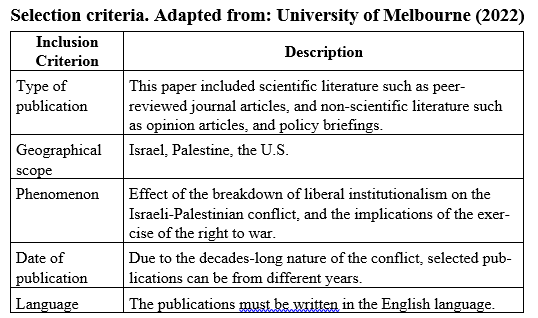
Qualitative research, which involves the process of analysing or theorising non-numerical data to understand ideas, was adopted for this paper (Bhandari 2023). Following this, a systematic literature review was employed as a research strategy in this paper. A systematic literature review is a strategy for qualitatively comparing and evaluating the results of various types of studies to answer a specific research question (Grant and Booth 2009; Greenhalgh et al. 2004; Reitz 2014; Sny-der 2019). Further, a systematic review follows established procedures for methodical search, screening, review, evaluation, analysis, interpretation, summarisation, and reporting of results from several sources (Pati and Lorusso 2018). The search of the comprehensiveness of the process has been stated to offer an accurate representation of available data and is a crucial element in eliminating bias (Centre for Reviews and Dissemination 2009). Given this, this paper used an established search strategy, the SPIDER search framework, and a set of selection criteria.
The SPIDER search framework is an acronym for the five elements, namely: sample, phenomenon of interest, study design, evaluation, and research type. The view of the Israeli-Palestinian conflict through the lens of liberal institutionalism implies that this would influence all elements of the SPIDER search framework. The sample of this paper will include academic and non-academic literature focusing on the breakdown of liberal institutionalism and its impact on the Israeli-Palestinian conflict, as well as the right to war and its implications. The phenomenon of interest of this paper is the breakdown of liberal institutionalism and its effect on the Israeli-Palestinian conflict. Relevant search such as ‘liberal institutionalism and the Israeli-Pa-lestinian conflict,’ ‘the United Nations and the Israeli-Palestinian conflict,’ ‘liberal institutions and the Israeli-Palestinian conflict,’ and ‘the right to war and the Israeli-Palestinian conflict,’ reflected this. These enabled the identification and collection of relevant literature. The design of the literature included in this paper is case studies, as a specific subject – the Israeli-Palestinian conflict – was analysed. Literature identified through the search framework was then evaluated based on the inclusion criteria of the paper and its relevance to the research question. Finally, this paper includes different types of literature. Due to the historical, persistent and evolving context of this conflict, non-scientific literature, such as opinion articles, historical literature and policy briefings were included. The inclusion criteria for this paper are outlined in the table below.
Table 1
Qualitative content analysis i the data analysis approach employed in this paper. According to Gheyle and Jacobs (2017), qualitative content analysis allows a systematic examination of textual material to identify themes or patterns. This approach emphasises semantic linkages and the overall meaning underlying texts, rather than just words (Mayring 2023). Further, qualitative content analysis is rigorous in nature and enables the drawing of conclusions via deductive approaches (Gheyle and Jacobs 2017). As a result, this paper was able to detect, analyse and connect themes and patterns in the effect of the breakdown of liberal institutions on the Israeli-Palestinian conflict, as well as the rights of nations to war.
In the context of research ethics in systematic reviews, various biases, like database, researcher, availability, and citation biases, pose major ethical risks (Almeida and Goulart 2017; Suri 2020). This paper mitigates these biases by using a rigorous search strategy and meticulously reviewing search results via the application of the inclusion criteria. Also, Glass (2000) and Godin et al. (2015) recommend including governmental reports and policy documents to reduce the possibility of search and publication biases. Following this recommendation, this study includes grey literature. Furthermore, evidence is presented and discussed in a transparent manner, and measures are taken to avoid plagiarism (Suri 2020).
4. ANALYSIS
The content analysis approach outlined in Chun (2019) was adapted to present and analyse the data. The approach is exemplified by the figure below.
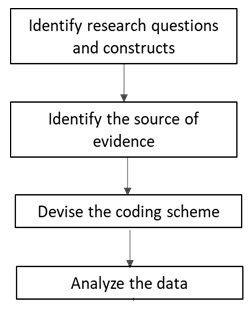
Fig. 1. Content analysis framework. Adapted from Chun (2019)
4.1. Research Question
The research question guiding this paper is ‘how has the breakdown of liberal institutionalism contributed to the persistent Israeli-Palestinian conflict, and what are the implications for the exercise of the right to war?’
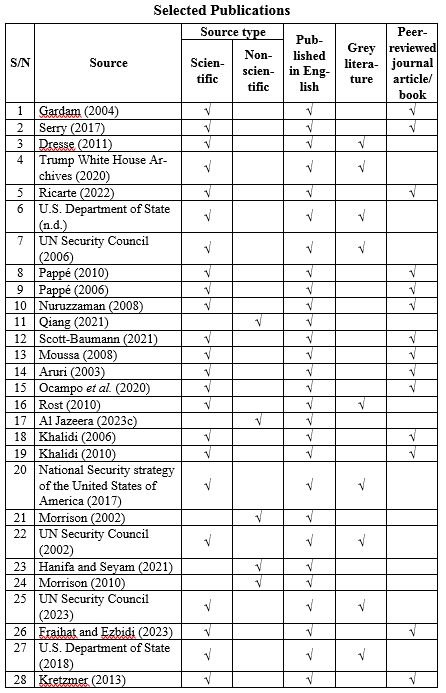
4.2. Sources of Evidence (Selected Publications)
To select publications for this paper, an extensive literature search on Google Scholar and Google was conducted, utilising the search strategy outlined in the previous section. The search initially yielded about 152 scientific and non-scientific publications. The assessment of these publications revealed that some focused on the asymmetry pervading the conflict, barriers to self-determination for the Palestinian people, history of the conflict, and political dynamics involved in the conflict. Further review of the publications, which involved application of the inclusion criteria, resulted in 28 publications aligning with the research question.
Table 2
4.3. Coding Scheme
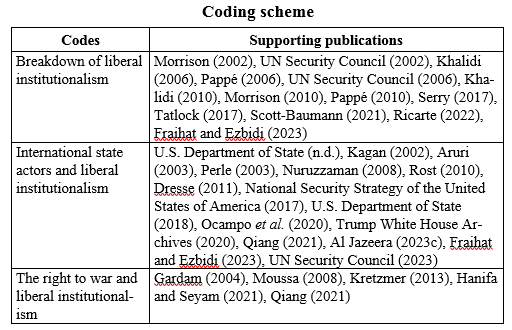
Selected publications were coded by identifying common themes and patterns of inefficacy in liberal institutions in the Israeli-Palestinian conflict. Table 3 below shows the codes that were created and their supporting publications.
Table 3
4.4. Review Analysis and Discussions
The findings and opinions in the collected literature were critically reviewed in this section. Literature gathered was systemically analysed, with a particular focus on the breakdown of liberal institutions, especially the UN. The UN was chosen deliberately due to its essential duty of preserving world peace and security, as well as safeguarding human rights.
4.4.1. Impact
of Liberal Institutionalism on the Israeli-Palestinian
Conflict
The Israeli-Palestinian conflict provides a clear example of the limitations and ineffectiveness of liberal institutionalism and institutions, especially the UN, in resolving conflicts and promoting peace among nations. To better understand why the UN has failed to fulfill its duty, several key arguments have been made. According to Ricarte (2022), the current form of the Israeli-Palestinian conflict started with the addition of the ‘Question of Palestine’ to the UN agenda after the dissolution of the League of Nations. This culminated in the UNGA's approval of Resolution 181, which called for a Jewish and Arabic state. Resolution 181 legitimised Jewish aspirations for an ethnically based state, while purposefully disregarding the realities of Palestinian national aspirations (Ricarte 2022). Additionally, numerous international initiatives that led to this resolution failed to consult with Palestinians and neglected their interests (Khalidi 2006). Scholars like Khalidi (2006) and Pappé (2006) assert that the resolution increased already existing Jewish-Arab hostilities and precipitated the nation's descent into one of the bloodiest periods in its history. This outcome demonstrates the UN's role in escalating the Israeli-Palestinian conflict, though inadvertently. In addition, the UN did not sufficiently consider the intricacies of the region when preparing resolution 181, which led to its non-acceptance by the Arabs.
It is important to note that, at that time, Palestine was not recognised as a legitimate, sovereign and cohesive nation-state fighting for self-determination, and was integrated into the larger Arabic identity, causing negotiations regarding it to be conducted via proxy (Khalidi 2006, 2010). As a result, Palestinians were deprived of their identity and uniqueness by their Arab neighbours, the global community and the peace process. Further, after the War of Independence in 1948, when Egypt controlled the Gaza Strip and Jordan the West Bank, an independent Palestinian state was not established by either nations. The lack of inclusivity and non-recognition of the identity by the UN reflected the disregard for the rights, aspirations, and democratic representation of the Palestinian people. On the other hand, at this time, Israel declared its independence and was recognized as a state by the nations involved in the Cold War (Scott-Baumann 2021). This recognition by the USSR and the USA facilitated Israel's admission to the UN as a full member, although with the UNGA condition that resolutions 181 and 194 were ratified and put into effect (Serry 2017). The asymmetrical treatment of Israel and Palestine by the UN persists and remains relevant in the present time, contributing to the persistence of the conflict. Subsequent wars were partly due to the struggle for an independent Palestinian state with the right to self-determination. Moreover, subsequent peace processes and UN diplomatic missions, from resolution 242 in 1967 to the Trump Administration's ‘Deal of the Century’ in 2020 consistently marginalised or sidelined the Palestinian people and their interests (Serry 2017). These processes primarily framed negotiations in state-to-state relations further diminishing the importance of Palestinian rights and aspirations.
Furthermore, the Arab rejection of the partition plan was used to justify the systematic eviction of the indigenous population from areas designated for a Jewish state under the plan, sparking a refugee crisis (Pappé 2010). Despite the adoption of Resolution 194 by the UNGA in 1948, which stated that refugees willing to return to their homes and live in harmony with their neighbours should be allowed to do as soon as possible, Palestinian refugees were permitted to return. This spurred the creation of the United Nations Relief and Works Agency (UNRWA) to relieve and assist the Palestinian refugees (Fraihat and Ezbidi 2023; Serry 2017). Israel's rejection of this resolution went unsanctioned primarily due to the non-binding nature of UNGA resolutions. This prompts the question: why should the UNGA convene and deliberate on a resolution if Member states were not obligated to implement it? This question prompts a critical analysis of the necessity and efficacy of the UN's structure within the global context. Furthermore, the UN assumed the responsibility of tackling the refugee crisis showing that when member states fail to implement resolutions, the UN will step in to fill the gap. Knowledge that the UN is willing to address gaps in these types of situations can further diminish the motivation of member states to implement resolutions.
Tatlock (2017) highlights the view of the UN's inefficacious structure by pointing out that responsibility for maintaining peace ultimately rests with the parties involved in the conflict, not the UN. While the UN can adopt resolutions or apply penalties with the goal of promoting peace and stability, these measures are ineffective if individual states do not support them. A glaring example is Israel's persistent re-fusal to implement UN Security Council resolutions, despite agreeing to do so under Article 25 of the Charter. From 1968 to 2002, Israel contravened 32 UN Security Council resolutions (Morrison 2010), attracting attention to the absence of repercussions for non-compli-ance. It is important to note that these UN Security Council resolutions were Chapter VI resolutions which do not specify military or economic sanctions for non-compliance. For this reason, Israel representatives, when called upon to defend its noncompliance, assert that Chapter VI resolutions are non-binding recommendations only executable through arbitration, or conciliation between disputing entities (Morrison 2002; UN Security Council 2002). However, these resolutions only require Israel to act in negation of the latter statement. Regarding the former assertion, it finds no support in the UN Charter, as clarified by the International Court of Justice in an Advisory Opinion in 1971, affirming the binding nature of Chapter VI resolutions on all UN members in accordance with Article 25 of the Charter (Morrison 2010).
Further discrediting Israel's stance on Chapter VI resolutions was its own justification for the military assault on Lebanon in 2006. Israel claimed that the assault was because of Lebanon's failure to implement the unconditional obligations set out in UN Security Council Resolution 1559 and 1680, which were both Chapter VI resolutions (UN Security Council 2006). This demonstrates the contradictions in Israel's approach, which expects other nations to fulfil obligations under Chapter VI resolutions but ignores similar obligations relating to its own actions. Moreover, even if Israel were right in its assertion, due to the absence of military and economic sanctions under Chapter VI resolutions, the Security Council consistently refrained from implementing Chapter VII resolutions, which contain economic and military sanctions against Israel despite its repeated violations of various resolutions (Morrison 2010). This disparity in treatment raises concerns about favouritism in the international context. Also, it highlights the restrictions and weaknesses in the UN's enforcement protocols, casting doubts on the organisation's capacity to guarantee adherence to its resolutions. The evident incapacity of the UN to get its members to comply with resolutions, poses questions about its capacity to resolve the Israeli-Palestinian conflict, or more broadly, guarantee world peace.
4.4.2. International State Actors and the Breakdown of Liberal Institutionalism
Among the numerous international state actors involved in the Israel-Palestine peace process, the U.S. is the most influential and involved party. It is impossible to examine the Israeli-Palestinian conflict without acknowledging the critical role that the U.S. plays as one of Israel's main allies within the UN. But first, the effect of the ‘war on terror’ approach on the Israeli-Palestinian conflict will be analysed.
The ‘war on terror’ approach, which relied exclusively on military force and taken by then-U.S. president, George W. Bush, after the September 11, 2001, attacks, as well as the advancement of global freedom and democracy, fostered a climate of global conflict and insecurity (Nuruzzaman 2008). The military invasion of Afghanistan and Iraq that ensued because of this approach, resulted in prolonged conflict and extensive instability in the affected regions with ripple effects felt by neighbouring nations. Further, the U.S. employed a unilateral approach to the invasion of Iraq, bypassing the UN Security Council, even though it is a permanent member (Nuruzzaman 2008). This deviation from multilateralism was justified by asserting that the UN was sluggish to respond and unable to handle problems that threatened peace; and resolutions that questioned the U.S.'s authority and limited its ability to act globally should not be complied with (Kagan 2002; Perle 2003). This approach significantly weakened the efficacy and credibility of international institutions, most notably the UN. Thus, the U.S. succeeded in undermining the UN's role in maintaining international peace, altering the landscape of global governance.
The Bush administration's war on terror stance and subsequent disregard for liberal institutions set the precedent for Israel's approach to Hamas and its interaction with liberal institutions. Rost (2010) notes that Israel, at that time, adopted policies that aligned with the U.S. war on terrorism with Prime Minister Ariel Sharon equating Palestinians aggression against Israelis to the suffering Al Qaeda* caused the U.S., as well as comparing Yasser Arafat to Osama Bin Laden although this was not appreciated by the Bush administration. Nonetheless, Israel's security approach to Hamas and subsequently Palestine, mirrored the Bush administration's strategy of solely utilising military force after the declaration of Hamas as a terrorist organisation (Qiang 2021). This military-centric approach prolonged the cycles of violence in the Israeli-Palestinian region, violated international law, affected civilian populations, and raised humanitarian concerns.
Further, Israel has continuously rejected and disregarded multiple UN Security Council and ICJ rulings, challenging the foundations of international law. For instance, the ICJ's Advisory Opinion declared that the ‘security fence’ in the West Bank and the associated Israeli ruling in the region violated international law and mandated that the barrier should be demolished (Dresse 2011). However, Israel rejected the ruling arguing that the barrier was a ‘security fence’ meant to protect Israelis from Palestinians' terrorist acts. Israel also claimed that the ICJ ignored Israel's right to self-defense, criticised the fairness of the process of requesting for the Advisory Opinion, and stated that the ICJ based its assessment on inaccurate information (Ibid.). This trend of rejecting international rulings and law and justifying acts on the pretext of self-defense is similar to the tactics used by the Bush administration.
Showing further disregard for the UN sub-organisations involved in the Israeli-Palestinian conflict, the U.S. withdrew from the United Nations Educational, Scientific and Cultural Organization (UNESCO) and ceased its support to UNRWA under the Trump Administration. The US withdrawal from UNESCO stemmed from the organisation's rejection of Israeli claims regarding Jews' ties to Jerusalem's holy sites, negating any Palestinian ties (Ocampo et al. 2020). As for the UNRWA, its financial support was ceased due to adoption of the Israeli argument that UNRWA's existence impeded the resolution of conflict by preventing refugees from assimilating into their host nations (U.S. Department of State 2018). These actions aligned with the National Security Strategy of the United States of America (2017), which prioritised putting effort in organisations that cater to American interests, thereby amplifying American power and hegemony globally, and further belittling the roles that liberal institutions play in global politics.
These are blatant examples of the US bias in favour of Israel, a bias that has remained largely consistent across administrations. This trend spans from the Truman and Eisenhower administrations, which strongly opposed the return of Palestinian refugees to their homes, to the recognition of Jerusalem as Israel's permanent capital by the Trump administration (Fraihat and Ezbidi 2023). Moreover, the U.S. leverages its diplomatic hegemony over the peace process to maintain its position as the only broker of power in the Middle East, further Israel's interests, shield Israel from international criticism for the abuse of Palestinian human rights and protect Israel from inquiries into possible transgressions of international law (Aruri 2003; Fraihat and Ezbidi 2023). Hence, the U.S. unwavering support of Israel has not only impeded the success of various peace processes proposed by other UN member states or the UN itself, but has also prevented Israel from being held accountable for its inhumane actions and international law violations. As a result, the UN's authority to maintain global peace has been eroded, diminishing its commitment to treating all states equally on the international scene. This highlights the inability of the UN to promote a just and equitable global order and implies hegemonic inclination of the U.S. foreign policy.
The breakdown of liberal institutionalism, and U.S. bias towards Israel is further evidence by the Trump administration's ‘Peace to Prosperity’ plan also known as the ‘Deal of the Century’ (DoC). The DoC further fragmented Palestinian territories, denied refugees their right to return, constrained the freedom of people and commodities to enter Palestinian territories, and granted Israel absolute authority over Jerusalem, among other conditions (Trump White House Archives 2020). In pace with past actions, Palestinians were once again disregarded and ‘moderate’ Arab states like the United Arab Emirates were encouraged to normalize relations with Israel under the Abraham Accords (Fraihat and Ezbidi 2023; U.S. Department of State, n.d.). This resulted in the suppression of Arab support for Palestinians which further exacerbated already existing power asymmetries between Israel and Palestine. Further, Fraihat and Ezbidi (2023) opined that the DoC significantly impaired the chances of resolving the Israeli-Palestinian conflict since succeeding U.S. administrations will face difficulties in undoing the new reality it created. This is evident in the Biden administration's wavering strategies to the resolution of the conflict, and the lack of consensus on the dominant paradigm to resolve this conflict among analysts or involved parties. Once again, the UN failed to rein in U.S. excesses regarding the Israeli-Palestinian conflict. Considering this recurring failure to restrain the U.S., the UN's mission and efficacy need to be critically examined. The seemingly unrestrained power of the U.S., which is probably a result of its permanent seat on the UN Security Council and the special status accorded to its five permanent members, raises concerns about the organisation's capacity to act independently and impartially for the sake of global peace and justice.
Moreover, the veto power held by the five permanent members of the UN Security Council, including the U.S., China, Russia, France, and the UK, is perceived to be a hindrance to the resolution of this conflict. Each country's representative has used its veto power to hinder the manifestation of a peace resolution for various reasons. Recent evidence of veto impediment is the vetoing of the US resolution by China and Russia, and a Brazil drafted resolution by the U.S. following the October 2023 Israel-Palestine war (Al Jazeera 2023c). The veto power, originally intended to avert rash decisions and promote consensus, has become a tool for these countries to promote their own agenda and thwart resolutions that would have been critical of their allies. For instance, data from the UN Security Council (2023) shows that the U.S. has vetoed a minimum of 53 resolutions critical of Israel and its actions since 1972. This highlights a structural weakness in the UN's ability to handle conflicts objectively and highlights the difficulties in reaching significant resolutions when these permanent members put their own priorities ahead of global justice and peace.
4.4.3. The Right to War and Liberal Institutions
Under International Humanitarian Law (IHL), two functions exist which guide states before and after a war – jus ad bellum and jus in bello (Hanifa and Seyam 2021). Jus ad bellum describes the application of justice to war, and the justification of war, whether for self-defense or to protect human rights. Jus in bello describes justice in wartime which regulates and tempers the conduct of war (Hanifa and Seyam 2021; Moussa 2008). In the Israeli-Palestinian conflict, both sides have invoked the right to self-defense in accordance with jus ad bellum (Hanifa and Seyam 2021). However, the claims of jus ad bellum violate jus in bello on both sides of the conflict (Qiang 2021). Israel's harsh counter-terrorism measures which involve inhumane treatment, incommunicado detentions, and higher civilian casualties, violate jus in bello. Nonetheless, Moussa (2008) asserts that these can be permitted by invoking the self-defense principle against immediate and serious threats of terrorism. Likewise, Hamas claims the protection of Palestinians rights under jus ad bellum but contradicts jus in bello by using suicide bombers among civilians and aiming rockets at civilian regions.
Further, the concept of proportionality under jus ad bellum introduces ambiguity to IHL. Although there is a wide consensus that the use of force in war ought to be proportionate, there are wide disparities in the understanding of what proportionality entails. Some scholars opine that proportionality means reactions ought to be commensurate to threats; some argue that it involves what is necessary to accomplish a state's goal; others assert that it gauges harm inflicted on both sides (Gardam 2004). This lack of clarity creates worries about the possibility of biased and easily manipulated evaluations of proportionality (Kretzmer 2013). Additionally, it blurs the boundaries of what constitutes legal behaviour under IHL, creating uncertainty about whether the use of force was appropriate and justified, as well as what behaviours liberal institutions ought to penalise.
Moreover, many grey areas exist in the application of Chapter VII of the UN Charter (Hanifa and Seyam 2021). The Chapter refers to ‘actions with respect to threats to the peace, breaches of the peace, and acts of aggression’. This begs the question of what constitutes aggression under jus ad bellum since it is not defined. Aggression could mean the use of military force by both sides, or it could imply the denial of Palestine's rights and the blockade of Gaza. According to Qiang (2021), the obscurity of the term ‘aggression’ under jus ad bellum compounds the existing unequal political power that various nations wield. Furthermore, the permanent five members of the UN Security Council are exempted from Chapter VII by virtue of the veto power which the U.S. uses to shield Israel. As a result, Israel can justify its conflict with Hamas by accusing them of aggression while theirs remains unchecked.
Despite persistent violations of jus ad bellum and jus in bello on both sides, the UN has failed to enforce compliance with IHL, highlighting the inadequacy and limitations of liberal institutions in resolving the Israeli-Palestinian conflict. The existence of the IHL, in theory, regulates armed conflict, but lacks the authority to ensure compliance and accountability especially with the involvement of powerful nations.
5. CONCLUSION
Through the examination of scientific and non-scientific publications, it was discovered that liberal institutionalism, represented by the UN, has failed to resolve the Israeli-Palestinian conflict, and thus failed in its duty to preserve world peace. The research showed that the UN in adopting resolution 181, recognising Israel as a state while simultaneously ignoring the Palestinian identity as well as their statehood, fueled the already existing Arab-Israeli tensions, and contributed to it becoming the modern day Israeli-Palestinian war. Additionally, the involvement of nations in the Cold War on behalf of Israel facilitated their admission into the UN.
Further, the U.S., one of the five permanent members of the UN Security Council, has significantly influenced this conflict. First, the Bush administration's war on terror strategy provided Israel with justification for its actions against Hamas. Secondly, the U.S. has used its position at the Security Council and its veto power to shield Israel from probes about humanitarian concerns and defend Israel's right to self-defense. Finally, subsequent U.S. administrations have also furthered Israel's interests while excluding Palestinians and their rights. An example of this is the Trump administration's DoC.
Moreover, pertaining to the right to war, it was discovered that both Israel and Hamas have invoked jus ad bellum in times of conflict although they often violate jus in bello. The ambiguity surrounding various terms under jus ad bellum like proportionality and aggression, impede the ability of the UN and its affiliated liberal institutions to prosecute violators of IHL and defend peace in the world. Thus, the UN's inability to resolve the Israeli-Palestinian conflict is attributed to the lack of objectivity and favouritism displayed by some members of the Security Council and the loopholes provided by the ambiguousness of IHL terms.
6. RECOMMENDATIONS
The inability of the UN to resolve the persistent Israeli-Palestinian conflict underscores the flaws and the imbalance of power within the organisation. To improve their capacity to resolve this conflict and future ones, this author recommends that the UN must clarify and provide universally accepted definitions of terms like aggression within the IHL. To ensure a more comprehensive method of assessing conflicts, this definition ought to cover a wide variety of actions like the use of military or non-military methods. In addition, the UN should promote changes that advance a more balanced distribution of power and strengthen the Security Council's capacity to resolve disputes without excessive influence from individual nations. Also, resolutions provided by the UNGA should have mechanisms that make them enforceable and binding. Furthermore, methods of strengthening IHL enforcement should be implemented which lessens the need for individual nations to hold one another accountable. Finally, the UN should explore other methods of dispute resolution that consider the complexities, intricacies, and dynamics of this conflict.
REFERENCES
Adel, I. 2023. Do
Palestinians have the Right to Resist, and What are the Limits? Short article. Law for Palestine,
October 8. URL: https://law4palestine.
org/do-palestinians-have-the-right-to-resist-and-what-are-the-limits-short-ar
ticle/.
Al Jazeera. 2017. Hamas Accepts Palestinian State with 1967 Borders. Al Jazeera, May 2. URL: https://www.aljazeera.com/news/2017/5/2/hamas-accepts-palestinian-state-with-1967-borders.
Al Jazeera. 2023a. What's the Israel-Palestine Conflict about? A Simple Guide. Al Jazeera, October 9. URL: https://www.aljazeera.com/amp/news/ 2023/10/9/whats-the-israel-palestine-conflict-about-a-simple-guide.
Al Jazeera. 2023b. What is Hamas? A Simple Guide to the Armed Palestinian group. Al Jazeera, October 8. URL: https://www.aljazeera.com/news/2023/
10/8/what-is-the-group-hamas-a-simple-guide-tothe-palestinian-group.
Al Jazeera. 2023c. Two More Resolutions to Halt Israel-Gaza War Gail at the UN Security Council. Al Jazeera, October 26. URL: https://www.aljazeera. com/amp/news/2023/10/26/two-more-resolutions-to-end-gaza-violence-fail- at-un-security-council
Alfonseca, K. 2023. Timeline: A Look into the Long History of the Israeli-Palestinian Conflict. ABC News, October 14. URL: https://abcnews.go.com/ amp/International/timeline-long-history-israeli-palestinian-conflict/story?id= 10387513
Al-Maswari, M. 2023. Hamas is a Liberation Group, not a Terrorist Organization – Erdogan. Albawaba. URL: https://www.albawaba.com/news/hamas- liberation-group-not-terrorist-organization-%E2%80%93-erdogan-1539139.
Almeida, C. P., and Goulart, B. N. 2017. How to Avoid Bias in Systematic Reviews of Observational Studies. Revista CEFAC 19 (4): 551–555. URL: https://doi.org/10.1590/1982-021620171941117.
Amnesty International. 2022a. Israel/OPT: Continuing Patterns of Unlawful Killings and Other Crimes Further Entrench Apartheid. Amnesty International, May 11. URL: https://www.amnesty.org/en/documents/mde15/5589/ 2022/en/?utm_source=annual_report&utm_medium=epub&utm_campaign= 2021.
Amnesty International. 2022b. Israel and Occupied Palestinian Territories 2022. URL: https://www.amnesty.org/en/location/middle-east-and-north-af-rica/israel-and-occupied-palestinian-te... lestinian-territories/#endnote-2.
Amnesty International. 2022c. Israel's Apartheid against
Palestinians: Cruel System of Domination and Crimes against Humanity. URL: https://www.
amnesty.org/en/wp-content/uploads/2022/02/MDE1551412022ENGLISH.
pdf.
Aruri, N. H. 2003. Dishonest Broker: The US Role in Israel and Palestine. South End Press.
Baker, A. 2021. The Legal War: Hamas' War Crimes and Israel's Right
to Self-Defense. Jerusalem Center for
Public Affairs, June 3. URL: https://
jcpa.org/article/the-legal-war-hamas-war-crimes-and-israels-right-to-self-de
fense/.
Bar-Siman-Tov, Y. 2014. Justice and Peace in the Israeli-Palestinian Conflict. Routledge.
BBC. 2008. A History of Conflict,
Israel and the Palestinians: Introduction. URL:
http://news.bbc.co.uk/2/shared/spl/hi/middle_east/03/v3_ip_timeline/
html/.
BBC. 2017. 1967 War: Six Days that Changed the Middle East. URL: https:// www.bbc.com/news/world-middle-east-39960461.
BBC. 2019. What was the Cold War? URL: https://www.bbc.co.uk/newsround/ 47122488.
BBC. 2023. Israel's Borders Explained in Maps. URL:
https://www.bbc.com/
news/world-middle-east-54116567.
Bhandari, P. 2023. What is Qualitative Research? Methods & Examples. Scribbr, June 22. URL: https://www.scribbr.com/methodology/qualita tive-research/.
Bickerton, I. J., and Klausner, C. L. 2001. A Concise History of the Arab-Israeli Conflict. 4th ed. Routledge.
Borshchevskaya, A. 2016. The Maturing of Israeli-Russian Relations.
The Washington Institute for Near East
Policy, April 15. URL: https://www.
washingtoninstitute.org/policy-analysis/maturing-israeli-russian-relations.
Bose, T. C. 1972. The Superpowers and the Middle East. Asia Publishing House.
Britannica. 2023. Cold War. URL: https://www.britannica.com/event/Cold-War. Accessed October 24, 2023.
Brown, P. M. 1948. The Recognition of Israel. American Journal of International Law 42 (3): 620–627. URL: https://doi.org/10.2307/2193961.
Bshara, K. (2025). Settler Colonialism Rebranded: Trump's Gaza Plan and the Capitalist Logic of War. Journal of Palestine Studies 54 (1): 62–70.
CBS News. 2012. UN General Assembly Votes to Recognize Palestinian State. CBS News, November 30. URL: https://www.cbsnews.com/news/un-general-assembly-votes-to-recognize-palestinian-state/.
CPA – Center for Preventive Action. 2023. Israeli-Palestinian Conflict. CFR, October 16. URL: https://www.cfr.org/global-conflict-tracker/conflict/israeli- palestinian-conflict.
Centre for Reviews and Dissemination. 2009. Systematic Reviews: CRD's Guidance for Undertaking Reviews in Health Care. University of York.
Chun, R. 2019. How Virtuous Global Firms Say They Are: A Content Analysis of Ethical Values. Journal of Business Ethics 155 (2): 57–73. URL: https://doi.org/10.1007/s10551-017-3525-3.
Congressional Research Service. 2023. U.S. Foreign Aid to Israel. URL: https://sgp.fas.org/crs/mideast/RL33222.pdf. Accessed October 25, 2023.
Cox, C. 2023. Treasury Department Weighs Methods to Cut off Hamas' Funding. CNBC, October 25. URL: https://www.cnbc.com/2023/10/25/israel- hamas-war-updates-and-latest-news-on-gaza-conflict.html.
Devitt, R. 2011. Liberal Institutionalism: An Alternative IR Theory or Just Maintaining the Status Quo? E-International Relations, September 1. URL: https://www.e-ir.info/2011/09/01/liberal-institutionalism-an-alternative- ir-theory-or-just-maintaining-the-status-quo/#_ftn1.
Dresse, A. 2011. International Law in International Relations: Understanding the Israeli Government's Legal Justification of the West Bank Barrier. Unpublished Master's thesis. Tilburg University.
Foreign, Commonwealth and Development Office, and Woodward, B. 2023. The UK Supports Israel's Right to Self-Defence in Line with the UN Charter: UK Statement at the UN Security Council [Speech transcript]. Gov.UK. URL: https://www.gov.uk/government/speeches/the-uk-supports-israels-right- to-self-defence-in-line-with-the-un-charter-uk-statement-at-the-un-security- council.
Fraihat, I., and Ezbidi, B. 2023. The Lasting Impact of Trump's ‘Deal of the Century’ on the Question of Palestine. Middle East Critique 4 (4): 1–21. URL: http://dx.doi.org/10.1080/19436149.2023.2261082.
Gaddis, J. L. 2005. The Cold War: A New History. Penguin Press. URL: https:// archive.org/details/coldwarnewhistor00gadd.
Gardam, J. 2004. Necessity, Proportionality and the Use of Force by States. Cambridge University Press.
Gasser, H.-P. 1995. The Geneva Conventions and the Autonomous Territories in the Middle East. Security Dialogue 26 (2): 173–180. URL: https://www. jstor.org/stable/26296471.
Gathara, P. 2021. The Fallacy of the Colonial ‘Right to Self-Defence’. Al Jazeera, May 16. URL: https://www.aljazeera.com/amp/opinions/2021/5/16/ the-fallacy-of-the-colonial-right-to-defence.
Gheyle, N., and Jacobs, T. 2017. Content Analysis: A Short Overview. Centre for EU Studies Working Paper.
URL: https://doi.org/10.13140/RG.2.2.
33689.31841.
Glass, G. V. 2000. Meta-Analysis at 25: A Personal History. URL: https://gv-glass-archives.blogspot.com/2022/10/meta-analysis-at-25-personal-history.
html.
Glusman, G. M. 2018. How the Cold War Ignited the Modern Israel-Palestine Conflict. Medium, March 4. URL: https://medium.com/thepensivepost/how-the-cold-war-ignited-the-modern-israel-palestine-conflict-9a49....
Godin, K., Stapleton, J., Kirkpatrick, S. I., Hanning, R. M., and Leatherdale, S. T. 2015. Applying Systematic Review Search Methods to the Grey Literature: A Case Study Examining Guidelines for School-Based Breakfast Programs in Canada. Systematic Reviews 4 (1): 138. URL: https://doi.org/ 10.1186/s13643-015-0125.
Golan, G. 1990. Soviet Policies in the Middle East: From World War Two to Gorbachev. Cambridge University Press.
Goodman, S., Tiripelli, G., and Kambashi, N. 2025. Uses and Abuses of ‘not Wanting Peace’ in the Context of the Israel/Palestine Conflict. Journal of Community & Applied Social Psychology 35 (1): e70016.
Grant, M. J., and Booth, A. 2009. A Typology of Reviews: An Analysis of 14 Review Types and Associated Methodologies. Health Information & Libraries Journal 26 (2): 91–108. URL: https://doi.org/10.1111/j.1471-1842. 2009.00848.x
Greenhalgh, T., Robert, G., Macfarlane, F., Bate, P., and Kyriakidou, O. 2004. Diffusion of Innovations in Service Organizations: Systematic Review and Recommendations. The Milbank Quarterly 82 (4): 581–629. URL: https://doi.org/10.1111/j.0887-378X.2004.00325.x.
Hahn, P. L. 2004. Caught in the Middle East: U.S. Policy toward the Arab-Israeli Conflict, 1945–1961. University of North Carolina Press.
Hanifa, N. A., and Seyam, B. 2021. Opinion – Collapse of International Humanitarian Law in
Israel-Palestine Conflict. URL: https://www.aa.com.tr/
en/analysis/opinion-collapse-of-international-humanitarian-law-in-israel-pa
lestine-conflict/2220937#.
Haruki, W. 2018. The Korean War: An International History. Rowman & Littlefield Publishers.
Hassan, Z., and Munayyer, Y. 2021. Approaching Peace: Centering Rights in Israeli-Palestinian Conflict Resolution. Carnegie Endowment for International Peace.
Human Rights Watch. 2023. Israel/Palestine: Devastating Civilian Toll as Parties Flout Legal Obligations. URL: https://www.hrw.org/news/2023/ 10/09/israel/palestine-devastating-civilian-toll-parties-flout-legal-obligations.
ICG – International Crisis Group. 2023. A Second October War in Israel-Palestine. URL: https://icg-prod.s3.amazonaws.com/s3fs-public/2023-10/
q%26a-israel-palestine-09x23.pdf.
ICJ – International Court of Justice. 1986. Reports of Judgments, Advisory Opinions and Orders: Case Concerning Military and Paramilitary Activities in and against Nicaragua (Nicaragua v. United States of America). URL: https://www.icj-cij.org/public/files/case-related/70/070-19860627-JUD- 01-00-EN.pdf.
Johnson, A. R. 2020. The Warsaw Pact Reconsidered: International Relations in Eastern Europe, 1955–1969. Journal of Cold War Studies 22 (1): 249–252. URL: https://doi.org/10.1162/jcws_r_00935.
Johnson, T., and Heiss, A. 2018. Liberal Institutionalism. In Weiss, T. G., and Wilkinson, R. (eds.), International Organization and Global Governance (pp. 123–134). 2nd ed. Routledge.
Jones, M. G., and Murray, S. 2023. Israel has Right to Self-Defence, but Some Actions ‘Counter International Law’ – Borrell. Euronews, October 10. URL: https://www.euronews.com/my-europe/2023/10/10/israel-has-right- to-self-defence-but-some-actions-counter-international-law-borrell.
Jupille, J., and Caporaso, J. A. 1999. Institutionalism and the European Union: Beyond International Relations and Comparative Politics. Annual Review of Political Science 2: 429–444. URL: https://doi.org/10.1146/annurev.po-lisci.2.1.429.
Kant, I. 2010. Perpetual Peace: A Philosophical Sketch. Slought Foundation, Philadelphia and the Syracuse University Humanities Center (Original work published in 1975).
Karsh, E. 2013. The Soviet Union and Syria (RLE Syria). Routledge. https://doi.org/10.4324/9781315818986. (Original work published 1988).
Keohane, R. O. and Nye, J. S. 2012. Power and Interdependence (4th ed.). Longman.
Khalidi, R. 2006. The Iron Cage: The Story of the Palestinian Struggle for Statehood. Oneworld.
Khalidi, R. 2009. Sowing Crisis: The Cold War and American Dominance in the Middle East. Beacon Press.
Khalidi, R. 2010. Palestinian Identity: The Construction of Modern National Consciousness. Columbia University Press.
Klinghoffer, A. J. 2021. Israel and the Soviet Union: Alienation or Reconciliation. Routledge. URL: https://doi.org/10.4324/9780429037610 (Original work published 1985).
Kretzmer, D. 2013. The Inherent Right to Self-Defence and Proportionality in jus ad bellum. The European Journal of International Law 24 (1): 235–282. URL: https://doi.org/10.1093/ejil/chs087.
Lamt, S. 2005. Contemporary Mainstream Approaches: Neo-Realism and Neo-Liberalism. In Baylis, J., and Smith, S. (eds.), The Globalization of World Politics: An Introduction to International Relations. 3rd ed. Oxford University Press.
Laron, G. 2010. Playing with Fire: The Soviet–Syrian–Israeli Triangle,
1965–1967. Cold War History 10 (2):
163–184. https://doi.org/10.1080/146827
40902871869.
Mansfield, E. D., and Pevehouse, J. C. 2008. Democratization and the Varieties of International Organizations. The Journal of Conflict Resolution, 52 (2): 269–294. https://doi.org/10.1177/0022002707313691.
Mayring, P. A. E. 2023. Qualitative Content
Analysis. In Tierney, R. J., Riz-
vi,
F., and Ercikan, K. (eds.), International Encyclopedia of Education (pp.
314–322). 4th ed. Elsevier Science.
McGreal, C. 2023. What are the Roots of the Israel-Palestine Conflict? The
Guardian, October 13. URL: https://amp.theguardian.com/world/2023/
oct/13/why-israel-palestine-conflict-history.
Mearsheimer, J. J. 1994. The False Promise of International Institutions. International Security 19 (3): 5–49. https://doi.org/10.2307/2539078.
Middle East Eye. 2017. The 43 Times US has Used Veto Power against UN Resolutions on Israel. URL: https://www.middleeasteye.net/news/43-times- us-has-used-veto-power-against-un-resolutions-israel.
Morrison, D. 2002. Correspondence with the Israeli Embassy in
UN Security Council Resolutions Being Violated by Israel. URL: http://david-morri
son.org.uk/palestine/israeli-embassy-corr.htm
Morrison, D. 2010. UN Security Council Resolutions Contravened by
Israel. Sadaka: The Ireland Palestine alliance. URL: http://www.david-morrison.
org.uk/sadaka/briefings/BRIEFING-UN_Security_Council_resolutions_con
travened_by_Israel.pdf.
Mousavi, S. A. M., and Sani, S. M. S. Z. 2025. Forced Displacement of Palestinians from Gaza in the October 7 War: a Case of Crime against Humanity. Journal of International Peacekeeping 27 (4): 420–444.
Moussa, J. 2008. Can jus ad
bellum Override jus in bello?
Reaffirming the Separation of the Two Bodies of Law. International Review of the Red Cross 90 (872): 963–990. URL: https://www.icrc.org/en/doc/assets/files/
other/irrc-872-moussa.pdf.
National Security Strategy of the United States of America. 2017. URL: https://trumpwhitehouse.archives.gov/wp-content/uploads/2017/12/NSS-Fi nal-12-18-2017-0905.pdf.
Nichols, M. 2023. Israel's Military Tells UN in Gaza: Ask Hamas for Fuel. Reuters, October 24. URL: https://www.reuters.com/world/middle-east/un- says-no-aid-trucks-enter-gaza-tuesday-2023-10-24/.
Nuruzzaman, M. 2008. Liberal Institutionalism and International Cooperation after 11 September 2001. International Studies 45 (3): 193–213. URL: https://doi.org/10.1177/002088170904500302.
Ocampo, J. E., Melgarejo, A. M., and Zapata, E. N. 2020. Supporting Israel by Withholding Support to International Organizations: UNRWA and UNESCO in Trump's foreign policy. Revista de Estudios Internacionales Mediterráneos 28: 25–42. URL: https://doi.org/10.15366/reim2020.28.00.2
OHCHR – Office of the High Commissioner for Human Rights. 2023. Israel/Occupied Palestinian Territory: UN Experts Deplore Attacks on Civilians, Call for Truce and Urge International Community to Address Root Cause of Violence. Press release. URL: https://www.ohchr.org/en/press-releases/2023/10/israeloccupied-palestinian-territory-un-experts-depl... tacks-civilians.
Pappé, I. 2006. The Ethnic Cleansing of Palestine. One World.
Pappé, I. 2010. A history of Modern Palestine. Cambridge University Press.
Pati, D., and Lorusso, L. N. 2018. How to Write a Systematic
Review of the Literature. HERD 11 (1):
15–30. URL: https://doi.org/10.1177/193758671
7747384.
Peace Now. 2023. Population. URL: https://peacenow.org.il/en/settlements-watch/settlements-data/population. Accessed October 27, 2023.
Perle, R. 2003. Thank God for the death of the UN. The Guardian, March 21. URL: https://www.theguardian.com/politics/2003/mar/21/foreignpolicy. iraq1.
Petti, M. 2021. Does America Need to be Involved in the Israeli-Palestinian Conflict? Reason, May 5. URL: https://reason.com/2021/05/19/does-ame-rica-need-to-be-involved-in-the-israeli-palestinian-conflict/.
Pevehouse, J., and Russett, B. 2006. Democratic International Governmental Organizations Promote Peace. International Organization 60 (4): 969–1000. URL: https://doi.org/10.1017/S0020818306060322.
Pillai, G. 2023. Biden Says Israel has Right to Defend Itself, Must Operate by Laws of War. BNN, October 22. URL: https://bnn.network/politics/biden-says-israel-has-right-to-defend-itself-must-operate-by-laws-of-wa....
Plesch, D. and Weiss, T. G. (eds.). 2015. Wartime Origins and the Future of the United
Nations. Routledge. URL: https://api.pageplace.de/preview/DT0400.
9781134668731_A23780981/preview-9781134668731_A23780981.pdf.
Qiang, A. 2021. The Self-Defense Principle Re-examined: The Israel-Palestine Conflict in International Law. Columbia Undergraduate Law Review. URL: https://www.culawreview.org/journal/the-self-defense-prin-ciple-re-examined-the-israel-palestine-con....
Rasgon, A., and Halbfinger, D. M. 2021. Seeking Restart with
Biden, Palestinians Eye End to Prisoner Payments. The New York Times, April 7. URL:
https://www.nytimes.com/2020/11/19/world/middleeast/biden-pales
tinian-prisoner-payments.html.
Reitz, J. M. 2014. Systematic Review. In Online Dictionary for Library and Information Science. URL: https://odlis.abc-clio.com/odlis_s.html. Acces-sed October 28, 2023.
Ricarte, J. 2022. The Impact of Protracted Peace Processes on Identities in Conflict: The Case of Israel and Palestine. Palgrave Macmillan.
Roosevelt, F. D. 1941. Annual
Message to Congress on the State of the Union. The American Presidency
Project. January 6. URL: https://www.presi
dency.ucsb.edu/documents/annual-message-congress-the-state-the-union.
Rost, M. L. C. 2010. In Peaces: The Bush Administration and the Israel-Palestine Conflict, 2001–2006. Master's thesis, Utrecht University. Utrecht University Student Thesis Repository. URL: https://studenttheses.uu.nl/ bitstream/handle/20.500.12932/4754/Rost%20Maurits%200329975%20Ma sters%20Thesis%20American%20Studies%20In%20Peaces.pdf?sequence=1.
Rusanti, E., Isman, A. F., Nashrullah, N., Mansyur, A., and Elzaanin, A. A. 2025. Israel-Palestine Conflict: Tracking Global Economic Responses and Fears. Shirkah: Journal of Economics and Business 10 (1): 1–19.
Saunders, H. 2011. Regulating Soviet-U.S. Competition in the Arab-Israeli Arena. In George, A. L., Farley, P. J., and Dallin, A. (eds.), U.S.-Soviet Security Cooperation: Achievements, Failures, Lessons. Oxford University Press (Original work published 1988).
Scott-Baumann, M. 2021. The Shortest History of Israel and Palestine: From Zionism to Intifadas and the Struggle for Peace. Old Street Publishing.
Serry, R. 2017. The Endless Quest for Israeli-Palestinian Peace: A Reflection from No Man's Land. Palgrave Macmillan.
Slater, J. 2021. Mythologies without End: The US, Israel, and the Arab-Israeli Conflict, 1917–2020. Oxford University Press.
Snyder, H. 2019. Literature Review as a Research Methodology: An Overview and Guidelines. Journal of Business Research 104: 333–339. https:// doi.org/10.1016/j.jbusres.2019.07.039.
Suri, H. 2020. Ethical Considerations of Conducting Systematic
Reviews in Educational Research. In Zawacki-Richter, O., Kerres, M., Bedenlier,
S.,
Bond, M., and Buntins, K. (eds.), Systematic
Reviews in Educational Research: Methodology, Perspectives and Application (pp.
41–54). Springer VS Wiesbaden.
Tatlock, J. R. 2017. The Israeli-Palestinian Peace Process, the United Nations, and Non-governmental Organisations. In Penaskovic R., and Ṣahin, M. (eds.), Peacebuilding in a Fractious World: On Hoping against all Hope (pp. 105–121). Pickwick Publications.
Tress, U. 2023. UN Human Rights Official Says Israel ‘can't Claim’ Self-Defense after Deadly Terror. The Times of Israel, April 9. URL: https:// www.timesofisrael.com/un-human-rights-official-says-israel-cant-claim-self- defense-after-deadly-terror/.
Trump White House Archives. 2020. Peace to Prosperity: A Vision
to Improve the Lives of the Palestinian and Israeli People. URL:
https://trump
whitehouse.archives.gov/wp-content/uploads/2020/01/Peace-to-Prosperity-0120.pdf.
United Nations General Assembly. 1982. United Nations General Assembly Resolution 37/43. Importance of the Universal Realization of the Right of Peoples to Self-Determination and of the Speedy Granting of Independence to Colonial Countries and Peoples for the Effective Guarantee and Observance of Human Rights. URL: https://digitallibrary.un.org/record/ 40572?ln=en.
United Nations News. 2004. International Court of Justice Finds Israeli Barrier in Palestinian Territory is Illegal. URL: https://news.un.org/en/story/ 2004/07/108912#:~:text=9%20July%202004%20The%20International%20 Court%20of%20Justice,Israel%20should%20make%20reparations%20for% 20any%20damage%20caused.
United Nations Security Council. 2002. 4625th Meeting: The Situation between Iraq and Kuwait. URL: http://david-morrison.org.uk/scps/200210 17.pdf.
United Nations Security Council. 2004. Resolution 1566. URL: https://digi-tallibrary.un.org/record/532676?ln=en.
United Nations Security Council. 2006. 5511th Meeting: The Situation in the Middle East. URL: http://david-morrison.org.uk/scps/20060811.pdf.
United Nations Security Council. 2023. Veto List. URL:
https://www.un.org/
depts/dhl/resguide/scact_veto_table_en.htm.
United States Department of State. 2018. On U.S. Assistance to UNRWA [Press statement]. URL: https://2017-2021.state.gov/on-u-s-assistance-to-unrwa/.
United States Department of State. N.d. The Abraham Accords. URL: https:// www.state.gov/the-abraham-accords/.
University of Melbourne. 2022. Systematic Reviews. URL: https://uni-melb. libguides.com/sysrev/inclusion-exclusion-criteria#:~:text=Search-,Systema tic%20Reviews,-An%20introduction%20. Accessed October 1, 2022.
Wright, E. (ed.). 2015. East-West Relations. In A Dictionary of World History. 2nd ed. URL: https://www.oxfordreference.com/display/10.1093/oi/autho-rity.20110803095739845. Accessed October 24, 2023.
Yee, V., Stevis-Gridneff, M., and Hijazy, M. 2023. Humanitarian Aid Continues to Amass at Egypt's Border as Crisis in Gaza Worsens. The New York Times, October 18. URL: https://www.nytimes.com/2023/10/18/world/ middleeast/gaza-aid-rafah-border-crossing.html.
Yousef, M. 2022. The Right to Self-Defence: Between Ukraine and Palestine. Middle East Monitor, March 2. URL: https://www.middleeastmonitor.com/ 20220302-the-right-to-self-defence-between-ukraine-and-palestine/.