The Cybernetic Revolution

Journal: Social Evolution & History. Volume 25, Number 1 / March 2026
DOI: https://doi.org/10.30884/seh/2026.01.09
Antony Harper Benedictine University, Lisle, USA
Review of Cybernetic Revolution and Global Aging. Humankind on the Way to Cybernetic Society, or the Next Hundred Years by Leonid Grinin, Anton Grinin, and Andrey Korotayev. Springer, 2024. ISBN 978-3-031-56766-7.
INTRODUCTION
The world-system is currently in a period of transition, one which may well not be smooth, as economic, political, and social reorganization will be required; never an easy plough-through. Also, accompanying this transition are the effects of climate change, the potential for pandemics, and ecological challenges, the mix of which will produce a less-than-palatable cocktail for the world-system to swallow; more rough plough-through. Against this backdrop Leonid Grinin, Anton Grinin, and Andrey Korotayev have produced a work of research forecasting the future trends of what they label as the Cybernetic Revolution, a revolution leading to the formation of a cybernetic society. The future for these authors is the next one hundred years, and the interplay of the components, MANBRICS or technologies associated with medicine, additive enhancements, the nano-scale of things, biologics, robotics, information, and cognition, is treated with the scholarly insight that these scholars have come to be known for.
PART I. TECHNOLOGICAL TRANSFORMATIONS IN THE PAST, PRESENT AND FUTURE
Ch. 1. Introduction: Between Human and Post-human Revolutions, or What Future Awaits Us?
We are currently living in period of transition, a period of revolutionary change, the Cybernetic Revolution, and like the two previous revolutions, the Agrarian Revolution and the Industrial Revolution, involve transitions into a future that will have profound effects on our species and how we address the question: What does it mean to be human? To symbolize this transition, a change into the (somewhat) unknown, the graph of hyperbolic growth due to Korotayev et al. (2006) is displayed below.
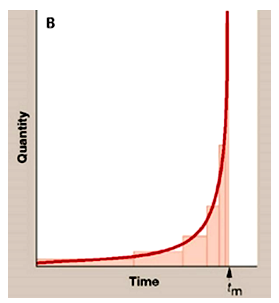
Fig. 1
The graph in Figure 1 represents the basic form of hyperbolic growth and in particular the reader should note the effectively vertical shape of the graph at the right side, a shape that Russian scholars have labeled most appropriately as the ‘blow up phase.’ Please note that this form of growth reaches an infinite rate in a finite amount of time, and this form is exhibited for a variety of historic processes including but not limited to world population growth and the growth of the world GDP, both presented below and on the following page.
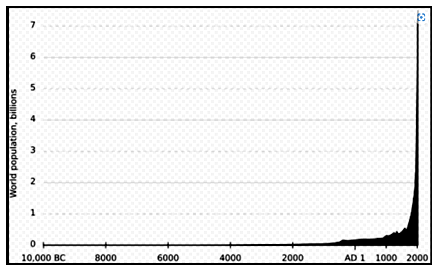
Fig. 2
This graph represents world population growth over the last 12,000 years and clearly exhibits a ‘blow up phase’ on the right side.
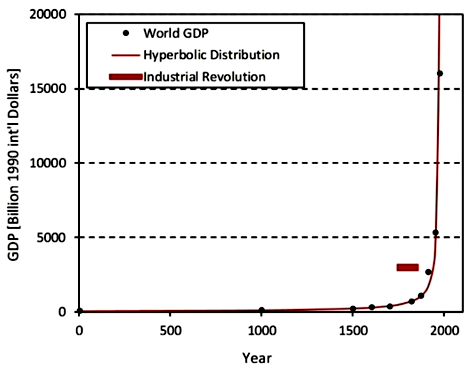
Fig. 3
Our position at the end of the first quarter of the twenty-first century is essentially at the top of the population and world GDP graphs. Yes, the top representing an abstraction, a singularity, is being replaced by a rate of population growth that, while positive, is declining and has done so since the 1960s. The GDP graph will follow suit, and both graphs will, from a macrosocial perspective, level off. Even so, the world-system is perched at the top this graph at a point in time at which our future is unknown and possibly precarious; these graphs then are symbols of this precariousness.
This is also the section of time, say from the 1930s onward through the end of this century, in which the Cybernetic Revolution is occurring. Interestingly, this current revolution will be driven by the reciprocal interaction between our currently aging world-system society and technological research, research specifically directed toward extending life and improving life for that extended period of time, the effects of which will change our biological nature, bring about significant social change, and will also influence our fundamental rights and freedoms. A cybernetic society (or cybernetic societies) being what Grinin et al. call the estate will be the ultimate result of this current transition.
As mentioned previously, reciprocal relationship will develop between the aging portion of the world-system population and technologies associated with extending and improving life. This will require significant paradigm-shifting biomedical research, but there technologies will be involved and will evolve to have spheres of interest of their own. The authors have created and acronym, MANBRIC, that represents this suite of technologies and stands for: Medical, Additive, Nano, Biological, Robotic, Information, and Cognitive technologies. Over the course of the Cybernetic Revolution, begun in the first half of the last century but accelerating in the 1950s and ending some time in the 2090s or the first part of the twenty-second century, individual systems will self-organize and in turn will be included in organizations of self-organized system or what the authors define as a process of self-management, producing self-managed systems. It should be obvious that this hierarchy of self-organized and self-managed systems will also represent a level of organization which is beyond human control and will make decisions for humanity with human input; this consequence is both intriguing and frightening.
There are several other consequences of the Cybernetic Revolution, some of which in passing are listed below:
1. The notion of singularity. This is an abstract notion, which mathematically is ‘real’ but not in an every-day sense. As singularities are approached, e.g. the demographic singularity of von Forester et al. (1960) or more lucidly presented by Korotayev et al. (2006), there is, certainly in the demographic case just mentioned, a change in the pattern of the growth process which removes any chance of a blow up phase occurring. Conceptually, the notion of singularity has worth.
2. The Ax Maker's Gifts, a la James Burke (1999), of discoveries, i.e. both the positive and negative aspects of discovery. The notion of creative destruction comes to mind here.
3. The conflicting foci of discovery, e.g. the enhanced quality and duration of life will place enormous stress on non-renewable resources.
4. The consequences of items #2 and #3 regarding the generation of conflict. These conflicts, certainly at the world-system level of organization, may take years or even decades to resolve.
5. Emergent events. Complex adaptive systems (CAS), of which the world-system is an example, exhibit emergent phenomena, events that are unpredictable and may have historically contingent, system-wide consequences, e.g. the Tylenol scare of a number decades ago and the more recent Baby Formula shortage are two such emergent events. Their occurrence is assured in such systems but is specifically unpredictable.
What follow for the rest of this book condensation is a more detailed description of the research and remarkable insight of the three authors concerning the trends of the Cybernetic Revolution and its impact on the next one hundred years. But, please, understand that the authors treat the history of the development of the Cybernetic Revolution as well as its progress into our near future, and the panoramic view presented ids both broad in perspective but detailed in focus.
Ch. 2. Global Technological Transformations since the Stone Age: Theory and History
The historical process of the development of world-system technology to this point in time is treated in this chapter. The discussion of both Production Principles and Production Revolutions constitutes the core of Chapter 2, and a theoretical framework of both these concepts is provided followed by a discussion of the ‘factual description of the technological history’ of humanity. [It should be noted here that considerable attention is given to this chapter, as the author considers the topics of this chapter to be of fundamental importance to the rest of the book.]
The specific production principles recognized by Grinin et al. and their chronologies are as follows:
1. The Hunter-Gatherer Production Principle. 50,000 YBP – 12,000 YBP.
2. The Agrarian Production Principle. 12,000 YBP – 1430 CE.
3. The Industrial Revolution Production Principle. 1430 CE – 1950 CE.
4. The Scientific-/cybernetic Production Principle. 1950 CE ~ 2070 CE,
and the production revolutions are:
1. The Agrarian Revolution.
2. The Industrial Revolution.
3. The Cybernetic Revolution.
[Note that the term, production, is effectively synonymous with technological.]
In general, revolutions are defined as ‘radical breakthroughs’ in world-system productive forces. It is also important to understand that revolutions are more general processes affecting the economy (and many other factors of society), while individual technological breakthroughs are just that, individual and restricted breakthroughs, e.g. the innovative use of the steam engine to drain British coal mines is a specific instance of a technological breakthrough, while the application of steam power to manufacturing and transportation is revolutionary. Further, the authors delineate revolutions into three phases: An initial innovative phase, an intermediate modernization phase, and a final phase of innovation. The transition period follows ushering in the next revolution. Initial phases are characterized by the emergence of a new revolutionary sector, while modernization involves development and diffusion of the revolutionary technology and the final phase is marked by improved opportunities for the new production principle. It is further explained that with respect to the Agrarian Revolution a new, more complex social division of labor ensued. Social adaptations also evolved during the Industrial Revolution, and there are social adaptations that are currently evolving during this phase of the Cybernetic Revolution, the intermediate phase.
Production principles may also be divided into phases; broadly speaking of a revolutionary phase followed by a phase which maximizes ‘structural, systemic, and spatial potentials.’ However, these broad phases are further parsed into six (sub-)phases: transitional, adolescent, florescent, mature, high maturity, and preparatory; this final phase being preparatory for the transition into the next production revolution. It is interesting to note that every principle has the same six phases, with the duration of each phase being approximately the same.
With this schema of phases for both production principles and production revolutions in place, an historical process with appropriate chronology that is here initiated approximately 50,000 YA can be established. However, this date is not consonant with the origin of Homo sapiens in the fossil record, i.e. 200,000 YA to 300,000 YA. This particular timing has been chosen by the authors because of the research of Klein (?) and others, as this time represents the appearance of relatively modern H. sapiens. It is suggested that characteristics such as speech and the production of art fluoresce at this time. This timing is also chosen as a time at which social forces came into play as a driver of the formation of human communities; only after this threshold time of approximately 50,000 YA did the influence of social forces become dominant in shaping human communities. What follows are specific descriptions of these four production principles.
The Hunter-Gatherer Production Principle (HGPP) is the least well understood of the four production principles being addressed here. As a result, this principle will be associated with ‘landmarks of human adaptation to and acquisition of nature.’ Further, the HGPP phases will be associated with major environmental changes and also with an absolute chronology. These phases and their chronologies are given in the following Table 1.
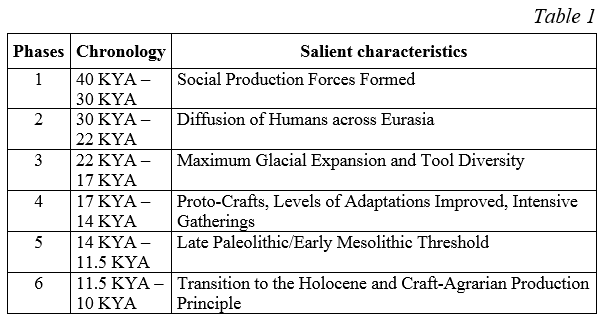
With regard to the above organization, it can be seen that improved human adaptation in the form of both technology and social organization were the dominant trends of this production principle. Further, the influences of climate played an over-riding role in the changes presented in Table 1. All of these changes of course led to the Agrarian Revolution and the production principle that revolution introduced.
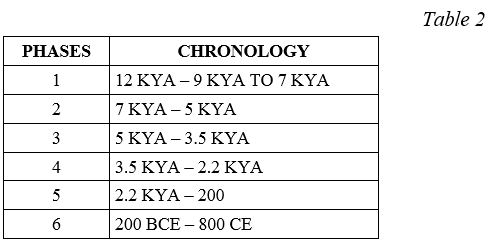
The first phase of the Craft-Agrarian Production Principle (CAPP) was the actual Agrarian Revolution and lasted from 12 KYA to 9 KYA, although some scholars would extend this period of time (see Graber and Wengrow 2021) and there is, of course, evidence of horticultural activity well before this time. This was a time of sedentism, domestication of animals and plants for farming, and the beginning of urbanization. Population growth, global population growth, also occurred at this time; implying that the application of craft and agrarian technology elevated the carrying capacity for human populations.
The second phase of the AGPP extended form 9 KYA to 7 KYA, and it is at this time that early state formation occurred, as did copper metallurgy and the further development of urbanization. The third phase, 7 KYA – 5 KYA, exhibited further development in animal husbandry, including but not limited to the domestication of the horse which enhanced transportation, trade, human migration, and military activity. The first states and empires formed at this time, and urbanization expanded to new areas.
Phases four, five and six of the AGPP constitute both intensification of the trends of the first three phases, considerable improvement in urbanization, and inventive, i.e. paradigm shifting, technology. New civilizations formed at this time and older ones collapsed. During the fifth phase new (types of) civilizations formed, maximum urban areas reached and exceeded one million in population, and some ancient civilization either met their demise or collapsed. Phase six production increased in both the Arab-Islamic world as it did in China (and in India (?)) and economic and urban growth developed in Europe; from the twelfth century onward the rate of development in Europe increased so that Europe caught up with China, India, and the reset of the world; preparation of the world-system for the Industrial Revolution was initiated. A chronology of these phases of the CAPP is given in Table 2.
Although many scholars designate the time of the Industrial Revolution (IR) from 1750 CE to 1950 CE, it is more reasonable to expand this time so that the first phase of the IR occurred from 1430 CE to 1600 CE. This period represents a time of innovation and also of the (increased) accumulation of surplus. Improved navigation, engineering, and mechanization also characterize this phase. Phase Two extends from 1600 CE to 1730 CE, and during this time the complex industrial sector developed. Phase Three and the diffusion of that production, 1730 CE – 1830 CE, included the development of steam power and the significant mechanization of manufacturing. The end of this phase marks the beginning of the Great Divergence (see Grinin and Korotayev 2015). The fourth phase, 1830–1890 CE, included both the ‘victory of production’ and the diffusion of that production. During the Fifth Phase from 1890 CE to 1929 CE chemical industries advanced; note here that the Haber-Bosch nitrogen fixation process emerged, as did the emergence of electric welding, the telephone, functional commercial and domestic electricity, and the radio a la Marconi. The final IRPP, 1929 CE – 1955 CE, yielded a number of important innovations, e.g. the television, and the standardization of production units.
The current production principle, in fact its revolution, the Scientific-Cybernetic Revolution (SCR), is ongoing. The first phase of the SCR was a time in which information technology evolved. The second phase involved the development of user-friendly computers, commercial technologies, cell phones etc. This phase exhibited a slow-down of the rate of technological development, and this slow-down will continue until the mid-2030s. At this point, the third phase will begin and be characterized by the development of self-regulating/self-managing systems (SSSs). This will be a period in which there will be a reduction in the significance and involvement of human administration. The fourth phase will be one of maturity and expansion; SSSs will expand and improve and MANBRIC technologies will become dominant, while manual and unskilled labor will become superfluous. The fifth phase will represent the dominance of SSSs and MANBRIC technologies; this will occur in the 2070s and 2080s, and the Sixth Phase to follow will be a time when the Cybernetic Society will fully develop.
Ch. 3. Cybernetic Revolution and Self-managing Systems
With the understanding that the term, cybernetic, implies the ‘receiving, storing, and processing of information in complex systems,’ it then follows that such a domain of human knowledge is well adapted for the study of and application to the process of self-regulation. It must be emphasized here that this Cybernetic Revolution is a revolution that is focused on the regulation of production. A further distinction must be made at this point between self-regulating and self-managing systems. Self-regulating systems regulate complex processes focused on a particular function, while self-managing systems can manage and regulate themselves.
Self-regulating systems imply autonomy in the sense of performing specified functions, i.e. performing in a ‘stand-alone mode.’ However, this fully functional mode has yet to be achieved. Car navigation is an example of an incipient self-regulating system, one which can make decisions; fully formed, self-regulating systems will make fully acceptable and unconditional decisions. As a result, decision making in the MANBRIC's domain will occur with less and less human intervention, ultimately leading to decision making without any human intervention. It is also important to understand that AI, today's most popular cybernetic acronym for the general public, is included within the notion of SSS, and SSSs will be able to reconfigure their functionality due to flexible programming and do so under changing conditions.
The authors then produce a classification of SSSs that includes a variety of characteristics encompassing but not limited to systems that are clearly self-regulating, are automatic, and are adapted to specific situations. The following trends represent some of the directions associated with the Cybernetic Revolution. In general, systems will be able to handle increased volumes of information, they will be designed to make use of AI, they will be resource and energy efficient, and there will be trends in which there will be syntheses of information and processes from different domains. Some of these trends will result in CR technologies in which universalization will play a major role; here consider the ability to interchange parts and processes from different systems. With all these changes and trends associated with the Cybernetic Revolution, it should be noted that information is the fundamental fuel on which these systems depend. Along with universalization, will be the phenomena of personalization, miniaturization, and communication with the external environment; all of which will lead to multifunctional, self-managing systems.
Ch. 4. Cybernetic Revolution and MANBRIC Technologies. When, How and Where Will the Forthcoming Breakthrough Start?
The main directions of the final phase of the Cybernetic Revolution are the focus of this chapter; these directions are encapsulated in the specific technologies of the acronym, MANBRIC, and the consolidation and convergence of these technologies will occur during the period from (approximately) 2030 to 2070. These seven technological fields do and will continue to reinforce each other. This consolidation and convergence will change almost every aspect of human existence, and these changes are embedded within the process of Kondratieff Long Cycles. Specifically, the sixth Long Cycle will begin in the 2020s and will be the period of time of the actual origin of the Cybernetic Revolution. [Note: The early phase of a long cycle will be a time of creation of new technological paradigms.]
The development of these new technological paradigms will proceed through the following steps:
1. Existing technologies will find new opportunities for application.
2. Previously minor technologies will come to the fore.
3. As a consequence of the first two events, breakthrough systems will emerge.
It should be kept in mind that the specific ‘clusters of technologies to emerge’ cannot be specifically identified, and further it should be understood that these innovative technologies will have an immense effect on innovation in social life; in general, these technologies affecting social life will be the MANBRIC's technologies. At this point, the authors present graphical evidence of essentially parallel growth trends in these technologies, which is suggestive of their potential convergence in the near future. This convergence will form ‘an advanced system of self-regulating production.’
A comparison of the change in the number of patents in two sets of technologies, those prominent in 1985 through the present and the development of MANBRIC's over this same period of time reveals a reversal of fortunes in which the MANBRIC's technologies continue to increase in patent number, while the technologies of past prominence unquestionably decrease in patent number through 2005, then exhibit an upward trend for approximately a decade, but from 2015 through 2020 show another clear decrease. Trends in the individual seven technologies are then described, but it is suggested that these trends will not necessarily be synchronous and will originate on small scales, i.e. in restricted areas of their future domains and ps. A pattern is then proposed for the evolution of the Cybernetic Revolution, and this pattern then lays the basis for future predictions of the state and direction of the CR. Specifically, the authors spend time delineating each phase, Initial, Modernization, and Final Phases and the characteristics and peculiar aspects of each phase.
Having gone into considerable detail for each phase, a specific technology, Medical Technology, is identified as the potential breakthrough technology to begin the CR. The criteria for predicting the breakthrough technological industry, including but not limited to the commodity being a primary necessity, being aligned with mainstream trends, will have high profits, will have the potential for integration with other trends, and will have a high potential for further growth. As was mentioned previously, medical technology will meet the previous criteria most efficiently and for the following reasons: Medicine stimulates constant activity in new technologies, technologies which can be combined into a single field, which has few structural obstacles, and in which profits will be high and will affect GDP positively. The fact that this phase will begin shortly is due to the impetus of an aging population and will be accompanied by reduced poverty and increased literacy. As the Industrial Revolution began in the (relatively) narrow field of the cotton industry, so will the breakthrough in medicine be characterized in some as-yet-to-be-identified sub-field.
PART II. DEMOGRAPHIC TRANSFORMATIONS AND GLOBAL AGING
This section emphasizes several key points with respect to the relationship between demographic transformations and global aging. There are several key points, one of which is that currently the low and declining global population growth rate is the result of both low birth and death rates. This condition will have a propound effect on the Cybernetic Revolution, and therefore the history of this demographic transition and those of the other two revolutions, the Agrarian and Industrial Revolutions, will be treated in some depth
Ch. 5. Demographic Transformations in the Historical Process
The relationship between the rates of the three technological revolutions and the major demographic transformations is the focus of this chapter. More specifically, each production principle and its further development lead to the replacement of the endemic type of population reproduction (TRP), and this combination of a replaced (new) TRP and the new production principle will ‘qualitatively’ affect social structure and social relations; the diffusion of innovations accompanied by changes in communication and intersocial relations will greatly accelerate the evolution of technology.
The term, demographic transition, will be used to refer to a decrease in mortality followed by a decrease in fertility and with this understanding, attention will now be turned to specific historical instances of these transitions, first the Hunter-Gatherer-Agrarian Transition, followed by the Agrarian-Industrial Revolution Transition, and then the final transition, superficially different from the previous two transitions, and currently occurring; this last transition will end in the next few decades. If the Largest Demographic Transition (LDT) is (?) associated with a given technological revolution, then LDTs are a final characteristic of a given type of TPR and in turn is associated with a particular production principle. [Note that TPRs are stable foci of population reproduction as a consequence of technological and socio-cultural levels of societal development.]
The authors distinguish six LDTs within the historical process. It is interesting that the fifth of these LDTs, the one now occurring, is associated with the process of aging. In order to understand these LDTs more clearly the constraints imposed on population growth must be considered and these constraints vary form production principle to production principle. Also, although each production principle amounted to an escape from the constraints of previous production principles, Malthusian limits, in the form of available land, wars, reduced GDP and the like, continued to raise their ugly heads. With respect to each production principle, the authors also discuss salient TPRs, e.g. with respect to H-Gs, the birth rate was low, while the death rate varied from low to medium; the Craft-Agrarian Production Principle was characterized by both high birth and death rates, the Trade-Industrial Production Principle had low mortality and initially high but decreasing rates of fertility, while the current Cybernetic Production Principle has low rates of both mortality and fertility; this condition or state will end the current demographic transition. Please be aware that while there is a clear relationship between production principles and LDTs, the H-G Production Principle effectively has none, while the remaining three production principles each have two LDTs and each is associated with specific phases of a given production principle. As a final note, it should be remembered that the transition to the Industrial Revolution and further transitions are associated with what Andrey Korotayev defines as hyperbolic population growth, only now slowing down to adapt to the development of the Cybernetic Revolution and its attendant production principle.
Ch. 6. Global Aging and Other Demographic Trends within Cybernetic Production Principle
While the previous chapter laid the foundation for understanding the effects of global aging within the context of past (and present) demographic transitions. This current chapter investigates the global demographic trend of aging with the cybernetic production principle, i.e. how aging will influence the development and evolution of cybernetic technology en masse. A discussion of long term demographic trends is presented followed by a focus on Africa and its unique position globally with respect to ongoing demographic transformations. Then attention is turned to aging and world-system depopulation. The relationship between demographic trends and the phases of the Mature Phase of the Cybernetic Production Principle is given significant attention. This then leads to a description and analysis of aging as it influences the future biomedical technological environment and thee most recent Largest Demographic Transformation (LDT). A final topic of changes in life expectancy within the context of an aging-motivated evolving technology is treated.
The authors support a strong correlation between technological revolutions and the LDT occurring during the evolution of a given revolution for all such revolutions, i.e. Agrarian, Industrial, and Cybernetic Revolutions. In fact, the current technological revolution was recognizable in the initial and modernization phases, as it was related to improvements in quality of life. These trends will ultimately lead to significant technological breakthroughs for even further improvement in the quality of life. However, it is recognized that there are limits to such improvements. Even so, the primary trend in improved health-related quality of life will characterize the next one hundred years. All of this will lead to a significant global-scale aging of the world-system even though currently less attention is paid to this phenomenon than one would expect.
While the overall world-system trend will result in depopulation globally, Africa and to some extent some of the countries of Asia, e.g. Yemen, will experience rapid population growth. Of the eight identified countries experiencing rapid population growth, four of them are in Africa. This rapid population growth with an attendant youth bulge may well lead to upheaval and violence over the next several decades. By contradistinction, the world-system in general will be most strongly influenced by demographic aging and, accompanying this aging process, a decline in total population which may/will have enormous social consequences, many or all of them being negative in effect. Embedded in all of these are the phenomena of a stabilized population, considerable further adaptation at large scale to the aging process, and potential changes in the reproductive process itself. In turn, these trends will influence economic distribution, the leveraging of taxes, and material consumption.
Adaptation to an increasingly aging world-system population will involve the largest demographic transition to ‘techno-medico-biological in nature’. Such technologies as care technology and reproductive technology will gain in prominence, and these gains will result in improved but fluctuating life expectancy at the global level. Note here that there will be positive feedback between the quality of life, increased life expectancy, and improved TMB. Such feedback could well result in life expectancy, defined here as the average time to death, exceeding ninety years of age!
Ch. 7. Global Aging, Adaptation to It and Future Demographic Transformations
While there are any number of young, developing nations, there are also a large number of (relatively) developed and also ageing states; Japan is most certainly the poster-child for this last clas, sbut the countries of western Europe, North America, and Pacific states are not far behind. Currently there are 22 countries in which the over-65 crowd amount to at least 20 % of the population, and by 2050 this segment of the population will be the largest proportion of the adult population. Potentially, an increasing ageing population will impede innovation, impede production, reduce over-all population mobility, reduce working hours, reduce the available labor force, and raise the retirement age. This chapter discusses these and other negative aspects of aging populations but also provides a variety of future scenarios, many of which offer at least partial solutions to the problems of societal and global aging.
Global, regional, and local aging will also result in an increase in life expectancy. In turn, these expectations will create incentives to improve medical, biological, and other forms of technology to supplement and then become the over-riding force in supporting an aging population; of no little importance in this process will be the input from self-regulating/self-managing systems. Further, these systems will be broad-ranging and effect potential solutions for such age-related problems as the pension crisis, especially if there is a collapse or partial collapse of the securities markets.
It should be noted, however, that a reduced fraction of younger age groups and in particular a consequent reduction in birth rate can mean that more investment in rearing offspring per child will occur. This will unfortunately be accompanied by alienation between age classes and a changed direction with regard to economic investment. Using South Korea as a model, it should be noted that a youth bulge occurring between 1950 and 1990 was followed by a much larger elderly bulge from 2010 on through the present. If this general pattern is used as a model for world-system growth, the impact of aging demographics will be enormous. This means that rising medical costs can be expected; a motivation for innovation in the medical and related technologies. Currently, there are few institutions adapted to dealing with these problems of aging. This will have to change.
In particular, specific contemporary institutions will have to be enhanced to deal with aging problems. Here it should be noted that retirement communities are an example of such an institution and by far more preferable than nursing homes. Sadly, this will also lead to demographic separation, and some isolation will occur. On a darker note, euthanasia as a phenomenon of aging must be recognized. Both illness and poverty will be prime factors in causing this suicidal behavior. It is interesting that while the incidence of capital punishment is decreasing, certainly in developed countries, euthanasia is on the increase, and, further, the choice of employing euthanasia may be taken out of the hands of the aging in into the hands of their offspring and others. There is much thought yet to be done on this very sensitive issue.
Focus must be directed to preserving the savings and property of older age classes. There are also many hurdles to be overcome in making the world-system in general more ageing-friendly. Issues such as the degree of effort to devote in the treatment of the elderly during a pandemic and in general in developing appropriate technologies for the elderly are required. In a zero-sum economic context, how will the elderly fare? Currently, much of developing technology is focused on the youth; technology adapted for an older demographic will be necessary.
At this point, it will be worthwhile to make some forecasts regarding aging in the future, certainly if by 2090 9 % of the global population will equal or exceed 90 years of age. In the face of such trends, ageism is most certainly a concern. Stereotyping of older people and due to the magnitude of the problem will not be eliminated but can be managed; an ambiguous area in which the complexity of the problem magnifies the difficulties of its resolution. As an added complication, the voting power of the elderly will increase making the potential for a gerontocracy possible: this must be avoided at all costs. As mentioned previously, an aging demographic will also affect population reproduction. A (hopefully) stable medical-biotech environment will (may) lead to social-qualitative reproduction in which there will be total technological support for the reproductive process to the extent that life may become fully dependent on such technologies.
In light of this previous potential context and others, what follows is a series of forecasts regarding the potential futures that may arise.
Scenarios at the state level:
1. Generational conflict with an aging electorate not having the same focus as the more youthful one.
2. Peace and order with the elderly locking in public spending.
3. Sustainable development amounting to both societal maintenance and controlled development.
4. Homeostasis; a societal equilibrium with little prospect of change.
5. Militant ageism also with little potential for change.
6. The rise of techno-medical power in which medico-technological and corporate institutions control everything.
Scenarios at the world-system level:
1. Senility and decline of the current developed world with new players emerging.
2. Young states with dynamic development.
3. Global conservatism.
4. Activity in spite of aging in which older, more developed countries are forced to innovate.
5. Quasi-colonialism with a mix of young and mature generations in younger countries. However, with respect to #5 younger countries will age!
Given all of the above, it is quite clear that the distribution of working class populations is critical to world-system survival. Based on the previous and assuming that reasonable guidance from self-regulating/self-managing systems can occur, and then a Cybernetic Society has the potential to arise.
PART III. MANBRIC-TECHNOLOGIES IN THE FORTHCOMING EPOCH OF SELF-REGULATING SYSTEMS (2030S–2090S)
Ch. 8. Medicine and the Cybernetic Revolution: On the Way to Control Over the Human Body
The authors are great periodizers and adhere to their periodizations as both a reference pattern and a source of context; this particularly applies to the analysis presented in Chapter 8. In this chapter, medical technology is analysed both in the beginning phase of the Cybernetic Revolution and also in its Modernization phase. This analysis makes the distinction between the effects of medicine in both developing and developed countries. In particular, it is noted that infant diseases and their associated mortalities and also the diseases of old age have been reduced in both prevalence and virulence. It should also be noted that many of these improvements will be the result of innovations based on pre-existing paradigm shifts; existing technologies will be improved on. A few such areas of medical technology will include gene therapy and surgery. Medicine will also interact with other technologies including but not limited to pharmaceuticals. There are, however, problems to be addressed and overcome with respect to these ‘interactions.’
The problems that newly adapted medical technologies will have to address include emergent diseases, the pandemic spread of disease, the clutch of incurable diseases that exist currently, patient rehabilitation, of course the cost of health care in general, and the status of medicine within society. The most important of the previously listed problems is the set of incurable diseases burdening our species. Beyond these diseases is also the threat of the increasing power of the medical-technical community. The suite of medical professionals, researchers, big pharma and the like can pose serious problems every bit as much as having the power to solve wicked twenty-first century problems.
Ch. 9. Biotechnologies in Perspective: Major Breakthroughs, Development of Self-regulating Systems and Possible Social Confrontations
‘In a word, we believe that in three or four decades our life will be absolutely impossible without biotechnologies.’ This sentence comes from Chapter 9 and is the cornerstone of thought that underpins all of this chapter. It crystalizes what Grinin, Grinin, and Korotayev believe to be the importance of biotechnologies to our existence, and it is this emphasis that is expanded upon here.
Biotechnologies are understood to be the application of living systems, their (isolated) processes, and related self-regulated and self-managed systems for producing various products. This field of the Cybernetic Revolution is then divided into color-associated sections: Red for health related biotechnologies, White for those aspects of biotechnology directly associated with industrial processes, Blue for that aspect of biotechnology that is related to aquatic organisms, and Green for food and environmental applications. Biotechnology, then, will drive the bioeconomy. A significant portion of the world-system economy.
The development of biotechnology has deep historical roots extending back to the Stone Age with the application of fermentation, but the big jump in the importance of this area of technology occurred in the early twentieth century, for example, the discovery of penicillin and beyond World War II this field gained considerable momentum, but its research, development, and production is greatest now; this growth will continue to accelerate into the near future. Note that within the past fifty to sixty years steroid production, the creation of a robust pharmaceutical industry, and currently all the research and application of that research in stem cells has all come about; this emphasizing the importance of the historical near past of biotechnological evolution. If we reconsider the color-defined sections of biotechnology, then GMDs, breeding genetics, are associated with the Green division, and to mention just a few other research and production areas, biofuels, the production of pesticides such as Round-Up, and a variety of other Big Pharma innovations are all part of the current stage that biotechnology occupies.
There are, however, both interesting prospects for the biotechnologies of the future and also potential conflicts, social confrontations, with the further growth of these technologies. With respect to the latter, the production of pesticides such as the previously mentioned Round Up, while crucial to agricultural production, this pesticide also has negative environmental consequences. Round Up, like many pesticides preceding it, has been associated with the occurrence of childhood and adult cancers. Drug companies devote an enormous amount of funding to the research and development of new products. Consequently, in order to generate profits, those new drugs have to be appropriate for a large population of customers. There are two negative effects of a profit economy as applied to the drug industry. The first of these is that the efficacy of the drug produced is compromised, as the drug has to be adapted to the needs of large and therefore highly variable populations. The second problem has to do with the fact that rare debilitating and fatal diseases are not considered for research at all, as the cost/benefit ratio will not generate enough revenue to pay for the research and production of the production question; sadly human life and well-being does have a price.
With these negative aspects that are part-and-parcel of all Ax Maker's Gifts, such as the products of Big Pharma are, put aside, the future does look bright for expanded research into new areas of biotechnology. The Red biotechnologies will still drive the Cybernetic Revolution, and cell biotechnology will be at the forefront of this impetus, but there are other areas of significant promise as well. Biopatterning, the application of biosensors, and the expansion of Big Pharma along with improved environmental conditions for the planet in general due to biotechnological applications, are all potential near-future improvements. These improvements will be coupled with and embedded within self-regulating and self-managing systems associated with biotechnology and with the coalescence of the MANBRIC's technologies; all holding significant future promise for humanity.
Ch. 10. Nanotechnologies, Robotics, Artificial Intelligence and Other MANBRIC Technologies in the Long-Term Development
There is a set of convergent technologies with significant potential for aiding medical improvement; the evolution of these technologies in the near future is treated in some detail in this chapter in order to lay the basis for understanding their medical application.
The authors forecast that the real nanotechnological breakthroughs will be in diagnosis, actual treatment of disease, and in increasing the human lifespan. An example of a nano-application in medicine is the use of nano particles with antibody recognition that will allow the attachment to specific cell which in turn will be destroyed on the release of IR radiation, a form of radiation that will be able to destroy affected, i.e. pathological, cells. There are also connections to nanotechnology at larger scales or biological levels of organization. In agriculture there are potential connections to animal husbandry and veterinary science, e.g. controlled protein synthesis, and as well immune monitoring to identify diseased and potentially infecting animals. Also, nano-powders are currently available with antibacterials that will confer resistance to among other factors adverse weather conditions. In fact, nano-technologies may well be in a position to contribute to the creation of self-regulating agricultural systems. An extension of these previous ideas will be the creation of new materials and system self-assembling and ultimately self-regulating systems. It should also be noted that miniaturization will play an important role in the Cybernetic Revolution, specifically in the form of self-assembling molecular devices that will bring about material change of matter to a prescribed form of matter, i.e. specific molecules adapted to a specific function.
Robots, self-regulating, self-managing systems, are becoming more commonplace, e.g. robotic vacuum cleaners and the like, and will continue to grow in use and their use will become daily aspects of our existence. Grinin et al provide a classification of robotic applications based on function and popularity:
Group 1: This group includes industrial and info-tech applications and also military and medical applications.
Group 2: Personal and domestic robots are included in this group as are personal service (social) and logistic robots.
Group 3: Here the environment from local to global and beyond, i.e. both inner and outer space, will be the focus.
Group 4: This last group includes nano-robots.
In turn, these various robot types will address problems in a variety of areas. These applications will occur with problems of electrical efficiency, effectors, and mechanics. As an example of a fully functional robotics, it is predicted that surgical robots, now actually in use, will only improve and may be especially important in developing countries, especially the BRICS countries. Robots will be nurses, as mentioned previously, surgeons, and at this level of service at the nano-level of function, will be able to assist in the introduction of therapeutic drugs into specific cells. Robots then will occupy positions in medicine, but also in the service industry requiring specialized skills, and will be able to fill gaps in the labor supply in general. However, it is suggested that robots be introduced slowly into the labor force; thus permitting adjustment within the human labor force being replaced.
Chapter
10 also covers such topics as self-driving cars, drones,
3-D printing, the relatively vast area of cognitive science, i.e. AI. With
regard to these last two topics, according to the authors, there will develop a
symbiosis between them. The cognitive sciences have been the motivation for the
development of AI, for the understanding of neural networks and underlying neural
physiology lays the basis for the development of AI.
Ch. 11. Anti-aging as a Key Challenge for the Medicine of the Future
The MANBRIC's technologies will be mustered collectively to address a variety of the twenty-first century problems; chief among them is the problem of anti-aging. Medicine per se will have greater reliance on technology and will reciprocally motivate innovations in those technologies. In particular, technologies will be adapted not only to addressing the problems of aging but also to slow down the vey process of aging. Current thinking suggests that the problems of aging are ‘linked to a common onset mechanism that manifests itself at the molecular level…’, i.e. that the problems of aging are a consequence of the processes of aging at the molecular level. In other words, aging itself may be considered a disease. The process of aging can then be defined or characterized as being associated with the following: chronic inflammation, increasing genomic instability, telomere attrition, mitochondrial disfunction, et al. In particular, there are a variety of aging theories such as oxidative stress and telomere unravelling as they are associated with uncontrolled cell division. Also, loss of mitochondria and their reduced function combine to create a reduced energy level of the whole organism.
To counter the effects of aging the authors suggest there will be increased efforts to extend life, to improve the quality of biological life, and to develop technologies to slow down aging and also rejuvenate the whole person. This will happen within a medical-technological environment which will evolve to reconfigure the medical profession. Pharmacological efforts in this direction will result in the production of ‘geroprotectors’, drugs that will slow down the aging process. There are a variety of such drugs now under scrutiny including but not limited to rapamycin, metformin, and the like.
Technologies will also be developed to improve ‘body potential’ such as boosting immunity; the immune system's relationship to aging seems quite strong. Hormesis, or the stimulating effects of low stress, appears to be quite promising, as does the area of stem cell research, varieties of cellular therapy, including but not limited to gene therapy, and stem cells coated with the previously mentioned genetic program of humans will be difficult if not impossible geroprotectors will be effective body potential boosters. Technologies of regeneration and cyborgization are also a consideration. The human microbiome comes in for consideration here as a factor of health which can positively affect the immune system. Further, while gene therapy holds great promise, e.g. CRISPR et al., control over the human genome will be difficult if not impossible and also quite dangerous. Even so, engineering approaches to understanding and controlling aging cells seem promising.
In order to bring about successful technologies to counteract aging serious study of both aging individuals and aging populations will be necessary. For example, longevity may well be inherited but also the subject of a supportive environment. Also, the development of individualized medicine, including preventive medicine, will be necessary. Given the current and future context of human progress, extending life and improving the quality of life will have prime importance as a vector for improving society. This integration of multiple modes of medicine will be a consequence of a self-organizing process in which medicine itself will have to evolve and adapt in an ongoing way. The authors conclude this chapter on the importance of medical trends in anti-aging by listing eleven reasons for anti-aging research being the driving force of medical evolution. These include extending life expectancy, changing attitudes toward the elderly, and the fact that medical evolution will become self-reinforcing.
PART IV. TRENDS OF CYBERNETIC REVOLUTION IN THE LIGHT OF TECHNOLOGICAL PROGRESS AND AGING
Ch. 12. Long-Term Dynamics of Technological Growth: Would it Lead Us to the Singularity?
Very clearly, the authors are masters of detail and also connections with respect to technological change over time in general and specifically the technological change that is the Cybernetic Revolution. This chapter takes a step back from the specifics of technological change and global aging to offer first to offer a broad picture of technological growth over the last 40,000 years, presents a simple mathematical model of this growth with astounding goodness of fit to empirical data. The model also predicts a singularity, appoint at which the rate of the process becomes infinite; unquestionably the singularity is an artifact of the math model, and the authors suggest that as the singularity is approached the mode of technological change will itself change. As a result the rate of technological change will shift to a finite reality. Beyond the math modeling, the authors also investigate the role of aging in affecting the technological change that in turn is at the heart of the Cybernetic Revolution.
In research spanning the last twenty-plus years, and initially following the work of von Forester et al. (1960) but with far more elegance and clarity, Korotayev et al. (2006) has shown that both the human population growth and technological growth occur at rates that are greater than exponential; they are hyperbolic in form. This is most likely due to the remarkable skills humans have for communication and cooperation, human conflict notwithstanding. In detail, a sequence of production principles is constructed and along with this the transitions between those principles is also described. Beginning with Hunter-Gatherer production principles with a date of 40,000 years ago, the authors then proceed to the Agrarian Revolution principle followed by the Industrial Revolution and its production principle and on to the current Cybernetic Revolution and its developing production principle. Embedded within a production principle is a further organization consisting of six phases applicable to the past three production phases and predictive of the current transition, the Cybernetic Revolution.
The relationship between global aging to support the general contention that over time, the last 40,000 and the pace of technological change is then considered. Here a raft of graphical and tabular data is presented that over time, i.e. over that last 40,000 years; the rate of technological change has increased. With regard to the Cybernetic Revolution itself, now approaching the third phase to a period of self-regulation ending in self-management.
Given that a number of researchers have noted that the rate of technological change has begun to slow down, although this rate of slowing will itself not be constant and in fact may exhibit spurts; these period of increased rates of change will be due to the effects and influences of aging on medicine and the technologies of MANBRIC's in general. Counterintuitively then the aging segment of the global population (≥ 60 years of age) will be a motivation for increasing technological change. Even so, there is also a potential downside to the effects of the aging segment of the global population; that of tension between this aging segment of the global population and the under-forty-crowd, both in terms of needs and cultural focus.
Returning to the mathematics of this chapter, the authors show that the duration of production principles, when represented by a succeeding set of ratios point to a stable pattern of phase lengths, the implication of which is that the sequential set of phases has recurrent features, that technological change increases as a consequence of production revolutions, and that as a result tentative but reasonable forecasts can be made.
This chapter closes with a treatment of the existence of a/the singularity and does so by noting emphatically that the mode of change will slow down and that there will in reality be no actual singularity. Given this as a theoretical construct also supported by empirical evidence, it suggests that the rate of evolution of the Cybernetic Revolution is hyperbolic in form. In fact, it is pointed out that while technological growth may occur at some value, the acceleration of that rate will be the square of that value. As stated previously however, the rates of change cannot increase infinitely, and changes in the technological rate of change will have to reduce. This deceleration will probably not occur until the late 21st or early 22nd centuries. Finally, it is suggested that this decelerating rate of change will be pronounced.
Ch. 13. Will Global Aging Change the Pace of Technological Progress and Create a New Consumption Model?
A growing and aging world-system population will reach stability in size somewhere between nine and ten billion late this century; this will result in the creation of dual influences affecting the world-system, influences that have both negative and positive consequences. On the negative side of the population ledger is the growing conservatism of a significant segment of this population. This in turn will have an inhibiting effect on technological development, while at the same time the increased fraction of aging and senescent individuals will spur technological development; this, in response to the need for an improved quality of life and also an extension of that life. This life extension, as previously mentioned, could easily extend average life expectancy well into the 80's and possibly the lower 90's in some regions of the world. ‘Healthy aging’, the authors' term, will become a prime motivation for improved technology, which of course in turn will result in a reciprocal relationship of further healthy aging leading to further technological improvement.
The notion of age-mediated conservatism comes in for serious scrutiny here. Conservatism is usually thought of as having an impeding effect on progress; risk aversion makes acceptance of new developments, let alone paradigm shifting ones, more difficult to tolerate and adapt to. The memory of the young is clearly more agile than that of the aging segment of our population and therefore more easily adapts to change. However, older individuals, i.e. adults, can in fact have a better grasp of complex situations than less seasoned minds. Even so, labor force mobility is reduced with age, and hours per day working lessens with age, both reducing economic growth; Japan currently reflects these trends more than any other country globally. Consumption per se also decreases.
Given the previous, it would seem that an aging world-system population would be/might be a harbinger of the death of economic improvement. Not so, suggests Grinin, Grinin, and Korotayev. Around the 2030s technological breakthroughs due to the positive feedback between technological development and the aging segment of the global population will bring about paradigm shifts in world-system functioning. This will occur due to the following factors: explosive growth of the aging segment of the population, an increased need for labor, and an increased capacity for work I the elderly, and a large number of well-educated people within the aging segment of the global population.
Ch. 14. The Cybernetic Revolution, COVID-19 and the E-state
This is the penultimate chapter in this book, the final chapter being a review of the previous fourteen, and treats the effects of the Covid-19 pandemic on the Cybernetic Revolution. It was proposed previously (?) that medicine, as focused on enhancing the quality of life of the over-sixty portion of the world-system population and also extending life expectancy beyond what it is now, will be the prime motivation for medico-technological improvements. Covid-19 has ramped up the need for these changes and therefore has had an affirming effect on the hypothesis put forth by Grinin et al. that medical need will drive technological improvements. To review, these proposed hypothetical effects, sans Covid-19, are not limited to medicine per se but were extended to society in general, i.e. the effects of medical changes required by an aging population would include the enhanced development of socio-technical, self-organizing systems (SSS). What follows is a discussion of the influence of pandemic-Covid-motivated changes in the MANBRIC technologies but led by the medical technologies.
The effects of Covid-19 were multidimensional. Public focus was most certainly changed and with this change in focus there will (come to) be important technological transformations; this as a consequence of health care being brought to the fore. Not only will new paradigms of technology and their applications emerge, but there will be convergence of many of these new technologies. This convergence is a kin to what happens when business-world hypercycles form (Padgett et al. 2003). The efforts to stem the pandemic have forced clarity on a number of problems, not unlike the influence of warfare on technological changes, e.g. the improvement of fighter planes prior to and through the duration of WWII, improvements which were then applied to peacetime activities. Furthermore, the authors predict that these enhanced and accumulated technological changes will lead ultimately to the formation of an e-state, a state driven by and controlled by enhanced technologies; they will lead to a reorganization of thought, of ideology and economics, as economics will be driven by (the need for) sustainability and not by mounting surplus-driven consumption.
Given that the elderly are the most vulnerable portion of the world-system population and also a rapidly growing part of this population, it is the elderly and their medical precariousness that will motivate rapid medico-technological changes in light of the potential for future pandemics and other exogenous factors. There will also be economic effects. These changes will lead first to a series of wicked problems (in the formal sense of the term). There is here a short term… ...long term dilemma; deal first with the development of the immediately required herd immunity or develop technologies, socio-technical innovations that is, that will create resistance to and resilience against future pandemics. Embedded within this potential for change is the need for research openness. In turn, the need for testing and vaccination, immediate solutions both requiring society wide involvement will require ‘openness’ with respect to much broader areas of research. [Note: this agglomeration of socio-technological talent and effort will also lay the foundation for potential e-states to form. But the speed at which technological convergence motivated by research needs will come at a cost; mistakes will happen.]
There are three areas of research that will bear scrutiny: medicine and public health policy, bio-, nano-, and additive technologies, and information and AI technologies.
Grinin et al. suggest that ‘new, combined technological systems’ are being created with the use of AI. There are or can be regulatory systems that can have a wide spread domain over human behavior and our humanity in general. This will occur in the absence of direct human input. These super complex, self-regulating systems will be applied to all areas of human existence, i.e. SSSs have the potential to regulate entire societies. Unquestionably, political and social functioning will change resulting in increased political control; e-government will be a direct result, and as a consequence, human privacy will be a prime concern. Public concern over such issues will lead to potential negative reactions. The basis for some of these concerns is underlain by human diversity, a hallmark characteristic of our species. In contradistinction, e-states in general are mechanisms of control,=: serious conflict, physical or otherwise, could result.
If SSSs s will be as prominent and as all-encompassing as the authors suggest, the e-state as a possible result of this process will result in less human involvement in societal guidance, it will be cheaper, but will also be (much) more controlling. Specifically, new means of SSS communication will arise, administrative structure will change, the cost of management will decrease, increased human frustration and alienation will result and democratic procedures will be affected. If we now consider the present extended into the future, Covid-19 may well be a tipping point in which the formation of paradigmatic technologies and their inclusion into the domain of SSSs may (or will) ultimately lead to the emergence of an e-state or multiple e-states. What Leonid Grinin, Anton Grinin, and Andrey Korotayev have given us is a thoughtful, insightful vision of a near future, say the next one hundred years or so that demands serious inspection.
Ch. 15. Conclusion. Toward Cybernetic Society
As with Chapter 1, this summative chapter touches on all the main topics of this book and in particular highlights the primary focus of this book, that an aging world-system population will drive technological research specifically to both lengthen and improve the quality of life. This interaction between aging and research, while directly affecting medical technology, will have spillover effects in a number of other technologies, which they have inclusively labeled as MANBRIC technologies, as noted before representing Medical, Additive, Nano, Biological, Robotic, Information, and Cognitive technologies. The authors also suggest that these technologies will be self-organizing systems that will function essentially autonomously. Further, the term ‘self-managed systems’ is used to describe the coalescence of self-organized systems into even larger autonomous wholes, wholes that will make decisions for humans (and humanity) without human input. It is noted that our species will be existing under very different conditions and selection pressures than ever before and may well become something quite unique in the history of our species. The societies we live in, will also be unique and will ultimately evolve into what Grinin et al. call an e-state.
There will, however, be considerable turmoil associated with the Cybernetic Revolution. As was mentioned previously but is worth repeating here, there can be conflict between different aspects of the technologies that enhance agricultural production while at the same time are degrading the environment, the dead zone in the Gulf of Mexico comes to mind as a contemporary example of this contradiction in research foci, as that dead zone is a consequence of modern fertilizer use, a product of high tech. research. This is a not unimportant harbinger of future conflict analogues. As the authors go onto point out, time will be required to adjust, adapt to, and optimize these technological interactions, and during this period of time turmoil and loss will not be unfamiliar companions.
Even so, the authors are, in their words, cautiously optimistic for the trajectory of the Cybernetic Revolution. Systems will have to be designed to aid in the evolution of cyber society and, at least from my own perspective, there will also have to be system design to generate system variability, as selection-driven canalization alone will lead down a dead-end path. In particular, as again in the authors' words, ‘… society does not learn enough from its own mistakes and pays little attention to future problems,’ there is then an enormous potential for society writ-large maintaining slim margins of error and consequently being vulnerable to both internal perturbations, for example, as a consequence of the burden of ever growing societal complexity, and external perturbations such as earth quakes, climate change, visitation from unwanted guests from outer space and the like. One further point, the rate of change promoted by the Cybernetic Revolution is itself growing at an increasing rate and the direction(s) being taken by this ongoing revolution are only assessed after-the-fact. With this in mind however, the authors take the position that ‘…we have no choice but to go forward, with the maximum caution, wisdom, prudence, and even some humility before the greatness of the Universe and the world, and deep respect for the heritage left to us by billions of years of biological evolution are absolutely necessary in order to successfully travel along this path.’
In closing the book condensation, and with specific reference to both the previously mentioned accelerating rate of change of the Cybernetic Revolution and a symbol of that accelerating rate introduced in Chapter 1, the graph of hyperbolic growth is again presented here as a reminder not only of the rate of change which must be bridled but also of the openness of our future on this planet and elsewhere.
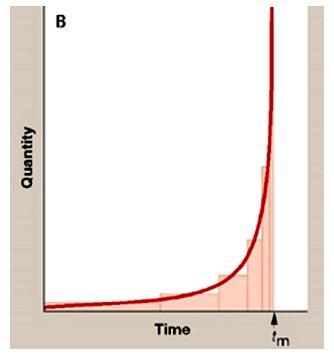
Fig. 4
REFERENCES
Burke, J., and Ornstein, R. 1997. The Axemaker's Gift: Technology's Capture and Control of Our Minds and Culture. Tarcher.
Graber, D. and Wengrow, D. 2021. The Dawn of Everything: A New History of Humanity. New York: Farrar, Straus, and Giroux.
Grinin, L., Korotayev, A. 2015. Great
Divergence and Great Convergence.
A Global Perspective. Springer International Publishing.
Korotayev, A., Malkov, A., and Khaltourina, D. 2006. Introduction to Social Macrodynamics: Compact Macromodels of the World System Growth. Moscow: URSS.
Padgett, J. F., Lee, D., and Collier, N. 2003. Economic Production as Chemistry. Industrial and Corporate Change 12 (4): 843–877.
von Forester H., Mora P. M., and
Amiot L. W. 1960. Doomsday: Friday 13th, November, A.D. 2026. Science 134
(3436): 1291–1295.