Labour Market Globalization and Its New Tendency (Georgia – Czech Republic Context)

Journal: Journal of Globalization Studies. Volume 17, Number 1 / May 2026
DOI: https://doi.org/10.30884/jogs/2026.01.04
Giorgi Kepuladze
University of Business and Technology, Tbilisi, Georgia
Tamila Arnania-Kepuladze
Akaki Tsereteli State University, Kutaisi, Georgia Corresponding author
One of the key aspects of the globalization process is the expansion of the international labour market. Based on semi-structured interviews with Georgian labour migrants in the Czech Republic, this paper aims to define new trends in international labour migration. These interviews identified two groups of participants, conditionally named ‘New Generation’ and ‘Old Generation’. Comparative analysis of responses of these groups of respondents allows for the definition of new trends in the international labour market that were identified among both employers and migrant workers. The main new tendencies demonstrated by employers include changes in attitude towards migrant-workers, the support of migrants' professional growth, the creation of comfortable working conditions, the promotion of tolerance and a positive work culture, and changes in the recruitment process. The key new trends developing among migrant workers are a focus on professional growth and personal skill development, targeted search for jobs in areas of migrants' specialty, greater readiness to adapt to new living conditions, a new way of self-representation on the international labour market and occupation jobs and positions that the older generation did not consider as their place of employment. These trends signify the emergence of a novel cohort of international labor migrants and establish novel labor relations in today's globalized world, contributing to the transformation of employment patterns on a global scale.
Keywords: labour market, globalization, international labour migration, employment, Czech Republic, Georgia.
Introduction: International Labour Migration and the Globalized World
The modern world is a highly interconnected and interdependent system conditioned by the development of the globalization process. This process creates new challenges and opportunities, changing the mechanisms of functioning of states, markets, businesses, and corporations (Stiglitz 2002).
Globalization is a multifaceted process that covers society's economic, political, social and cultural spheres and determines the intensification of ties between nations, as well as the establishment of interconnected economic systems, dissemination of technology and information, deepening of the international division of labour, liberalization of markets, reduction of trade barriers, strengthening of the influence of international organizations, spread of global mass culture, unification of consumer preferences, etc. (Brynjolfsson and McAfee 2014; Bhagwati 2004; Sachs 2005).
Globalization facilitates the movement of goods, increases foreign investments, accelerates the cross-border movements of capital and labour, expands global production networks and supply chains, and enhances opportunities for international cooperation and scientific exchanges. Due to this, globalization strengthens the interdependence between national economies and expands international cooperation, thereby predetermining changes in the current world order, economic and socio-political development of states and deepening interstate interdependence. One of the most important manifestations of globalization is the intensification of international migration.
Migration is a continuous process and complex phenomenon linked to the technological transformations affected by ‘a wide range of high-priority policy issues’ that are considered ‘a top-tier political issue’ and tightly connected with ‘human rights, development, and geopolitics at national, regional and international levels’ (IOM 2020: xv; 2022: xii).
As the World Bank reported, 184 million people, or approximately 2.5 % of the world population, live outside their home country (World Bank 2023: xxiii).
International labour migration (ILM) takes a specific place in the international movements of the population, which significantly modifies the global labour market.
International labour migration, as a response to the imbalance in the economic development of different countries and regions, occupies a special place in the globalization process and ensures redistribution of labour on a global scale. ILM brings significant changes to the function of the international labour market, shaping new trends that define the future of the global and local labour markets.
ILM is rightly regarded as a most visible and important integral part of the globalization process, which, on the one hand, supports the process of globalization and, on the other hand, is its consequence (Nyberg-Sørensen et al. 2002: 10, 15; Tacoli and Okali 2001).
The scale of international labour exchange between countries has increased dramatically in recent decades and has become one of the most noticeable phenomena in global life. This period saw a quantitative increase in migration and an expansion of the geography of labour migration flows. Additionally, there was a significant reassessment of the role of labour migration in the economies of both developed and developing countries. Therefore, while international labour migration did not attract much attention of researchers and international organisations until the 1990s, in the light of the changes that have taken place in the international labour movement over the past four decades, this interest has begun to grow more and more.
International labour migration is recognized as an important factor in world development that provides a more rational redistribution of factors of production and flexibility of the international labour market. According to recent studies, today's international labour market undergoes significant changes driven by globalization, various socio-economic, environmental, and political factors, digital transformation and demographic shifts.
First of all, it is necessary to note the intensification of international labour migration growth and its significance. As the International Labour Organisation (ILO) estimates, about 169 million people or about 5 % of the global workforce were migrant workers before the COVID-19 pandemic (ILO 2021: 11). A substantial proportion (68.4 %) of these workers was employed in high-income countries, underscoring the demand for labour in developed economies. Increased labour migration contributed to remarkable (over 650 %) growth in remittance from USD 128 billion in 2000 to USD 831 billion in 2022 (IOM 2024). These funds play a crucial role in supporting the economies of developing nations, often surpassing foreign direct investments and making up a significant part of the local budget.
Since the end of the twentieth century, there have been pronounced demographic disparities influencing migration that generated new trends in the international labour market. Demographic changes in wealthier societies are associated with rapidly ageing of the population, while working-age populations continue to grow in emerging economies and low-income countries. This factor led to labour shortages in developed countries and stimulated the influx of migrants (Munz 2013; Bhagwati 2004), which, ultimately, caused changes in the structure and functioning of the labour market in both labour-re-cipient and labour-donor countries. In turn, developing countries face an outflow of qualified specialists, which slows down their economic development (Sachs 2005).
In the twenty-first century, along with demographic factors, one of the drivers of migration flows are environmental factors, particularly climate change, extreme weather events, rising sea levels, resource scarcity, etc. (IOM 2024). The compelled relocation of people, including labour migration, appears as an adaptation strategy to mitigate negative implications of world-wide change and resulting employment problems.
Another new trend in the international labour market is the changes in the migration flows. Following established conventions, labour mobility is defined as the phenomenon of individuals migrating from one economic region to another, seeking employment opportunities deemed to be more abundant or lucrative in the destination economy. In this regard, the EU countries are becoming increasingly attractive for labour mig-ration from non-European countries. Thus, according to Eurostat data, 2.3 million immigrants came to the European Union from non-EU countries in 2021, and among 448.8 million people living in the EU, 27.3 million people or 6.1 % of the EU population were non-EU citizens on 1st January 2023. A similar situation is observed in the Czech Republic. In 2021, about 78 % of all immigrants in the Czech Republic were from a non-EU country according to their previous residence. On January 1, 2022, the share of a non-national population in Czechia was about 5 % and 3.5 % among them were from non-EU countries (Eurostat 2022).
Another trend is also observed, when increased number of population migrated to less developed countries (Arp 2014).
The dissolution of the socialist system in the late twentieth century also led to profound transformations in global migration patterns, particularly affecting labour migration. While in the first years after the collapse of the Soviet Union and the disintegration of the Eastern Bloc the migration was ethnic and many individuals sought to return to their ancestral homelands or relocate to countries with shared cultural and linguistic ties, later this process took on an economic character, when people began to leave their home country in the hope for improving their quality of life.
One of the new trends in international labour migration is the changes in the sectoral structure and nature of employment, a decline in the share of the industrial sector in the economy of developed countries and an increase in the service sector. According to the ILO (ILO 2021: 11), labour migrants are predominantly concentrated in agriculture and construction or low-skilled industries. However, the development of technologies, the adoption of digitalization and automation have a powerful impact on the labour market and employment structure, manifested in the replacement of routine and low-skilled types of work, leading to a reduction in jobs in traditional sectors of the economy (Autor 2015; Castells 2010). At the same time, the development of AI and robotization creates new jobs in high-tech areas that require workers with digital skills and increased demand for IT specialists, data analysts and artificial intelligence engineers (Brynjolfsson, McAfee 2014; Sassen 2016). These new trends have increased the competition for talents between countries and companies, thus contributing to the growth of international labour migration of highly skilled personnel (Milanovic 2016), and increased the role of continuous education and retraining in the conditions of a rapidly changing economy (Castells 2010). In addition, companies adapt hiring strategies and methods, increasingly using digital platforms for hiring and managing personnel, expanding the boundaries of international cooperation and reflecting on the growing importance of intercultural skills and diversity (Baldwin 2020; Stiglitz 2002).
The spread of the COVID-19 pandemic gave new impetus to changes in the global and local labour markets and accelerated the transition to remote and flexible forms of work.
Today remote work is becoming the norm in different industries, especially in IT, finance and consulting, and companies strive to adopt flexible employment models and reduce reliance on traditional employment relationships.
As labour migration to EU countries permanently increases and becomes a character trend for both labour-recipient and labour-donor countries, the investigation of labour migration to European countries and its peculiarities becomes an important subject for scholarly interest.
International Labour Migration: Different Directions of Study
There is no single factor that determines labour migration and each of the factors needs to be considered on the individual level as well as in combination with other factors. The impact of every factor and their combination on labour migration is complex, interdependent and not always clear.
The classical view on international labour migration goes back to the neoclassical economic school and is based on the assumption of perfect competition in the factor market. According to this approach, international labour migration results from intercountry differences in labour supply and demand and therefore, intercountry differences in labour force price. The representatives of the (neo)classical theory of international labour migration (Harris and Todaro 1970; Stark 1991; Tacoli and Okali 2001; Ravenstein 1885; Lee 1966, etc.) proceed from the assumption that ILM is a result of differences in wages in various countries, when the labour force, striving to maximize individual utility, moves from places with low wages to places with higher incomes. This theory considers migrants as rational individuals who make migration-related decisions based on a comparative analysis of the costs and benefits associated with the move and estimates migration as a tool that levels inequality and, therefore, brings national labour markets into equilibrium.
Developed in the frame of the classical theory of ILM, the Human Capital Theory as a main determinant of international labour migration considers differences in human capital (Chiswick 1986; Chiswick and Miller 2009; Becker 1964, etc.).
The Human Capital Theory (HCT) of international labour migration considers each migrant to be the result of investments in his/her education, skills and health care. In addition to the economic losses of migration, the HCT also takes into account psychological losses, in particular, separation from relatives, adaptation to new conditions of life and culture etc., which remained outside the scope of the earliest visions of the neoclassical economic theory of migration (Becker 1964, etc.).
Within the confines of HCT of international labour migration, the simple Human-Capital Migration Models are developed by Gary S. Becker (1964), Larry A. Sjaastad (1962), and Barry Chiswick (1986, 1999; Chiswick and Miller 2009). These models express the rate of return from migration that is linked to earnings in the origin and destination, migration that includes forgone earnings and direct or out-of-pocket costs, investments in human capital, and investments in migration (Chiswick 1999: 181).
Studying the link between educational level and occupational attainment, Chiswick and Miller (2009) found that overeducation is more common for young migrant workers and undereducation for older workers (Chiswick and Miller 2009). Skilled migrants have more chance to be successfully recruited but at the same time high level of education is not a guarantee to be utilized and valued in the foreign labour market (Ho 2006: 2; Kofman 2000: 56).
Herewith, the question of determining highly skilled migrants remains debatable. In this regard, a distinction is made between migrants educated in the country of migration and the country of origin. Based on such an approach the patterns of high-skilled migrants are developed (The World Bank Group 2018: 235–238).
The studies of the role of universities in gaining bright students who can stay in the university area after they finish their studies led to the opinion that student mobility decision is a function of two factors – university quality and conditions on the local labour market (Dotti et al. 2013: 443).
The classical approach faces criticism for its narrow economic focus, neglecting socio-cultural dimensions of migration (de Haas 2021; Massey et al. 1993).
Aspirations–Capabilities Theory (de Haas 2021), integrates migration within broader socio-economic changes and considers it as ‘an intrinsic part of broader processes of social change and ‘development’ (de Haas 2021: 2).
The Economic Opportunity Thesis (Fukurai 1991) may be considered as a type of Aspirations–Capabilities Theory which links migration to wage disparities and employ-ment prospects, viewing migration as a response to economic imbalances (Fukurai 1991; Tacoli and Okali 2001). The followers of this approach believe that economic growth and increased migration narrow the wage gap, which should reduce the incentive to migrate.
Migration-Development Nexus Theory (MDNT) is very close to the classical theory of international labour migration. The MDNT (Nyberg-Sørensen et al. 2002) expresses the connection between migration and the economic development of migrants sending and receiving countries. MDNT emphasizes the impact of migration on economic growth in both sending and receiving countries. While developed nations benefit from migrant labour to counter ageing populations (Engler et al. 2020), developing nations face challenges such as brain drain, which could hinder long-term economic stability (Athukorala 1993; Arnania-Kepuladze 2020; Tacoli and Okali 2001; Lucas 2008). Despite potential drawbacks, remittances contribute to poverty alleviation and economic development in migrant-sending regions (Nyberg-Sørensen et al. 2002: 5; The World Bank Group 2018: 1).
Labour Migrants Distribution Theory (LMDT) considers one of the most debatable issues such as the distribution of labour migrants by sectors of the economy and its explanation. As researchers argue, labour immigrants take unattractive jobs that ‘natives don't want’ (Orrenius and Zavodny 2009: 525) and are concentrated predominantly in the agriculture, construction, and service sectors (Nivorozhkin and Poeschel 2022; Orrenius and Zavodny 2009; Constant 2014; Hatton and Williamsone 2008). This situation is explained as a result of lacking proficiency in the host-country language and/or English language ability and educational attainment.
Another debatable issue is the age-specific distribution of migrant workers among metropolitan and non-metropolitan communities. As some studies have found (Fuguitt and Heaton 1995), migration becomes highly differentiated, with younger individuals favouring metropolitan areas while older migrants in non-metropolitan areas.
The Gender Theory of International Labour Migration began to emerge in the 1990s when new demographic and social groups of people started to be involved in the migration process (Anthias 2000; Zlotnik 2003; Arnania-Kepuladze 2020). While before the 1990s, women were considered as ‘invisible in studies on migration’ (Anthias 2000: 146), after the 1990s and especially in the 2000s, the term ‘invisibility’ no longer referred to the position of women in the migration process. The increasing participation of females in the international movement led to the concept of ‘feminization of migration’ (Zlotnik 2003; Kofman 2003; Feminization of Migration 2007; Female Face of Migration 2022; Anthias and Lazaridis 2000) and was linked to globalization, shifting societal roles, and labour market demands (Nyberg-Sørensen et al. 2002).
The differences in the earning level in labour donor and receiving countries are not the only reason for labour migration. Some authors (Stark 1991; Massey et al. 1993) argue that migrants, due to the labour migration process, try to minimize the risks associated with the insufficient development of the labour market, insurance and credit system in their home country.
The study of theoretical approaches in the field of migration serves to understand the impact of migration processes on the population and labour markets, and the patterns and consequences of migration processes.
Research Objectives and Methodology
The present article aims at studying the contemporary features of international labour migration and revealing its new trends through the investigation of the particularities of Georgian labour migration to the Czech Republic. To this end, this work employs general scientific methods, including analysis and synthesis, induction and deduction, classification, information analysis, the qualitative research method, namely, the interviewing method, and the socio-economic observation method.
The theoretical and methodological foundation of the study proceeds from the comprehensive review of literature in the field of international labour migration and is based on the general theory of migration, Ravenstein's Laws of Migration (Ravenstein 1885), Lee's ‘Push/Pull-factors’ economic model (Lee 1966), Piore's theory of a segmented labour market (Piore 1975), and Duncan's generational theory of assimilation (Duncan and Trejo 2015; 2018).
Lee's ‘Push/Factors’ economic model was applied to identify the factors influencing the migrants' decision to move from Georgia to the Czech Republic.
Ravenstein's Laws of Migration were applied to gain insights into the underlying motivations, challenges, and outcomes associated with individual migration experiences.
By applying Piore's theory of a segmented labour market, there were insights into how structural factors, institutional arrangements, and migrants' characteristics intersect to shape their individual experiences within the labour market segments.
Duncan's generational theory of assimilation provides a framework for understanding the intricate interplay between individual experiences, cultural identity dynamics, and societal integration processes of the first-generation Georgian migrants in the Czech Republic.
The empirical foundation for the study is the primary data collected through semi-structured interviews and life observation of Georgian migrants who live and work in the Czech Republic.
The interviews present migrants' stories regarding the key moments such as Motivation and migration-related decision-making process, Job searching and recruitment process, Assistance in Adaption to the Workplace, Social integration, Work environment and corporate culture, Assessment of own migration state, and Vision of own future.
Based on the random sample method, the study was conducted in Brno, Prague, Pardubice, Hradec Kralove, Olomouc, and Ostrava.
The participants of the interviews included only Georgian citizens who live and work in the Czech Republic and excluded Georgians who are Czech (or third-country) citizens. Our interviewers are first-generation migrants, i.e. people who moved to the Czech Republic in adulthood, despite the fact that their parents already might live and work in the Czechia.
Most of the interviewed Georgian migrants (12 out of 21 respondents) live in Prague and work in or near Prague or live near Prague and work in Prague.
During the interviewing and analysis process of the obtained data, it was noted that opinions and views of interviewed migrants on motivational factors that made them move to the Czech Republic, methods of searching for a job, adaption and integration into society varied and expressed different strategies in decision-making, and thus, form new trends in migrants' behaviour depending on whether the migrants were in the country for a longer or shorter period, their age, and the location (at Georgia or abroad) of the educational institutions that the migrants graduated from. Thus, two distinct groups of respondents were identified: those who followed traditional strategies in choosing areas of employment and methods of employment, adaptation, etc., and those who viewed their place in the European labour market in a new way and thereby formed new trends in Georgian citizens' labour migration to Czechia.
This predetermined the authors' decision to divide the interviewed respondents into two categories, when analyzing the information obtained during the inter-view process: one category included migrants who arrived to the Czech Republic for employment or family reunification, who have been living in the Czech Republic for a relatively long (more than five years) time and who are employed in the sphere of the economy that are typical for labour migrants (Orrenius, Zavodny 2009; Nivorozhkin, Poeschel 2022; Constant 2014; Hatton, Williamsone 2008). This group of respondents was conditionally referred to as the ‘Old Generation’, thus emphasising not their age but their traditional approach to international labour migration. The other category included migrants, who were relatively young respondents (aged 23–29 years old) who have lived in the Czech Republic for a relatively short (2–4 years) time and whose main purpose of visiting the Czech Republic was education and who work in the relatively new sphere for migrants' employment – international organisations. We have conditionally named this group of respondents the ‘New Generation’, bearing in mind certain new tendencies in their migration behaviour.
Thus, our analysis is based on dividing the interviewed migrants into two groups, conventionally designated as the ‘New Generation’ group of respondents and the ‘Old Generation’ group of respondents and is implemented following key points of semi-structured interviews.
This approach provides an opportunity to identify new trends in the labour migration of Georgian citizens to the Czech Republic.
The authors proceed from the assumption that the general particularities (composition) of the interviewed groups might be an important factor that impacts the result of the investigation.
Therefore, the next part of the study analyses the general characteristics of the interviewed Georgian labour migrants by their sex and age, education, reasons for migration, and duration of stay in the Czech Republic.
Results
Composition of the interviewed Georgian migrants
The sex-age composition of the respondents. The age of the interviewed respondents
fluctuated from 23 to 35. Among the respondents were 11 women (Rf = 11) and 10
men
(Rm = 10).
The youngest female respondent was 23 years old, and the youngest male respondent was 27 years old. The oldest female respondent was 34 years old, and the oldest male respondent was 35 years old. The average age of female respondents was 29.5 years, and for male respondents – 31.4 years.
The composition of the respondents by education level. Eight out of twenty-one interviewed Georgian migrants have completed or incomplete master's programs, and thirteen out of twenty-one respondents have a completed or incomplete bachelor's program. Four out of five respondents who worked for international organisations studied or completed master's programs in the Czech Republic.
The composition of the respondents by reasons for coming to the Czech Republic. Five respondents came to the Czech Republic to study for a master's program and then started working. Four of them began working for international organisations. Twelve respondents went to the Czech Republic for employment, most of them had work visas, and some of them were helped to find jobs by Georgian citizens living in the country.
The composition of the respondents by distribution among sectors of occupation. As obtained due to semi-structural interview data shown, interviewed Georgian labour migrants in the Czech Republic were employed in different spheres, such as farming, tailoring, construction, finance, control and audit etc. that were divided into four sectors of occupation: International Companies (IO), Construction Industry (CI), Service Sector (SS), and Agricultural Sector (AS). Most of the interviewed persons worked in sectors that typically employ low-skilled workers.
The service sector (SS) where the respondents work includes tailoring and repair of clothes, restaurants, beauty sphere, and repair of household appliances. Respondents who work in the agriculture sector (AS) were mainly engaged in the sphere of animal husbandry and poultry farming, while those who work in the construction industry (CI) were engaged predominantly in the construction of residential and non-residential buildings in the Czech Republic. As for Georgian migrants employed in international companies (IO), the main spheres of their engagement were finance, control and audit, computing, and international marketing.
The composition of the respondents according to the length of their stay in the Czech Republic (in full years). The interviewed Georgian migrants resided in the Czech Republic for different periods, with the duration of their residence in the Czechia ranging from a minimum of two years to a maximum of 11 years (see Table ‘The results of the interviews with Georgian labour migrants’).
Table
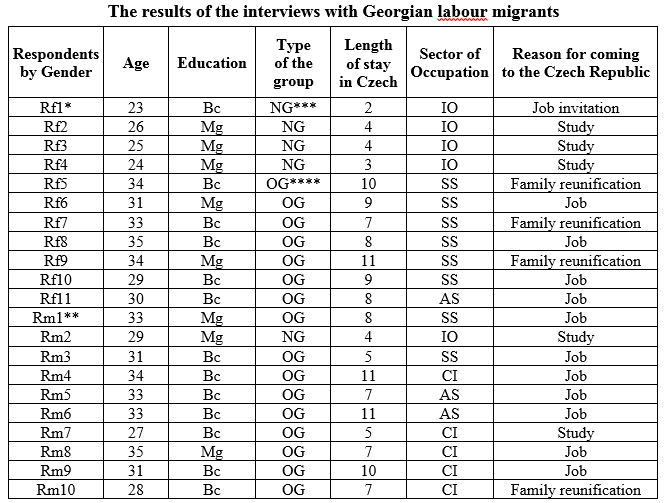
* Rf – Female respondents,
** Rm – Male respondents
*** – NG: ‘New Generation’ of interviewed migrants,
**** – OG: ‘Old Generation’ of interviewed migrants.
Source: authors' own calculations.
Interpretation and Analysis of the Interviewing Results
The analyses of the interviews with Georgian labour migrants in the Czech Republic are performed separately for each group of respondents, which we conventionally call the ‘New Generation’ and the ‘Old Generation’ of interviewed migrants.
The basis for identifying the new trends in international labour migration is the analysis and interpretation of key points from semi-structured interviews with Georgian migrants, including motivation and decision-making about migration, job search and recruitment processes, assistance with adapting to the workplace, social integration, work environment and corporate culture, assessment of their emigration status, and vision for their future.
The ‘Old Generation’ Group of Respondents
Motivations and Migration-Related Decision-Making. The main reason for moving from Georgia to the Czech Republic for the bulk of this category of interviewed migrants was reunification with family already living in the Czech Republic and the search for better opportunities for work and life.
In case the reason for coming to the Czech Republic was employment, the motivation for moving from Georgia to the Czech Republic was related to finding a job after losing a job in Georgia or seeking better employment opportunities. In case the reason for coming to the Czech Republic was family reunification, interviewees noted their initial desire to start working in the Czech Republic.
Job Search and Recruitment Process. The job searching process depended to a large extent on the reason for coming to the Czech Republic. As some respondents mentioned the purpose of their coming to the Czech Republic was a job, but they had not any job invitation or job permission. They started looking for work upon arrival in the Czech Republic and for this purpose they contacted various employment agencies or private individuals. In some cases, respondents found jobs related to their skills and experience (e.g. in a restaurant) or facilitated by the respondents' hobbies (e.g., working in a tailor's shop as a dressmaker). In these cases, respondents rate their work as interesting and exciting. However, a larger number of the interviewed Georgian migrants had to accept jobs that did not match their education and their job was not related to their major. In this case, respondents took into account certain aspects of stability and convenience in work. This group of migrants expressed a desire to change jobs to more suitable ones but faced limited opportunities due to insufficient knowledge of the Czech language and the lack of suitable vacancies for them.
Assistance in the Adaption to the Workplace. The respondents mentioned that to solve problems and navigate life in the Czech Republic, they seek advice and assistance from family, friends, and sometimes the Georgian embassy or consulate in the Czech Republic. It depends on the type of problem. The Consul of Georgia in the Czech Republic assists with job permission and other legal issues. Migrants often run to their employers for assistance and get this one.
Sometimes, they turn to an intermediary who helps them with their job search, and as some interviewers indicated, the assistance is not always gratuitous.
Social Integration. Respondents mention their family and predominantly Georgian friends as important sources of support and help when problems arise. They note that, depending on the type of problem, they can contact their Czech colleagues or the Georgian consulate in the Czech Republic.
Some of the respondents also mentioned that they communicate with other migrants from the former Soviet Union, even though they do not know Russian well. In such a way within the Czech cultural environment, migrational subcultural relationships were created that were wider than the national diaspora. Communication with Georgians and other migrants from the former Soviet Union makes migrants feel more comfortable in the new country. Migrants from the former Soviet Union also help in case of problems and the process of adaptation to the new environment. Communication with Czech colleagues and/or neighbours helps to adapt and feel more comfortable in the new living and working conditions. This especially applies to migrants who have, to a certain extent, mastered the Czech language. For migrants who did not speak Czech, adapting and integrating into new conditions was much more difficult.
Work Environment and Corporate Culture. Before arriving in the Czech Republic, the correspondents had certain education and specialization, and certain work experiences that appeared largely useless upon arrival in the Czech Republic. Respondents agreed to the jobs available to them, considering aspects of work existence, stability and convenience.
Respondents noted different working conditions and the presence of competition in their workplaces. Some respondents claim that they do not feel there is competition due to the division of work responsibilities. In contrast, others believe that there is no competition in their work due to the nature of the work, meaning difficult and low-paid work in construction or on a farm that attracts mostly migrant workers and is not interesting to native workers.
Respondents working in the service sector, in particular restaurants or a sewing workshop, noted positive working conditions and good relationships within the work team, while those employed in construction or agriculture noted the difficulty and instability of work, frequent changes of workplace and a certain tension in relationships with colleagues.
Assessment of Own Migration Status. As the respondents took the jobs that did not correspond with their formal education and work experience, they had to master their new specialities. This new speciality was usually not very attractive to them but most of the respondents considered their current jobs as the only possibility in the Czech Republic. Their main goal was to earn money and provide for themselves and their family. Other respondents were oriented toward a more comfortable life in the Czech Republic and, therefore, tried to study the Czech language, adapt to the local environment, and get residence permission.
The Vision of Own Future. Interviewed Georgian migrants expressed uncertainty about their future in the Czech Republic. Some respondents see themselves in the Czech Republic on a long-term basis and express a desire to stay in the Czech Republic and settle in this country in case they receive a residence permit. Others were less defined in their plans and considered both possibilities – to stay in the Czech Republic and return to Georgia.
Since migrants generally do not work in jobs not related to their major and often their level of education exceeds the requirements of their work position, some respondents believe that their current job is not a final decision and they may consider other options for working in the Czech Republic. As a rule, respondents did not have a clear long-term plan and were willing to consider other opportunities for further employment.
The ‘New Generation’ Group of Respondents
Based on the features of the responses received, reflecting new trends in cross-border labour mobility, five respondents were included in this group of interviewed migrants. All of them worked in international organisations, four of them came to the Czech Republic to study and then stayed in Czechia to work, and one was initially invited to work by the company after going through a complex online selection process.
Motivations and Migration-Related Decision-Making. One of the factors that led interviewed Georgian migrants to come to the Czech Republic for the bulk of this category of respondents was to obtain an education. For this reason, one of the interviewees refused a promising job in Georgia and expressed satisfaction with her choice, citing the broader perspective and opportunities for personal and professional development offered by her educational experience abroad. Other interviewed migrants, after finishing their education in the Czech Republic, decided to stay in the country and supplement their education with work experience abroad.
The interviewed migrants did a deep exploration regarding potential destinations before making decisions about migration to the Czech Republic for study. This process involved gathering information about culture, study and overall life conditions in Czechia. Their decisions were informed by factors such as getting a good education, new experience and lifestyle preferences.
Besides many factors which impacted migrants' decision-making to stay in the Czech Republic after finishing their studies, the main one was the available jobs related to their field of specialization with alignment to what they were experts in.
Job Search and Recruitment Process. During their studies in Czechia, this group of respondents considered the possibility of working. For this purpose, respondents searched for information about available job, companies' corporate cultures, and work environments.
Interviewed migrants noted a rather complicated and competitive recruitment process. They underwent a rigorous selection process that involved submitting applications, attending multiple interviews (some conducted online due to the COVID-19 pandemic), completing various tasks and exercises, and providing a recommendation from a contact within the company.
Respondents emphasized the complexity of selection process and significant competition during the job application process.
Assistance in the Adaption to the Workplace. Upon securing employment, migrants encountered challenges related to adapting to new work environments and technologies and the necessity to master new knowledge and skills, in particular, unfamiliar programming languages and software, etc. Respondents underscored the importance of the assistance that employers provided with immigration paperwork, the provision of housing, etc. This support gave the migrants a sense of safety, a feeling of security and stability at their job.
Social Integration. Migrants mentioned that they faced initial challenges upon arrival to the Czech Republic due to unfamiliar cultures, languages, and people. However, they were ready to adapt to new life conditions and expressed a willingness to learn.
Migrants highlighted the importance of social networks in their adjustment process. In their private life, they primarily interacted with fellow nationals and maintained contact with colleagues from different countries at work since representatives of different countries worked in international companies. Support from familiar peers facilitated their integration into the Czech reality.
Work Environment and Corporate Culture. Migrants expressed great enjoyment of supportive working conditions in their companies. They mentioned that the lack of stress and a feeling of synergy when working integrated them into the company's culture which fostered a sense of belonging to the company and developed a feeling that they are a valuable part of the company. Moreover, they reported that despite the presence of competition between applicants when being invited to a job interview, there is little to no question of competition at work in their companies. The employers offer comfortable working conditions where workers help each other rather than try to ruin someone's projects.
Their employers invested in their training and development and, therefore, assisted their professional development, promoted tolerance and positive work culture through training and policies fostering diversity, mutual assistance and collaboration. In this way, employers ensured the employees the feeling of belonging, the significance of which was particularly essential at the initial stage of their career in an unfamiliar work environment.
Assessment of Own Migration Status. The migrants highlighted that studying and working in the Czech Republic provided them with invaluable opportunities for personal growth, supported the expansion of their professional mindset, and enriched their life experiences. They view their time in the Czech Republic as an opportunity to gain independence and get a broader understanding of the world, which they believe will benefit their future endeavours. Respondents also emphasized personal characteristics developed during their stay in the Czech Republic that might contribute to their future advancement in the international job market and career development, such as a proactive approach to work, initiative, and adaptability.
A Vision of Own Future. Migrants expressed contentment with their current situations and wanted to continue building their careers in Czechia. They highlighted the stability and opportunities offered by this country. At the same time, one of the respondents entertained the possibility of eventually relocating to the United States, and her immediate plans centred on continuing to build her career and financial stability abroad. Some of the respondents along with employment in the Czech Republic, considered the possibility of continuing their education to get master's or doctoral degree in the Czech Republic.
Discussion
A comparative analysis of both groups of respondents revealed some common approaches towards reasons for migration, such as the availability of jobs and economic stability, striving to maximise the utility of their stay in the Czech Republic and improve their lives.
Nevertheless, if for the ‘Old Generation’ group of respondents, the primary reasons for migration were family reunification and better job opportunities regardless of their education and speciality, the ‘New Generation’ group of respondents expressed new trends in the vision of migration and prioritized the opportunities to develop personal and professional knowledge. Subsequently, this decision was supplemented by the desire to maximize the overall utility of staying in the Czech Republic by gaining work experience in the speciality abroad.
After migration to the Czech Republic, Georgian migrants from the ‘Old Generation’ group of respondents were forced to work in jobs that did not correlate with their level of education, so they could not be the most productive. This category of respondents usually work for income only, without an opportunity and therefore, without striving to occupy a more attractive and prestige job position and social status. A work environment that exists in the secondary sector of the labour market with low wages, unstable conditions, and lack of prospects for feature professional and career development does not attract the local labour force who strive to take jobs in the primary sectors of labour market where wages are higher, jobs are more secure, and there are opportunities for professional and career development.
However, Georgian migrants from the ‘Old Generation’ group maximized the overall utility of migration through the wage differences between Georgia and the Czech Republic and, in the case of some migrants, through connection with family and the opportunity to educate their children in Czechia.
Respondents from both groups of interviewed Georgian migrants underscored the importance of social networks. First of all, they mentioned the role of emotional support from family and friends, as well as from their colleagues and official institutions in solving problems with adaptation to work and life environments in the country of migration. These networks help migrants solve social, economic, and some other problems. Nevertheless, the interviewed persons did not perceive themselves as part of the local community.
Interviewed Georgian migrants, as the first generation living in the Czech Republic, carry out economic penetration and have only external features of penetration into the Czech society. The interview of Georgian migrants has shown that there is economic and social integration, while the emotional component and life values continue to be formed by their ethnic group. This state of affairs is largely consistent with Hannibal Gerald Duncan's generational theory of assimilation. The trends for more stable penetration into the international social environment of which the Czech Republic is an integral part was manifested by ‘New Generation’ groups of respondents.
The study has shown that there are certain differences in the migration ‘push-pull’ factors between the ‘New’ and the ‘Old’ generation groups of respondents.
Contrary to the ‘Old Generation’, the ‘New Generation’ of respondents demonstrated a novel trend to seek personal and professional growth as a migration ‘push factor.’ This emergent trend is exemplified by an opportunity to work in the attractive sphere of employment with a supportive work environment, to have an opportunity for career advancement and to gain experience in their field on the international labour market, which acted as ‘pull factors’ for the interviewed migrants from this group.
As for the ‘Old Generation’ group of the respondents, the existence of family members abroad and striving for family stability, limited job opportunities and/or job loss in Georgia, a desire to provide for the family's future and ensure better financial stability acted as a ‘push factor’, while the availability of job opportunities in the Czech Republic and opportunity for family reunification, as well as educational opportunities for children served as a ‘pull factor’.
Conclusion
As the results of the semi-structured interview-based study showed, each interview had common and specific features and found a certain interconnection between the time of residence of Georgian labour migrants in the Czech Republic, their age, education and the migrants' occupation sector.
According to this study, interviewed Georgian migrants, who have lived in the Czech Republic for more than six years at the interviewing period, and who were over 30 years old and were educated in their home country, mostly were employed in the secondary sector of the labour market in the traditional for migrants' sphere of employment such as construction, agriculture sector, and service sector that are less attractive to the native labour force. At the same time, the interviewed Georgian migrants who have lived in the Czech Republic for less than five years at the interviewing period and who have predominantly graduated from Czech universities, demonstrated new patterns of the migrant behaviour and worked in spheres of employment that are new for Georgian migrants, particularly in various international organisations.
These differences between the interviewed migrants allowed the authors to divide the respondents into two conventional groups: ‘the Old Generation’ and ‘the New Generation’ of migrants. This division, first of all, reflects the understanding of the ‘traditional’ spheres of migrants' employment and follows these traditions as well as differences in migration behaviour, motivation to move to the Czech Republic, differences in approaches toward adaptation to a new life and working environment, their career development opportunities, and differences in the vision of professional and personal prospects.
The interviews present various aspects of the life and adaptation of Georgian immigrants in the Czech Republic, both at the individual level and at the level of conventional groups into which we divided the respondents. All respondents emphasize the importance of family and social support and express uncertainty about their future in the Czech Republic.
The study confirms the opinion (Nivorozhkin and Poeschel 2022; Orrenius and Zavodny 2009, Hatton and Williamsone 2008, etc.) that due to the lack of proficiency in the host country's language (in our case – Czech language) or lack of knowledge in English, immigrants work in secondary sectors of employment and take jobs that are less attractive for natives.
Respondents from the ‘Old Generation’ face challenges such as language adaptation and search for a job in their field or preference, while respondents from the ‘New Generation’, who are employed in international companies where the working language is English, and work in the field of their speciality, do not have such problems.
The study found new trends in international labour migration among both migrant workers and their employers.
Migrants' employers demonstrated the following new tendencies:
– Changes in recruitment process: the employers conduct complex personnel selection, widely use digital platforms for hiring and managing personnel, and request a recommendation from a contact within the company.
– Changes in the attitude towards migrant-workers: the employers provide migrants with assistance in completing immigration documents and securing housing, thereby fostering a sense of safety and security. This assistance also contributes to the establishment of a stable employment environment, which in turn can enhance the migrants' overall well-being and sense of stability.
– Employers actively support migrants' professional growth, investing in skills training and fostering a positive corporate culture.
– The employers offer comfortable working conditions where workers help each other rather than ruin someone's projects.
– Employers promote tolerance and positive work culture through training and policies fostering diversity, mutual assistance and collaboration.
– Estimating workers' actual knowledge: employers evaluate not the formal education (the possession of a diploma) of the hired migrants-workers but their actual knowledge.
New trends in international labour migration were demonstrated predominantly by interviewed migrants from the ‘New Generation’ group, among which the following new trends were revealed:
– Greater readiness to adapt to new living conditions: the trends for more stable penetration into the international social environment of which the Czech Republic is an integral part.
– Education-based migration: greater willingness and desire to learn, to improve own work skills in the chosen field of work activity.
– Focus on professional growth: migrants actively strive to prove themselves for professional growth and enrich their life experiences that contribute to long-term professional success.
– Focus on personal skill development: migrants actively cultivate personal traits such as independence, adaptability, and goal orientation that help them thrive in international work environments.
– Targeted searching for jobs: migrants work not only for the income but search jobs in areas related to their education and specialty.
– Job conditions: Even being in a foreign country, labour migrants value comfortable and supportive working environments, the opportunity for career advancement and gaining experience in their field, foster collaboration, diversity, and professional growth.
– New vision of migration: migrants view migration as an opportunity for personal and professional growth and advancing their future career.
– New way of representation in the international labour market: possession of specific knowledge and skills, migrants work in the spheres and take the jobs that the older generation does not consider for employment, particularly in international companies in spheres of finance, computing, control and audit, international marketing etc.
– Despite that the ‘New Generation’ of Georgian migrants emerge as bearers of new trends in international labour migration, the ‘Old Generation’ also demonstrate some specific features, particularly, our research has not confirmed that overeducation is more common for young migrant workers and undereducation for older workers (Chiswick and Miller 2009; Fuguitt and Heaton 1995). In this regard, our study has revealed an opposite trend, particularly, overeducation has been found among the ‘Old’ generation of migrants, who do not even apply for positions corresponding to their education and are occupied in the secondary labour market, while young migrant workers are more successful in the allocation of their education, knowledge, and skills and take more advantage through taking the more attractive jobs.
These new trends indicate the emergence of a new cohort of international labour migrants who represent themselves in a new way on the international labour market, as well as changes in the attitude towards migrants on the side of employers. All these contribute to the establishment of new labour relations in today's globalized world and to the transformation of employment patterns, workplace dynamics, and economic policies on a global scale.
Acknowledgements
This work would be impossible without the support of the Ministry of Education, Youth and Sports of the Czech Republic which awarded the scientific research project ‘Georgian labour migrants in the Czech Republic and effects of COVID-19 pandemic’, without the invitation to carry out the research at Masaryk University in Brno (Czech Republic) and the friendly support of colleagues at the Faculty of Economics and Administration. The authors thank the Consul of Georgia of the Czech Republic, Ms. Julieta Svanidze, for her interview and consultation on migration issues. We are also grateful to the respondents for their openness and cooperation during the interview. The authors express their deep gratitude to the anonymous reviewers for their helpful comments and recommendations.
NOTE
* The article presents a part of the study that was carried out at the Faculty of Economics and Administration, Masaryk University (Lipová 507/41a, Brno, Czech Republic) in the framework of the research project ‘Georgian labour migrants in the Czech Republic and effects of COVID-19 pandemic’, granted by the Ministry of Education, Youth and Sports of the Czech Republic.
REFERENCES
Anthias, F. 2000. Gendering Migration: the Case of Southern
Europe. In Anthias F., and Lazaridis G. (eds.), Gender and Migration in Southern Europe:
Women on the Move (pp.
15–48). Oxford: Berg Publishers. URL: https://link.springer.com/chapter/10.1057/
9780230523128_9.
Accessed November 2023.
Anthias, F., Lazaridis, G. (eds.) 2000. Gender and Migration in Southern Europe: Women on the Move. Oxford: Berg Publishers. DOI:10.4324/9781003085447.
Arnania-Kepuladze, T. 2020. Labour Migration and Effects of the COVID-19 Pandemic (on the context of Georgia). Nauchnyye Trudy Severo-zapadnogo Instituta Upravleniya Rankhigs 4 (46): 6–16, https://www.elibrary.ru/item.asp?id=44871505. (In Russian).
Arp, F. 2014. Emerging Giants, Aspiring Multinationals and Foreign Executives: Leapfrogging, Capability Building, and Competing with Developed Country Multinationals. Human Resource Management 53 (6): 851–876. doi:10.1002/hrm.21610.
Athukorala, P. 1993. Enhancing Developmental Impact of Migrant Remittances: A Review of Asian Experiences. Asian Regional Programme on International Labour Migration. New Delhi: ILOUNDP Project.
Autor, D.H. 2015. Why are There Still So Many Jobs? The History and Future of Workplace Automation. Journal of Economic Perspectives 29 (3): 3–30.
Baldwin, R. 2020. The Globotics Upheaval: Globalization, Robotics, and the Future of Work. Oxford University Press.
Becker, G. S. 1964. Human Capital. New York: National Bureau of Economic Research.
Bhagwati, J. 2004. In Defense of Globalization: It has a Human Face. Rivista di Politica Economica 94 (6): 9–20.
Brynjolfsson, E., McAfee, A. 2014. The Second Machine Age: Work, Progress, and Prosperity in a Time of Brilliant Technologies. W.W. Norton & Company.
Castells, M. 2010. The
Rise of the Network Society. 2nd edition with new preface.
Wiley-Blackwell, A John Wiley & Sons, Ltd., Publication. URL: https://memotef.web.
uniroma1.it/sites/default/files/file%20lezioni/Manuel%20Castells%20-%20The%20Rise
%20of%20the%20Network%20Society,%20With%20a%20New%20Preface_%20Volume%20I_%20The%20Information%20Age_%20Economy,%20Society,%20and%20Culture%20(Information%20Age%20Series)%20(2010,%20Wiley-Blackwell)%20-%20lib
gen.lc_.pdf.
Chiswick, B. R. 1986. Human Capital and the Labor Market Adjustment of Immigrants: Testing Alternative Hypothesis. Research in Human Capital and Development 4: 1– 26.
Chiswick, B. R. 1999. Are Immigrants Favorably Self-Selected? American Economic Review 89 (2): 181–185.
Chiswick, B. R., Miller, P.
W. 2009. The International Transferability of Immigrants' Human Capital. Economics of Education Review 22 (2): 162–169.
https://doi.org/10.1016/
j.econedurev.2008.07.002.
Constant, A. 2014. Do Migrants Take the Jobs of Native Workers? IZA World of Labor 2014: 10. doi: 10.15185/izawol.10.
Dotti, N. F., Fratesi U., Lenzi C., Percoco M. 2013. Local Labour Markets and the Interregional Mobility of Italian University Students. Spatial Economic Analysis 8 (4): 443–468. DOI: https://doi.org/10.1080/17421772.2013.833342.
Duncan, B., Trejo S. J. 2015. Assessing the Socio-Economic Mobility and Integration of U.S. Immigrants and Their Descendants. Ann. Am. Acad. Political Soc. Sci. 657 (1): 108–35.
Duncan, B., Trejo S. J. 2018. Socioeconomic Integration of US Immigrants over the Long Term: The Second Generation and Beyond. NBER Work. Pap. 24394.
Engler, P., Margaux M. D., Piazza, R., Galen S. 2020. Migration to Advanced Economies Can Raise Growth. IMF Blog.
Eurostat 2022.
Migration
and Migrant Population Statistics. Eurostat Statistics Explained.
URL: https://ec.europa.eu/eurostat/statistics-explained/index.php?title=Migration_and_
migrant_population_statistics#Acquisitions_of_citizenship:_EU_Member_States_gran
ted_citizenship_to_827_300_persons_in_2021.
Female Face of Migration. 2022. IOM Mission to Georgia.Issue Brief IOM, UN Migration, 8 March. URL: https://georgia.iom.int/sites/g/files/tmzbdl1311/files/documents/iom-georgias-brief-for-int.-womens-....
Feminization
of Migration 2007. Working
Paper 1, Gender, Remittances and Development. UN Instraw. URL: https://www.renate-europe.net/wp-content/uploads/2014/01/Femini
zation_of_Migration-INSTRAW2007.pdf.
Fuguitt, G. V., Heaton, T. 1995. The Impact of Migration on the Nonmetropolitan Population Age Structure, 1960–1990. Population Research and Policy Review 14: 215–232.
Fukurai, H. 1991. Japanese
Migration in Contemporary Japan: Economic Segmentation and Interprefectural
Migration. Social. Biology 38 (1–2): 28–50.
DOI: 10.1080/19485565.
1991.9988771.
Harris, J. R., Todaro, M. P. 1970. Migration, Unemployment and Development: A Two-Sector Analysis. The American Economic Review 60 (1): 126–142. http://www.jstor.org/ stable/1807860.
Haas de, H. 2021. A Theory of Migration: The Aspiration Capabilities Framework. Comparative Migration Studies 9 (8): 1–35. https://doi.org/10.1186/s40878-020-00210-4.
Hatton, T., Williamsone, J. G. 2008. Global Migration and the World Economy: Two Centuries of Policy and Performance. The MTT Press.
Ho, C. 2006. Women Crossing Borders: The Changing
Identities of Professional Chinese Migrant Women in Australia. URL: https://www.researchgate.net/publication/
267797710_Women_Crossing_Borders_The_Changing_Identities_of_Professional_Chinese_Migrant_Women_in_Australia.
ILO – International Labour
Office. 2021. Global Estimates on
International Migrant Workers. Results and Methodology. Third edition.
Geneva: ILO. URL: https://www.ilo.org/
wcmsp5/groups/public/---dgreports/---dcomm/---publ/documents/publication/wcms_
808935.pdf.
IOM – International Organization for Migration. 2020. World Migration Report 2020. International Organization for Migration. URL: https://publications.iom.int/system/files/ pdf/wmr_2020.pdf.
IOM – International Organization for Migration. 2022. World Migration Report. URL: https://publications.iom.int/system/files/pdf/WMR-2022.pdf.
IOM – International Organization for Migration. 2024. World Migration Report. URL: https://worldmigrationreport.iom.int/what-we-do/foreword/foreword.
Kofman, E. 2000. The Invisibility of Skilled Female Migrants and Gender Relations in Studies of Skilled Migration in Europe. International Journal of Population Geography 6: 45–59.
Kofman, E. 2003. Women Migrants
and Refugees in the European Union. In The
Economic and Social Aspects of Migration, Conference jointly organized by the
European Commission and OECD, Brussels, 21–22 January 2003. URL: https://www.oecd.org/
migration/mig/15515792.pdf.
Lee, E. S. 1966. A Theory of Migration. Demography 3 (1): 47–57.
Lucas, Robert E. B. 2008. International Labor Migration in a Globalizing
Economy. Carnegie Endowment for International Peace. URL:
https://carnegieendowment.org/files/
international_migration_globalizing_economy.pdf.
Massey, D. S., Arango, J., Hugo, G., Kouaouci, A., Pellegrino, A., and Taylor, J. E. 1993. Theories of International Migration: A Review and Appraisal. Population and Development Review 19 (3): 431–466. https://doi.org/10.2307/2938462.
Milanovic, B. 2016. Global Inequality: A New Approach for the Age of Globalization. Harvard University Press.
Munz, R. 2013.
Demography and Migration: An Outlook for the 21st Century. Migration Policy
Institute.
https://www.migrationpolicy.org/sites/default/files/publications/Demography-
Migration-Outlook.pdf.
Nivorozhkin, A., Poeschel F. 2022. Working Conditions in Essential Occupations and the Role of Migrants. Economic Analysis and Policy 74: 250–261.
Nyberg-Sorensen, N., Van Hear, N., Engberg-Pedersen, P. 2002. The Migration–Deve-lopment Nexus: Evidence and Policy Options, International Organization for Migration. IOM Migration Research Series No. 8. URL: https://publications.iom.int/system/files/ pdf/mrs_8.pdf.
Orrenius Pia M., Zavodny M. 2009. Do Immigrants Work in Riskier Jobs? Demography 46 (3): 535–551. doi: 10.1353/dem.0.0064. PMID: 19771943; PMCID: PMC2831347.
Piore, M. J. 1975. Notes for a Theory of Labour Market Segmentation. In Edwards, R. et al. (eds.), Labour Market Segmentation. Lexington, Mass.: Heath.
Ravenstein, E. G. 1885. The Laws of Migration. Journal of the Statistical Society of London 48 (2): 167–235.
Sassen, S. 2016. Expulsions: Brutality and Complexity in the Global Economy. Harvard University Press.
Sachs, J. D. 2005. The End of Poverty: Economic
Possibilities for Our Time. NY: Penguin Press. URL: http://www.economia.unam.mx/cedrus/pdf/jeffrey_sachs_the_end_of_poverty_
economic_possibilities_for_our_time__2006.pdf.
Stark, O. 1991. The Migration of Labour. Oxford: Basil Blackwell Ltd.
Stiglitz, J. E. 2002. Globalization and Its Discontents. New York: W. W. Norton & Company. DOI:10.9774/gleaf.978-1-907643-44-6_39.
Sjaastad, L. A. 1962. The Costs and Returns of Human Migration. Journal of Political Eco-nomy 70 (4): 80–93.
Tacoli, C., Okali, D. 2001. The Links between Migration, Globalization and Sustainable Development. World Summit on Sustainable Development, IIED. https://www.iied. org/sites/default/files/pdfs/migrate/11020IIED.pdf.
The World Bank Group. 2018. Moving for Prosperity: Global Migration and Labor Markets. Policy research report, International Bank for Reconstruction and Development.
World Bank. 2023. World Development Report 2023: Migrants, Refugees, and Societies. Washington, DC: World Bank. doi: 10.1596/978-1-4648-1941-4.
Zlotnik, H. 2003. The Global Dimensions of Female Migration, MPI. URL: https://www. migrationpolicy.org/article/global-dimensions-female-migration.