Comparing the Effect of Globalization on Export Competitiveness in the Fruits and Nuts Sector: Evidence from Developing and Developed Countries

Journal: Journal of Globalization Studies. Volume 17, Number 1 / May 2026
DOI: https://doi.org/10.30884/jogs/2026.01.06
Prihartini Budi Astuti
Putra Bangsa University, Kebumen, Indonesia
Suliyanto Suliyanto
Jenderal Soedirman University, Banyumas, Indonesia
Abdul Aziz Ahmad
Jenderal Soedirman University, Banyumas, Indonesia
Trade liberalization initiated by the WTO has accelerated the flow of globalization in both developing and developed countries, affecting various economic sectors. However, the influence of globalization on export competitiveness, both in developing and developed countries, has not yet found a clear common ground. Therefore, this study examines the association between globalization and export competitiveness in the fruits and nuts sector, comparing 55 developing and 16 developed countries over the period 2003–2023. Secondary data was used in this study and the data were arranged in the form of panel data consisting of 55 developing countries and 16 developed countries between 2003 and 2023. The data were analyzed using a dynamic panel model estimated through the two-step System GMM approach, complemented by a pooled interaction regression. The results of the analysis show that globalization has a positive influence on export competitiveness in the fruits and nuts sector for developed countries, but has a negative influence on developing countries. Developed countries tend to be able to compete well when the flow of globalization increases, but developing countries suffer from weak mastery of technology and low quality of human resources.
Keywords: globalization, export competitiveness, developing countries, developed countries, two-step sys-GMM.
1. Introduction
In recent decades, the World Trade Organization (WTO) has been actively promoting trade liberalization. The WTO's intention to realize trade liberalization can be seen from its concrete measures through the GATT (General Agreement on Tariffs and Trade) policy. The policy encourages all WTO members to reduce, even remove, tariff or non-tariff trade barriers between countries (Gnangnon 2024). Even so, not all WTO members respond positively to this policy (Prasada and Dhamira 2022). Based on a report from the WTO secretariat, developed countries demonstrate the highest commitment to the implementation of the GATT policy (66 %), while developing countries and Least Developed Countries (LDCs) only have a commitment of 28 % and 21 %, respectively (WTO 2019).
The effect of trade liberalization, which promotes globalization, on a country's economic performance is still debatable. Some studies have shown that increased rate of globalization can improve trade performance, i.e., a higher rate of globalization can provide certainty to trade activities as well as increase stability and predictability of trade between countries (Chowdhury et al. 2021; Gozgor 2022; Mansfield and Reinhardt 2008). Furthermore, less trade barriers between countries can also increase agricultural commodity exports (Cubillos et al. 2021). An increased rate of globalization can improve income distribution in both developed and developing countries because globalization promotes job reallocation from developed to developing countries (Davidson et al. 2020; Mushtaq et al. 2022; Tabash et al. 2024). Although globalization may seem to have a positive effect on a country's economic performance, the results of some previous research have also shown its negative effects.
A higher rate of globalization indicates tighter competition between countries (Nugroho et al. 2021). Unfortunately, competition without good adaptability and effectiveness in terms of policy formulation can cause losses for a country (Karwat-Woźniak 2009; Meyer and Meyer 2017). In addition, countries with a low level of efficiency can only produce products at high prices, making it difficult for them to compete with similar products from other countries (Luo et al. 2023; Stauvermann and Kumar 2023). Furthermore, countries with a low level of technology proficiency tend to be unable to compete with countries with a high level of technology proficiency (Bacca-Acosta et al. 2023; Jegan et al. 2024). Even, countries with a low level of readiness to face globalization potentially experience major environmental degradation (Wu et al. 2022; Zhang L. et al. 2022). These are some of the concerns for developing countries in facing a high rate of globalization.
There have been many studies on globalization where globalization is closely related to international trade activities (Angles et al. 2011; Paul and Dhiman 2021). However, these previous studies focus on determining the effect of globalization on a country's economic performance (Broitman et al. 2020; Tabash et al. 2024; Uddin and Azam Khan 2023). Several previous studies seem to test the impact of globalization on exports, but are limited to export performance and focus on one particular country where the results of the analysis show that globalization can encourage increased export performance (Dash 2021; Endris et al. 2025). Other studies focus more on competitiveness, without considering the influence of globalization in the model that is compiled, so this study offers strong novelty in identifying the influence of globalization on export competitiveness.
In particular, this study focuses on the fruits and nuts sector (excluding oil nuts), which represents a high-value agricultural commodity group with strong exposure to global market dynamics (Caratti et al. 2022). The sectoral focus distinguishes this research from previous macroeconomic analyses of trade competitiveness and ensures that the findings reflect commodity-specific patterns rather than economy-wide effects.
Furthermore, the data analysis of the current study was done on two different data sets, i.e., the developing country data set and the developed country data set. The classification of developing and developed countries in this study was driven by the significantly different economic structures (Nugroho et al. 2023). Developed countries tend to have high income levels, low poverty rates, and better living standards than developing countries (CM et al. 2024; Makhlouf 2023). This indicates a different level of readiness to face globalization between the two categories. Therefore, this study aimed to compare the impact of globalization on export competitiveness in developing and developed countries.
However, rather than estimating separate models in isolation, this study also performs a pooled regression with interaction terms between a ‘developed-country dummy’ and the main regressors to formally test whether the effects of globalization and other determinants differ significantly between country groups. The pooled interaction model allows direct comparison between coefficient differences across country groups, offering a more rigorous test of heterogeneity than running separate regressions (Paun et al. 2025).
This study also offers a dynamic panel data analysis approach using the two-step sys-GMM model in modelling the effect of globalization on export competitiveness. This model has several advantages compared to static panel data analysis models (common effect model, fixed effect model, and random effect model) where the model allows the use of panel data analysis that has limited cross-section data and time series data (Mulyo et al. 2023). In addition, this model is designed to overcome the problems of heteroscedasticity and serial correlation in the model (Baltagi 2005), so that the use of the two-step sys-GMM model becomes more effective. Moreover, the dynamic structure of the model captures persistence in export competitiveness (through lagged RCA) and allows the estimation of both short-run and long-run associations. While the two-step sys-GMM approach mitigates endogeneity, the results are interpreted as statistical associations rather than strict causal effects, acknowledging possible reverse causality and omitted-variable biases.
2. Literature Review and Hypothesis
Globalization index measures the extent to which a country is integrated in the global economy, which can be seen in terms of trade, investment, technology, information, as well as political and social relations (Haelg 2020). Countries with a high globalization index usually have better access to international markets due to trade openness and strong diplomatic relations (Stiglitz 2004). This allows exporters to reach more markets and increase export volumes. A globally integrated country will be able to respond more quickly to changes in trends and consumer demand in the international market, thus increasing product competitiveness (Kim et al. 2020). From the perspective of modern trade theory, globalization facilitates the realization of comparative advantage (Ricardo 1817) and the exploitation of factor endowments (Heckscher 1919; Ohlin 1933), as countries specialize in sectors where they possess relative efficiency. In agricultural sectors such as fruits and nuts, globalization can enhance market access, technology transfer, and productivity, thereby strengthening revealed comparative advantage (RCA). Based on the literature review, the first hypothesis is as follows:
Hypothesis 1: Globalization positively affects export competitiveness.
In this study, the influence of globalization on export competitiveness is determined through a dynamic panel model. This has the consequence that this study also identifies other variables that have theoretical or empirical relationships to export competitiveness. The dynamics of international trade allow export competitiveness to be influenced not only by one variable, but many other variables that affect export competitiveness (Prasada, Nugroho and Lakner 2022). Therefore, in addition to the globalization variable, this study adds the exchange rate variable (hypothesis 2), added value (hypothesis 3), nitrogen fertilizer imports (hypothesis 4), and credit to agriculture (hypothesis 5).
These variables are theoretically linked to competitiveness through different mechanisms of comparative advantage, firm productivity, and market integration. Exchange rates affect price competitiveness (classical trade mechanism), while agricultural credit and fertilizer imports influence productivity (factor endowment and input efficiency). Meanwhile, value-added reflects the firm-level heterogeneity emphasized by Melitz (2003), where more productive firms or sectors engage more successfully in export markets.
Exchange rate is a key indicator in international trade. When the exchange rate of the local currency depreciates against foreign currencies, the price of export products becomes more affordable for foreign consumers, thus increasing export competitiveness (Lugo Arias et al. 2020; Zhu W. et al. 2022). On the other hand, a stronger exchange rate has the potential to cause export prices to be more expensive for consumers in the export destination countries. Therefore, the expected direction of the relationship is negative, where exchange rate appreciation reduces competitiveness. Therefore, the second hypothesis in this study is as follows:
Hypothesis 2: Exchange rate depreciation increases export competitiveness.
In addition to exchange rates, value-added of exported products can also increase export competitiveness. Value-added in agricultural products can be interpreted as a way to increase the value of a product, without incurring greater additional costs by improving the quality of the product (Al Hinai et al. 2022). Higher value-added has a significant impact on the competitiveness of agricultural products in the international market, including: increasing export prices and profits, attracting demand from premium markets, maintaining more stable prices, and extending the product shelf life (Nugroho et al. 2021). Thus, higher value-added is expected to have a positive effect on export competitiveness, reflecting firm-level productivity differences highlighted in heterogeneous firm trade theory (Melitz 2003). Based on the above literature, the third hypothesis is as follows:
Hypothesis 3: Value-added positively affects export competitiveness.
Fertilizer is one of the important inputs in agricultural sector. Fertilizers that are easily available and of good quality can also increase production and productivity of cultivated plants (Yousaf et al. 2017). In addition, affordable fertilizer prices for farmers are important. Several countries have implemented trade liberalization in agricultural inputs, including agricultural fertilizers, as an effort to keep the price of agricultural fertilizers affordable for farmers (Sunge and Ngepah 2019; Trakem and Fan 2024). The results of previous studies have shown that imports of agricultural fertilizers can improve the performance of the agricultural sector and reduce the price of agricultural fertilizers by up to 30 % at the farm gate (Abbas and Procházka 2010), thus encouraging an increase in the competitiveness of the agricultural sector. Following the factor endowment framework, access to fertilizer imports represents a productivity-enhancing input that can strengthen a country’s comparative advantage in agricultural exports. Therefore, nitrogen fertilizer imports are expected to have a positive association with export competitiveness. Therefore, the fourth hypothesis in this study is as follows:
Hypothesis 4: Nitrogen fertilizer imports positively affect export competitiveness.
Credit to agriculture has an important role in increasing the export competitiveness of agricultural products. Such credit allows farmers and agricultural business players to obtain the capital needed for investment in technology, equipment, and other agricultural inputs, allowing their farms to become more efficient (Balana et al. 2022; Khan et al. 2024). Access to agricultural credit improves capital availability and facilitates technology adoption, consistent with Porter's Diamond framework, where factor conditions such as finance drive competitiveness (Porter 1990). Therefore, the expected relationship is po-sitive. Therefore, the fifth hypothesis is as follows:
Hypothesis 5: Credit to agriculture positively affects export competitiveness.
Finally, it is expected that the magnitude and even direction of these effects may differ between developing and developed countries due to variations in technology, institutional quality, and market integration. Developed countries typically possess stronger financial systems, higher technological capacity, and more efficient institutions, allowing them to capitalize on globalization gains (Alkharafi and Alsabah 2025; Saeed U. F. and Klugah 2025; Tesega 2022), whereas developing countries may face structural constraints that dampen these effects (Handoyo 2024; Zhang S. et al. 2024).
3. Theory and Variable Selection
Adam Smith, in modern international trade theory, explains the importance of trade between countries to improve the economic performance between countries. Adam Smith considered that an international trade can be conducted due to the absolute advantage of one country compared to other countries. Such absolute advantage arises from a more efficient production process in producing certain goods or services (Handoyo et al. 2023; Machado 2023). However, at the same time, a country also has an absolute disadvantage, i.e., the production of certain goods or services cannot be done with a better level of efficiency compared to other countries. When a country has an absolute advantage in the production of the first commodity but has an absolute disadvantage in the production of the second commodity compared to another country, then if the country exchanges output with another country that has an absolute disadvantage in the production of the first commodity, but has an absolute advantage in the production of the second commodity, each of these countries will benefit from the trade (Salvatore 2013). This also serves as a background for the formulation of free trade, which is believed to benefit not only developed countries, but also developing countries.
While Smith's framework introduced the foundation of trade through absolute advantage, later economists such as Ricardo (1817) refined it into the theory of comparative advantage, emphasizing that countries gain from specialization based on relative efficiency rather than absolute productivity levels. Heckscher (1919) and Ohlin (1933) further extended this idea, suggesting that countries export goods that intensively use their abundant factors of production (e.g., land, labor, or capital). These modern theories form the basis for explaining why globalization and factor-related variables, such as agricultural inputs and credit affect export competitiveness differently across countries.
Countries with absolute advantage tend to have competitiveness. This is in line with Porter's Diamond theory that resource availability is a factor that affects commodity competitiveness (Porter 1990). Countries with abundant resources can produce commodities with high competitiveness. In addition, the competitiveness of a commodity is also determined by the level of competition, structure, and strategy applied by a country in its economic activities. Furthermore, competitiveness is also influenced by demand factors and related industries and supporting industries.
More recent frameworks in international trade also recognize that competitiveness does not solely depend on national resources or policies but also on firm-level dynamics and global production networks. The new trade theory (Krugman 1980) highlights firm heterogeneity and productivity differences where only the most efficient firms participate in export markets. In addition, the global value chain perspective suggests that integration into international production networks can enhance or constrain a country's export competitiveness, depending on its technological capacity and institutional quality (Zeng et al. 2025).
This study operationalizes multiple trade theories through selected variables: the globalization index (comparative advantage and global value chain integration), exchange rate (price competitiveness), value-added (firm heterogeneity), nitrogen fertilizer imports (factor endowment), and agricultural credit (factor conditions in Porter's Diamond). Together, these variables capture both classical and modern determinants of export competitiveness in the fruits and nuts sector.
4. Methods
4.1. Data source
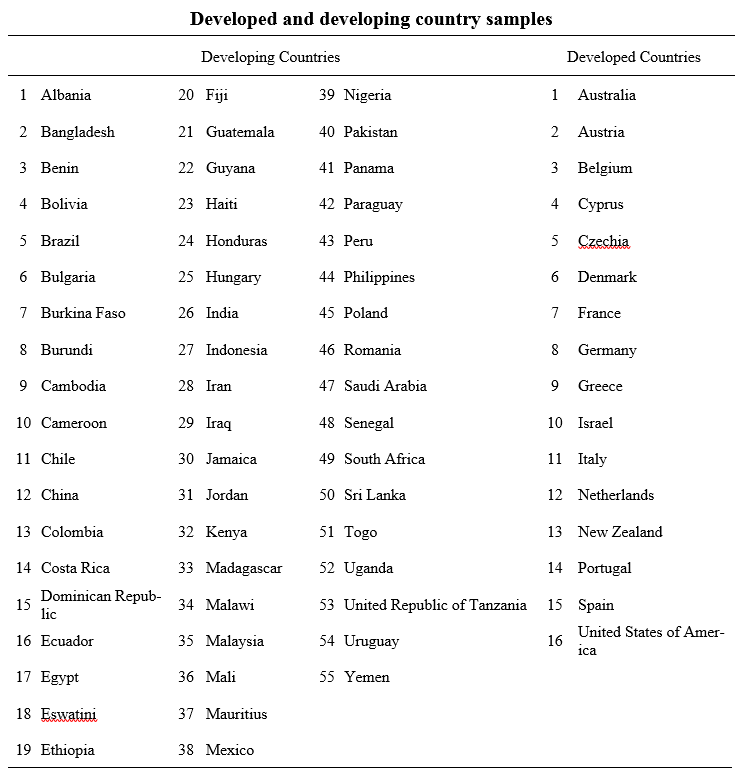
Panel data were used in this study. The data consisted of cross-sectional data from 55 developing countries and 16 developed countries (Table 1) as well as time-series data from 2003–2023. This means that this study used 1,155 observation data from developing countries and 336 observation data from developed countries. Both the developed and developing country samples in this study were determined based on the completeness of data on each research variable; these countries represented those that carried out fruits and nuts (excluding oil nuts) export activities, including fresh or dried commodities. This commodity was chosen as a proxy for overall export competitiveness because the commodity has a rapidly increasing global demand along with the increasing public awareness of healthy living (Fanzo et al. 2023; Zhu X. 2023). In addition, fresh fruits and edible nuts are included in the high-value agricultural commodities category (Fu et al. 2021). Furthermore, these commodities require complex supply chain management so that they are sensitive to policy changes (de Castro Moura Duarte et al. 2024).
Table 1
The variables in this study were obtained from the secondary data from UNCTAD, FAO, and KOF Swiss Economic Institute (Table 2). The competitiveness variable was the RCA (revealed comparative advantage) index developed by Balassa (1965, 1978) for both fresh and dried fruit and nut (excluding oil nuts) commodities. The RCA variable was used as the dependent variable. This study had five independent variables, namely exchange rates (EXR), agricultural value added (AVA), nitrogen fertilizer imports (NFI), credit to agriculture (ACR), and globalization index (GLI). In this study, globalization is defined as the process of creating a network of connections that erodes a country's national boundaries by integrating the economy, culture, technology, and national governance, thereby creating complex dependencies between countries (Gygli et al. 2019).
Table 2
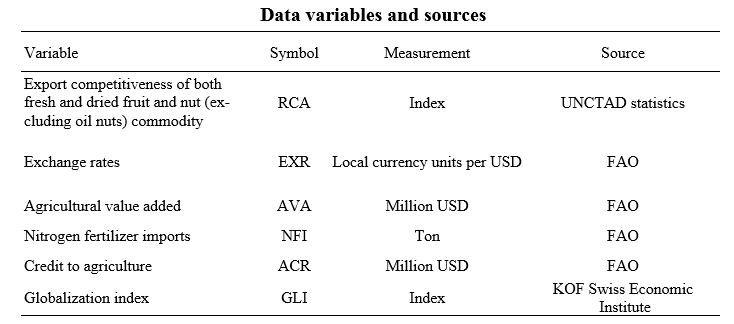
Notes: Variables are reported in original measurement units for descriptive purposes. In the econometric estimation, continuous variables were transformed into natural logarithms to reduce scale bias.
4.2. Data analysis
The collected data were then analyzed using a dynamic panel model, namely two-step sys-GMM, and complemented by a pooled regression with interaction terms as a robustness check to validate the consistency of the main results. The dynamic specification was chosen because export competitiveness may exhibit persistence over time, while the pooled regression with interaction terms was employed to capture group-specific heterogeneity that may not be fully addressed by the GMM framework.
The use of two-step sys-GMM analysis was considered beneficial because this model can overcome serial correlation and heteroscedasticity problems that cause biased and inconsistent estimates (Baltagi 2005). In addition, the model can also overcome the problem of weak instruments due to the use of limited sample sizes (Blundell & Bond 1998). The two-step sys-GMM analysis started with a stationarity analysis using the Levin Lin Chu (LLC) method to avoid spurious regressions (Levin et al. 2002; Prasada, Dhamira et al. 2024). Once all variables had been stationary, the two-step sys-GMM model could be applied properly. The first stage of the two-step sys-GMM analysis was to construct the dependent variable as a function of its independent variables in a static panel data model. Mathematically, the model can be written as follows (Arellano and Bover 1995):

Where: is RCA time specific fixed effect; is country-specific fixed effect; is error term. To address scale heterogeneity across countries and stabilize the variance of the data, all continuous variables were transformed into their natural logarithmic forms prior to estimation. This transformation allows the interpretation of the estimated coefficients as elasticities (Yaman and Offiaeli 2022), indicating the percentage change in export competitiveness (RCA) in response to a one percent change in each explanatory variable.
In the first equation (Eq. 1.), the probability of bias in the static panel data model was detected from the positive correlation between and . Thus, the second stage was done to remove the bias by rearranging Equation 1 into the sys-GMM model as follows:

Where: is random term ( )
To improve the efficiency of the estimator in Equation 2, it is necessary to change variable as an instrument of variable . Mathematically, Equation 2 can be rewritten as follows:

The two-step sys-GMM model is considered valid if it does not detect the emergence of serial correlation in the second order which can be seen from the value of Arellano-Bond test for AR (2) and if there is no endogeneity problem (Sargan test) (Baltagi 2005). These two tests must be carried out so that the model that has been prepared can be ensured to have high consistency (Kafili et al. 2023).
Given the dynamic nature of the model, the estimated coefficients represent short-run effects (SRE). To provide a fuller interpretation, the long-run effects (LRE) of the explanatory variables were derived using the formula:
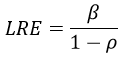
Where denotes the estimated coefficient on the lagged dependent variable ( ) and is the short-term coefficient on each independent variable used in the model.
To formally test whether the effects of globalization and other determinants differ between developing and developed countries, a pooled regression with interaction terms was estimated. This specification provides a direct statistical test of coefficient differences across groups, complementing the separate two-step sys-GMM estimations. The mo- del is specified as follows:

Where is dummy variable equal to 1 for developed countries and 0 for developing countries and is coefficient capturing the differential effect of each variable for developed countries. In this framework, represents the effect for developing countries, and represents the corresponding effect for developed countries. The joint significance of the coefficients is used to test whether the relationships differ significantly between the two groups. This analysis allows for a unified estimation framework that explicitly captures heterogeneity in the globalization–competitiveness relationship across development levels, providing stronger comparative inference than separate subsample estimations (Skare et al. 2026).
5. Results
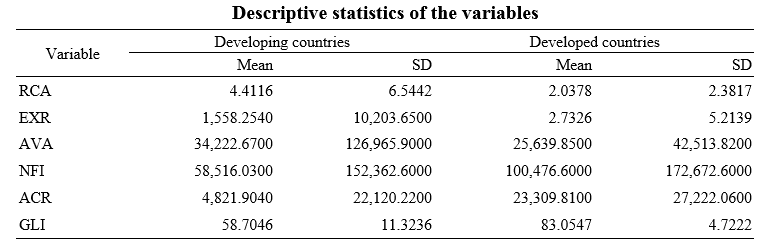
The data showed that the export competitiveness of both fresh and dried fruit and nut (excluding oil nuts) commodities and agricultural value-added were higher in developing countries compared to developed countries (Table 3). Nevertheless, significant differences were identified in the RCA and AVA values between the groups of developing countries and developed countries as indicated by the high standard deviations of the RCA and AVA variables. Besides, the credits to agriculture programs in the developed countries were more robust than those in the developing countries, along with higher levels of nitrogen fertilizer imports. The exchange rate of the developing countries' currencies against the USD was relatively weaker than that of developed countries. Even so, some developing countries also had a strong exchange rate against the USD and some developed countries had a weaker exchange rate against the USD. In addition, the rate of globalization in developed countries was higher than that in developing countries, indicating that developed countries were relatively more open to international trade than developing countries.
Table 3
Source: Own elaboration.
The analysis results showed that each variable used in the two-step sys-GMM model had a different type of stationarity, in both the developed and developing country groups (Table 4). In the developing countries, the RCA and GLI variables were level stationary, the EXR, AVA, and ACR variables were significant at the 1st difference, while the NFI variable was stationary at the 2nd difference. In the developed countries, the RCA and EXR variables were stationary at the 1st difference and the other variables were level stationary. The data on each variable has been stationary so that it can be ensured that the further analysis carried out will be unbiased due to spurious regression (Prasada, Dhamira and Nugroho 2022). The stationary variables were then used for data analysis using the two-step sys-GMM model.
Table 4
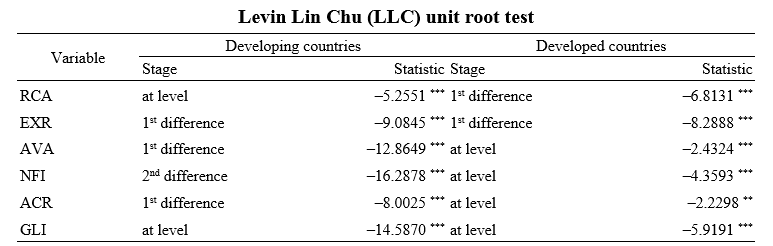
Where: *** significant at 1 % alpha; ** significant at 5 % alpha.
Source: Own elaboration.
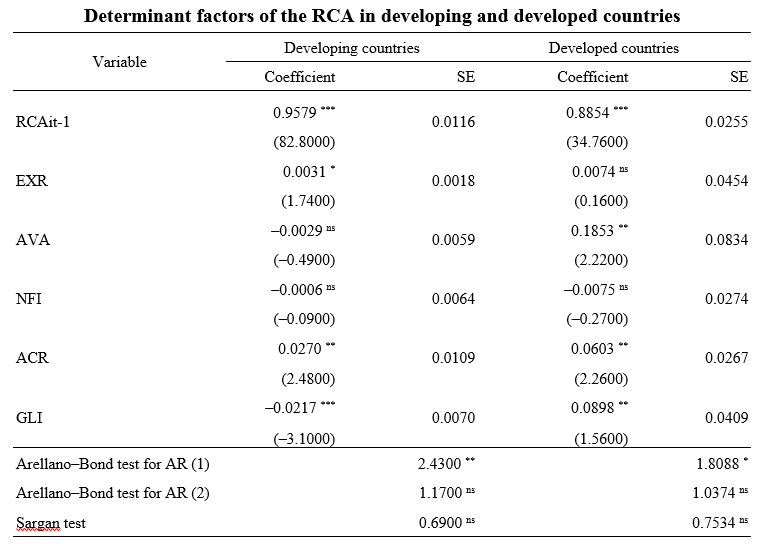
Once the stationarity test had been conducted, the two-step sys-GMM model was tested to ensure that the model used valid and consistent parameters. The Sargan test was used to test the parameter validity in the two-step sys-GMM model, and the Arellano-Bond test for AR (2) was used to determine parameter consistency (Baltagi 2005). The analysis results showed that the two-step sys-GMM model that has been prepared is valid, as indicated by the insignificant Sargan test value (Table 5). In addition, the Arellano-Bond test for AR (2) showed insignificance, meaning that the two-step sys-GMM model in this study used consistent parameters.
The results of the two-step sys-GMM analysis showed that the one period lagged variable of RCA influenced the increase in export competitiveness of developing countries (0.9579 %) and developed countries (0.8854 %); the higher the RCA value of the previous year, the higher the current RCA value. In addition, the export competitiveness in developing countries can be improved by depreciating the local currency exchange rate against the USD. However, the variable of local currency exchange rate against the USD (EXR) did not significantly influence the export competitiveness of developed countries. In fact, the export competitiveness of developed countries was influenced by agricultural value added (0.1853 %), an increase in agricultural value added in developed countries could increase the export competitiveness of both fresh and dried fruits and nuts (excluding oil nuts). The ACR variable was also identified to have a significant effect on the export competitiveness of developing countries (0.0270 %) and developed countries (0.0603 %). An increase in the availability and access to credit to agriculture can increase the export competitiveness of both fresh and dried fruit and nut (excluding oil nuts) commodities in both the developing and developed country groups. However, the output analysis showed contradicting results between the effect of the globalization variable on the export competitiveness of both developing and developed countries. Globalization had a negative effect on the export competitiveness of developing countries, meaning that the higher the globalization, the lower the export competitiveness of developing countries. In developed countries, however, the globalization variable had a positive and significant relationship with the export competitiveness variable, meaning that the higher the globalization, the higher the export competitiveness of developed countries.
Table 5
Where: *** significant at 1 % alpha; ** significant at 5 % alpha; * significant at 10 % alpha; ns not significant.
Source: Own elaboration.
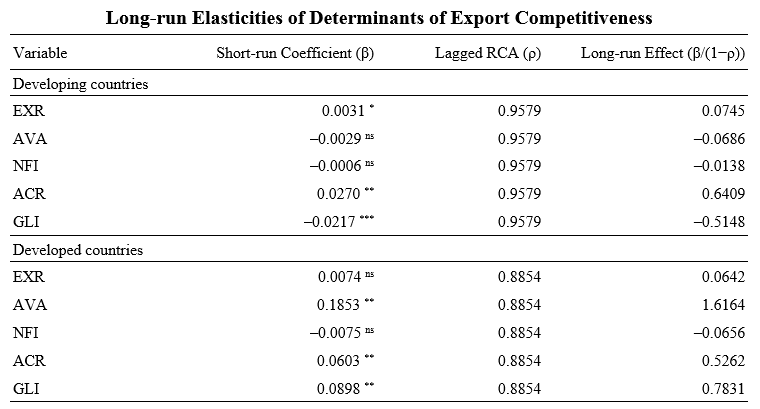
The estimated coefficients reported above represent the short-run effects of each explanatory variable on export competitiveness. Given the high persistence of the lagged dependent variable (0.9579 for developing and 0.8854 for developed countries), the long-run effects were also calculated as (Table 6).
Table 6
Source: Own elaboration.
The results show that the long-run impacts are substantially larger, reflecting the cumulative nature of competitiveness over time. Specifically, the long-run elasticity of globalization on export competitiveness is −0.5148 % for developing countries and 0.7831 % for developed countries, indicating that globalization has a persistent negative association in developing economies but a lasting positive association in developed ones. These results confirm that competitiveness in the fruits and nuts sector evolves gradually, where short-term changes compound over time to produce stronger long-term outcomes.
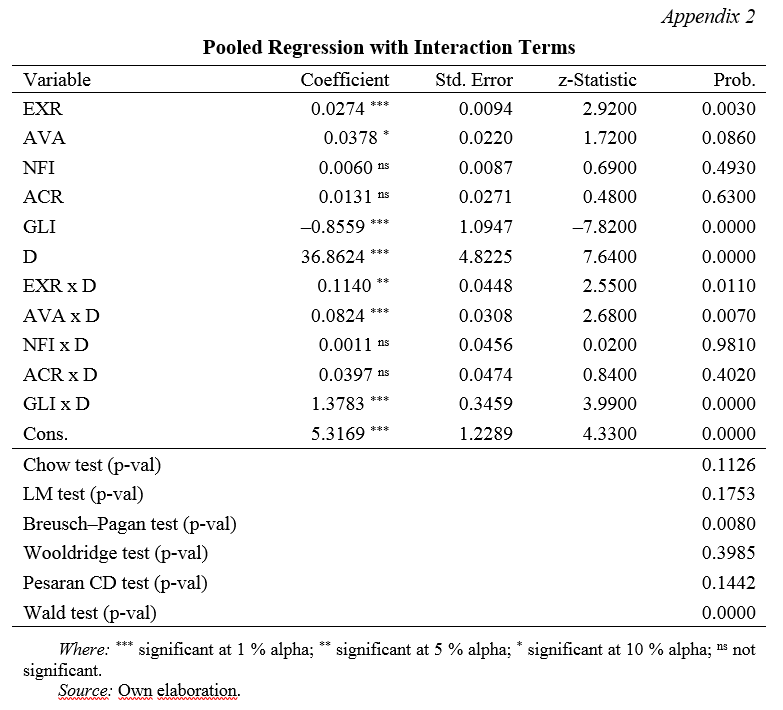
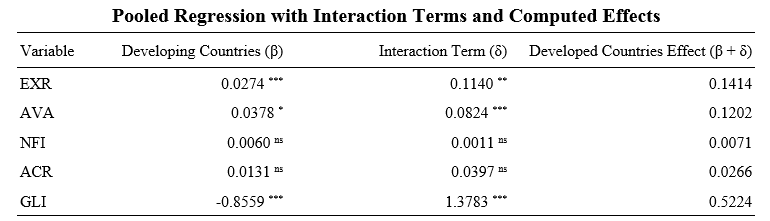
To ensure the robustness of the dynamic panel estimation results obtained from the two-step System GMM model, an additional analysis was conducted using a pooled regression model with interaction terms between the main explanatory variables and a developed-country dummy (the detailed regression outputs are presented in Appendix 2, while the computed effects for developed countries are summarized in Table 7). This robustness specification serves two main purposes. First, it provides a complementary approach by relaxing the dynamic structure of the GMM model, allowing the relationships to be examined under a simpler static framework. Second, it enables a formal statistical test of whether the effects of globalization and other determinants differ significantly between developing and developed countries. Through the inclusion of interaction terms, this model captures potential heterogeneity in the responsiveness of export competitiveness across country groups, thereby strengthening the empirical validity of the overall findings.
Table 7
Source: Own elaboration.
The pooled regression with interaction terms shows that exchange rate and agricultural value added have a positive and significant influence on export competitiveness, with stronger effects observed in developed countries. In contrast, nitrogen fertilizer imports and agricultural credit do not show significant effects in either group. Meanwhile, globalization exhibits contrasting effects across development levels, where it reduces export competitiveness in developing countries but increases it in developed countries. These findings indicate that the key determinants of export competitiveness vary systematically between developing and developed economies.
6. Discussion
6.1. Export competitiveness in developing and developed countries
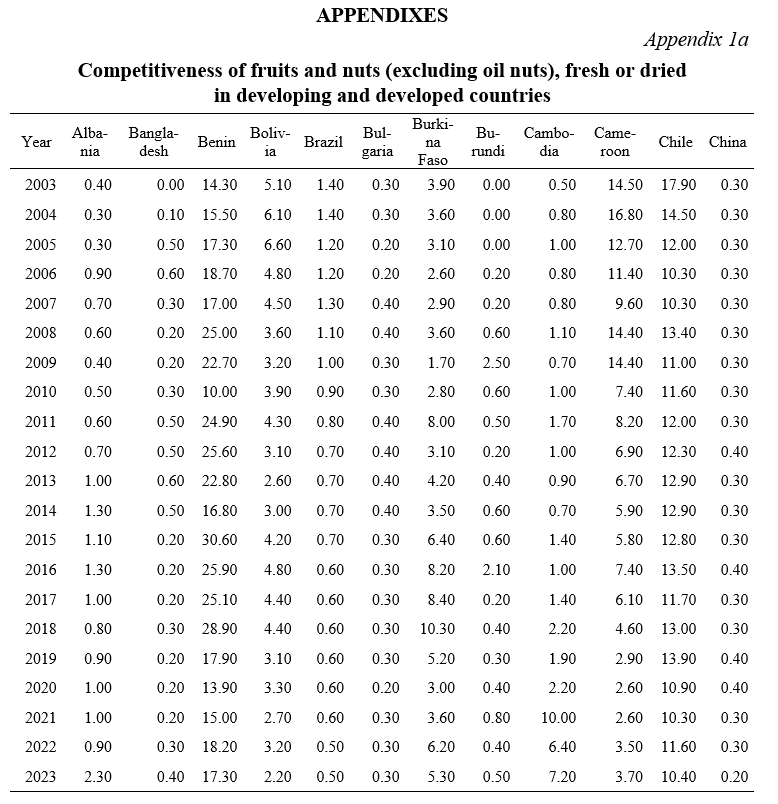
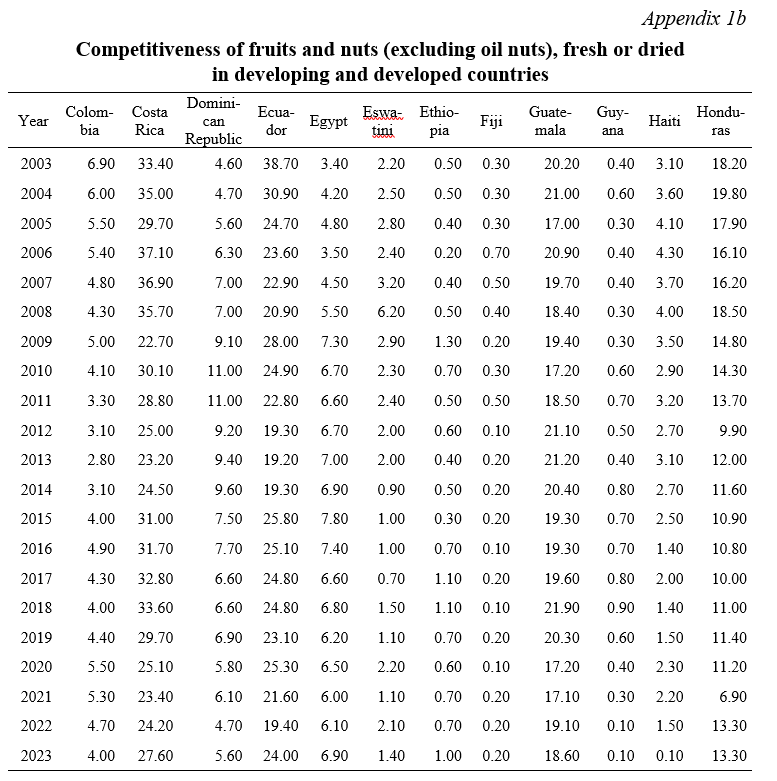
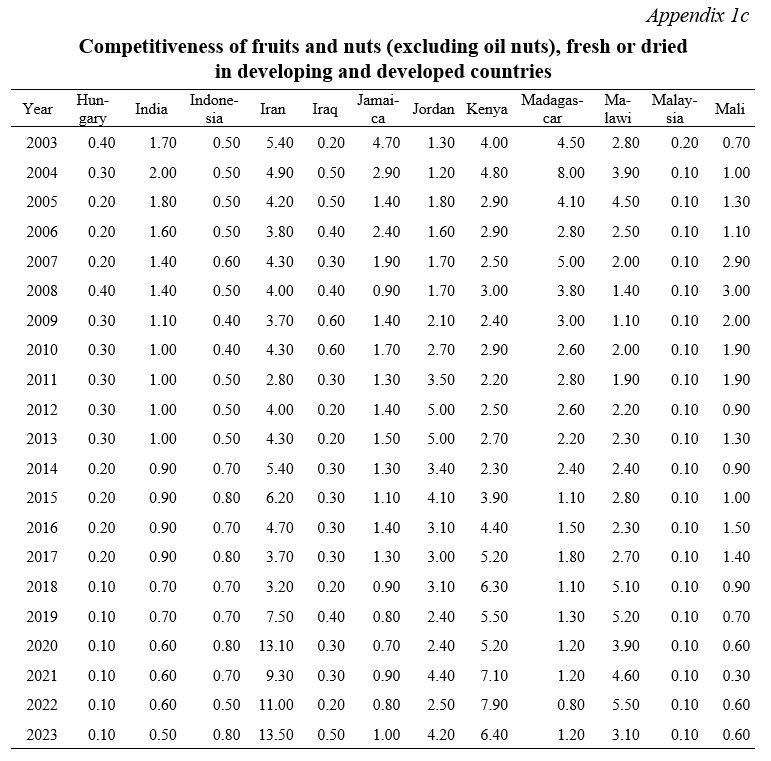
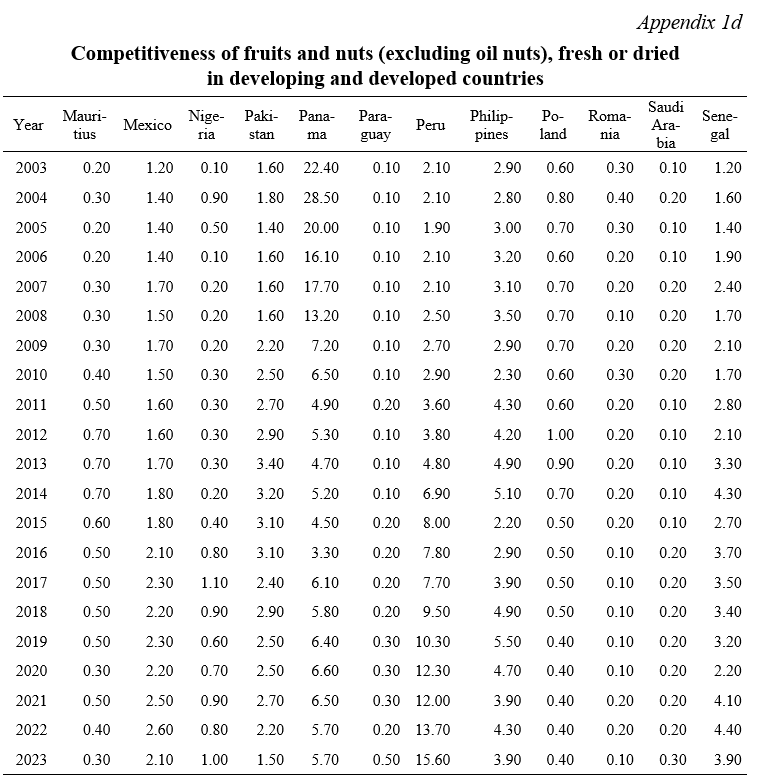
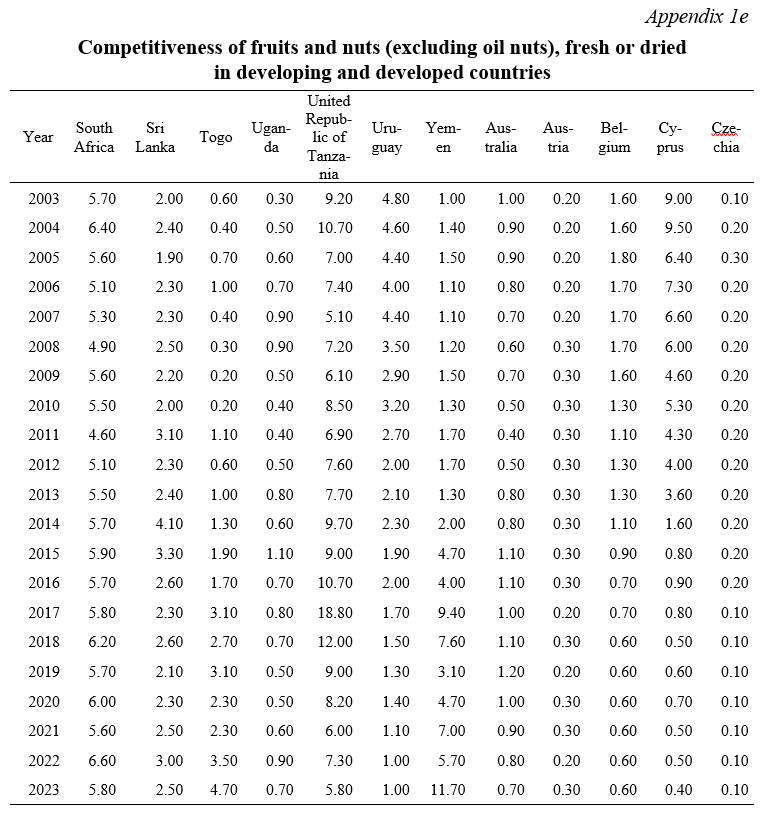
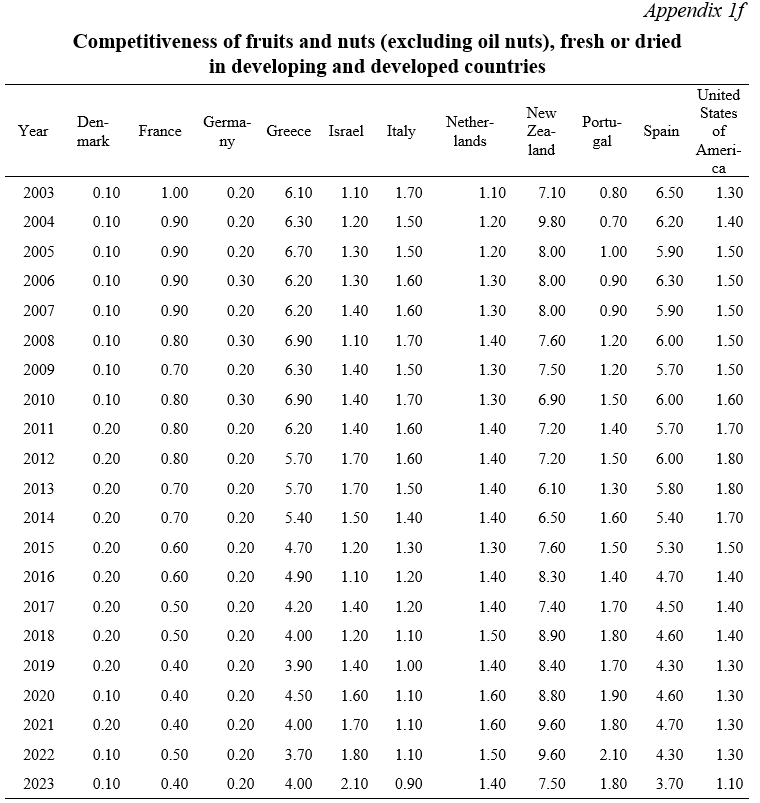
The export competitiveness of both fresh or dried fruit and nut (excluding oil nuts) commodities had an increasing trend over the last decade in both developing and developed countries (Appendix 1a-1f). The increase in competitiveness was due to the implementation of various agricultural policies, especially those related to the provision of agricultural incentives for farmers. The developing countries in Asia focused on agricultural development through modernizing the agricultural sector (Rambo 2017; Wang and Buck 2024), educating farmers to improve their knowledge and skills to implement good agricultural practices (GAP) (Tran et al. 2023; Zhang M. et al. 2023), and increasing farmers’ access to capital (Anik et al. 2017; Ma et al. 2024). Meanwhile, the countries in Africa focused on increasing production and productivity by using appropriate technology to improve the competitiveness of their agricultural products (Habtewold and Heshmati 2023; Porteous 2020). Unlike the countries in Asia and Africa, the countries in the European Union, which are dominantly developed countries, prioritized the implementation of the Common Agricultural Policy (CAP) which provides support for the development of the agricultural sector through the implementation of output subsidy policies, marketing efficiency, increase in agricultural labor productivity, and agricultural risk management (Nowak and Różańska-Boczula 2022; Nowak and Zakrzewska 2024).
From the perspective of modern trade theory, the observed differences in competitiveness trends between developing and developed countries can also be explained by variations in comparative advantage (Schetter 2024), factor endowments (Cieślik and Gurshev 2021), and technological capacity (Marti and Puertas 2023). Developed countries, with greater access to advanced technology, capital, and institutional support, are better positioned to strengthen competitiveness through innovation and productivity growth. In contrast, developing countries tend to rely more on resource-based advantages and labor-intensive production, which may limit their ability to sustain competitiveness under globalization. It is important to note that the export competitiveness analyzed in this study reflects a sectoral dimension, as it is measured using the Revealed Comparative Advantage (RCA) index for fruits and nuts rather than economy-wide trade performance. Therefore, the discussion and interpretation of the results should be understood within the specific context of the fruits and nuts export sector.
6.2. Effects of globalization on export competitiveness of developing and developed countries
The results revealed differences in the effect of globalization on developing countries and developed countries. In developing countries, globalization had a negative effect on export competitiveness; the higher the globalization rate, the lower the export competitiveness in developing countries. In other words, developing countries had not had good readiness to face globalization. Unlike these developing countries, developed countries were more prepared in facing globalization and trade between countries. This is supported by the results of previous research, showing that globalization had a positive effect on the export competitiveness in developed countries.
These contrasting effects were further confirmed by the pooled regression with interaction terms, which showed that globalization reduces export competitiveness in developing countries but increases it in developed countries. This reinforces the view that globalization does not have a uniform impact across development levels, and that its benefits depend strongly on structural readiness (Audi et al. 2025), technological capability (Bashan and Kordova 2021), and institutional quality (Saeed K. A. 2022).
Both developing and developed countries' level of readiness can be assessed in terms of several aspects, i.e., human capital quality, the ability to create efficiency, and strategic trade policies that affect the performance of trade between countries. In terms of human capital quality, developing countries still encountered the problem of low human capital quality, while developed countries had better human capital quality (Phiri 2022). The better the human capital quality, the faster is the emergence of innovations in the agricultural sector and the higher is the productivity of the agricultural sector (Baiyegunhi 2024; Danta and Rath 2024). Human capital development is highly dependent on the education system implemented in each country. We found that although the country is a developing country, for example Malaysia and Saudi Arabia, they have a qualified technology-based education system, very different from Sri Lanka which is also included in the category of developing countries (Alharbi 2023). However, the education system in developed countries, for example Australia, is still superior to developing countries. The education system in developed countries not only equips students to think and act critically in facing various challenges, but also equips students with the ability to actively contribute to society, the economy, and their environment (Yang and Ng 2024).
Developing countries in terms of infrastructure availability are also more limited compared to developed countries. This limited infrastructure drives up logistics costs from production units to export ports (Olyanga et al. 2022; Peprah Adu et al. 2024). Increasing logistics costs can have consequences for increasing product selling prices and higher selling prices can have an impact on decreasing the export competitiveness of the product (Prasada, Nugroho and Lakner 2022). Chakrabartty (2022) emphasized that developed countries tend to be able to manage the entire supply chain of agricultural products well through the availability of solid infrastructure, while developing countries are still tied to various domestic problems such as conflict and riots, so that the management of the supply chain of agricultural products in these countries results in expensive costs. Straub and Terada-Hagiwara (2010) shows that infrastructure development in developing countries tends to have similarities where development takes place massively. However, the impact of this infrastructure development is considered not yet able to increase economic productivity in developing countries.
Furthermore, developing countries also have low institutional quality compared to developed countries. On the other hand, the supply chain of agricultural commodities is very long so that poor institutional quality can hinder the increase in export competitiveness. Developing countries are identical with low institutional transparency, long bureaucracy, corruption, and low law enforcement (Mulyo et al. 2023; Nugroho et al. 2022). Transparency International (2024) released corruption perception index data where developed countries have a very good corruption perception index compared to developing countries. For example, Australia, the Netherlands, and Denmark occupy the top 10 countries with the best corruption perception index in the world. In contrast to developed countries, developing countries have a low corruption perception index, such as Indonesia, Pakistan, and the Philippines which are ranked 100 and above.
In terms of efficiency in the agricultural production process, both on-farm and off-farm, the developed countries were much more efficient than the developing countries. This is due to the fact that the developed countries were more superior in terms of using agricultural technology than the developing countries (Eberhardt and Vollrath 2018; Goel et al. 2021). Sanyaolu and Sadowski (2024) show that Germany and France have shifted to a precision farming system by utilizing technology in the agricultural sector, but at the same time Prasada, Anisya, et al. (2024) show that Indonesia focuses on agricultural mechanization where agricultural mechanization has long been carried out by developed countries.
These findings are consistent with modern trade theory, particularly the concept of comparative advantage and factor endowments, where developed countries with higher technology adoption and skilled labor are able to specialize in high-value products and benefit more from global integration (Elfaki and Ahmed 2024). In contrast, developing countries, constrained by lower technological capacity and institutional inefficiency (Tan et al. 2021), often face adjustment costs that erode their export competitiveness under globalization pressures.
Moreover, the high persistence of the lagged RCA variable found in the GMM estimation indicates that export competitiveness is a highly path-dependent process. Improvements in globalization readiness, infrastructure, or technology are therefore likely to yield benefits only gradually over time, suggesting that structural reforms are essential to enhance long-term competitiveness rather than short-term export gains.
6.3. Other factors affecting export competitiveness in developing and developed countries
The coefficient of one period lagged export competitiveness had a positive coefficient, meaning that the export competitiveness in the current year was influenced by the export competitiveness in the previous year. This was identified in both developed and developing country groups. The result of the analysis was, however, not surprising because some previous studies have shown that the lagged dependent variable can properly explain the variation of the dependent variables (Nugroho and Lakner 2022). In addition, the positive effect of the one period lagged export competitiveness variable on the export competitiveness variable was also caused by the tendency of trade relations between countries, in which both exporting countries and importing countries were willing to maintain mutually beneficial trade relations, thus making the trade relations stronger to maintain trade performance between one country and another (Bekele and Mersha 2019; Eshetu and Mehare 2020).
The high coefficients of the lagged RCA variable (0.9579 for developing and 0.8854 for developed countries) indicate a strong persistence of export competitiveness over time. This suggests that improvements in competitiveness occur gradually rather than instantaneously, reflecting the structural nature of agricultural trade performance. Therefore, the short-run coefficients presented in the GMM results represent only partial adjustments, while the long-run effects (β / (1 − ρ)) are substantially larger, underscoring the importance of sustained policy and institutional reforms to maintain competitiveness in the long term.
The local exchange rate variable against the USD had a positive effect on developing countries, but had an insignificant coefficient on developed countries. Exchange rate is one of the key variables that can promote the competitiveness of agricultural commodity exports (Sedighi 2024). The results of this study are in line with the results of previous research, showing that the depreciation of the local currency against the USD can increase export competitiveness (Lee and Naknoi 2024). This is because currency depreciation lowers the price of goods exported by exporting countries, allowing them to compete with similar products from other countries (Dogru et al. 2019).
The pooled regression with interaction terms further confirmed that the effect of exchange rate depreciation is positive and stronger for developed countries, as indicated by the positive and significant interaction term (δ = 0.1140). This difference implies that developed economies may respond more effectively to exchange rate movements due to better market integration and export diversification (Sein and Sah 2025), while in developing countries, depreciation may improve competitiveness mainly through price adjustments rather than productivity gains (Zhu W. et al. 2022).
The AVA coefficient had a positive effect on developed countries, but had an insignificant effect on developing countries. This is because developing countries have limited ability to formulate value added to exported agricultural commodities due to the low level of industrialization and technology proficiency in the off-farm sector (Haraguchi et al. 2017; James 2021). Unlike developing countries, developed countries have better uses of agricultural processing technology. In fact, an increase in value added is important to improve export competitiveness. Products with value added tend to have better quality, thus allowing them to reach more consumers (Demirci and Erkip 2024; Zaman and Tanewski 2024). The added value of fruit and nuts commodities in this study is limited to dried fruit, frozen fruit, and shelled nuts. However, global demand for these products has tended to increase over the past few years (Hernández-Alonso et al. 2017).
This finding is consistent with the pooled regression results, where agricultural value added significantly enhances competitiveness in both country groups, but with a stronger effect in developed countries (β + δ = 0.1202). The greater impact in developed economies aligns with Porter's Diamond model, which emphasizes innovation capability, advanced factor conditions, and supporting industries as key sources of sustained competitive advantage (Porter 1990).
In addition, the export competitiveness of both fresh and dried fruit and nut (excluding oil nuts) commodities in developing and developed countries is influenced by agricultural credit (ACR). The ACR coefficient was positive, so an increase in agricultural credit could increase export competitiveness. Credit to agriculture is like the financing of farming activities that is usually done by farmers. Higher amounts of credits to agriculture mean that more capital is available to farmers to carry out their farming activities, thus increasing production and productivity in the agricultural sector (Haryanto et al. 2023). For example, in Pakistan which is a developing country, credit to agriculture is channelled through formal financial institutions with an amount that always increases over year; it is directly proportional to an increase in the performance of the agricultural sector (Chandio et al. 2018). Another country, Australia, has implemented a Managed Investment Schemes (MIS) policy to raise investment from investors to help finance credit to agriculture (Larder et al. 2018).
However, in the pooled regression model, the effect of agricultural credit was statistically insignificant for both developing and developed countries. This suggests that while credit expansion may improve production capacity, it does not necessarily translate into higher international competitiveness unless accompanied by improvements in productivity, technology adoption, and export-oriented policies.
7. Conclusion
We conducted a data analysis on the effect of globalization on export competitiveness in 55 developing countries and 16 developed countries. The results of which revealed an interesting phenomenon where globalization has a positive effect on export competitiveness for developed countries, but has a negative effect on export competitiveness for developing countries. These results indicated that developing countries are still not prepared for globalization, leading to increasingly tighter competition between countries. This contrasting effect was also confirmed through the pooled regression with interaction terms, which formally demonstrated that globalization reduces competitiveness in developing countries but increases it in developed countries. The finding suggests that the influence of globalization depends strongly on a country's level of structural readiness, technology adoption, and institutional capacity.
Thus, to increase the readiness of developing countries, it is important to consider several things. First, developing countries need to focus on improving the quality of human capital, to allow them to make more agricultural innovation and help them increase production and productivity. Improving the quality of human capital can be done through training activities, technical guidance, and mentoring for various stakeholders involved in the agricultural product supply chain. Second, developing countries must focus on improving the quality of infrastructure through integrated and environmentally friendly infrastructure funding programs. Third, bureaucratic reform needs to be carried out by developing countries so that it can improve the quality of institutions. Fourth, developing countries need to strive to increase production efficiency by applying appropriate technology. Fifth, developing countries also need to accelerate adaptation processes and address various policies that potentially hinder trade activities to boost export competitiveness.
Export competitiveness in developing countries is also affected by the local exchange rate against USD and the amount of credit to agriculture. A stable exchange rate and an increase in the amount of credit to agriculture can increase export competitiveness in these countries. In developed countries, however, in addition to globalization, export competitiveness is also influenced by value added of agricultural products and the amount of credit to agriculture. To increase export competitiveness, developed countries need to focus on increasing their products' value added, so they can reach a wider market and gain more profits. Besides, developed countries need to focus on providing credit to agriculture to boost production and productivity in the agricultural sector.
From a theoretical perspective, these findings are consistent with modern trade frameworks emphasizing comparative advantage, factor endowments, and Porter's Diamond theory. Developed countries, which possess more advanced technological and institutional environments, can leverage globalization to reinforce competitive advantage, while developing countries still face constraints related to efficiency, governance, and innovation capacity.
The persistence of export competitiveness, as indicated by the significant lagged RCA coefficient, also highlights that improvement occurs gradually over time. Therefore, long-term strategies such as enhancing education, research capacity, and market access are crucial for sustaining competitiveness in the global market.
In this study, agricultural commodities are focused on fruits and nuts (excluding oil nuts). However, international trade is a broad and complex economic activity. In addition, the use of aggregate data is a challenging aspect for the author, because it is very difficult to eliminate all possible confounding factors, so this is a limitation stated in this study.
REFERENCES
Abbas, B., and Procházka, P. 2010. The Effect of Trade Liberalisation on Syrian Agriculture. Acta Universitatis Agriculturae et Silviculturae Mendelianae Brunensis 58 (6 PART 2): 665–672. https://doi.org/10.11118/actaun201058060665.
Al Hinai, A., Jayasuriya, H., Pathare, P. B., and Al Shukaili, T. 2022. Present Status and Prospects of Value Addition Industry for Agricultural Produce – A Review 7 (1): 207–216. https://doi.org/doi:10.1515/opag-2022-0084.
Alharbi, A. M. 2023. Implementation of Education 5.0 in Developed and Developing Countries: A Comparative Study. Creative Education 14 (5): 914–942. https://doi.org/ 10.4236/ce.2023.145059.
Alkharafi, N., and Alsabah, M. 2025. Globalization: An Overview of Its Main Characteristics and Types, and an Exploration of Its Impacts on Individuals, Firms, and Nations. Economies 13 (4): 91. https://doi.org/10.3390/economies13040091.
Angles, S., Sundar, A., and Chinnadurai, M. 2011. Impact of Globalization on Production and Export of Turmeric in India – An Economic Analysis. Agricultural Economics Research Review 24: 301–308. DOI: 10.22004/ag.econ.119383.
Anik, A. R., Rahman, S., and Sarker, J. R. 2017. Agricultural Productivity Growth and the Role of Capital in South Asia (1980–2013). Sustainability 9 (3). https://doi.org/10. 3390/su9030470.
Arellano, M., and Bover, O. 1995. Another Look at the Instrumental
Variable Estimation of Error-Components Models. Journal of Econometrics 68 (1): 29–51.
https://doi.org/
10.1016/0304-4076(94)01642-D.
Audi, M., Ahmad, K., Poulin, M., and Ali, A. 2025. From Globalization to Innovation: Investigating the Impact of R&D, Internet Penetration, and Economic Factors on Digitalization in BRICS. Research in Globalization 11: 100314. https://doi.org/10.1016/ j.resglo.2025.100314.
Bacca-Acosta, J., Gómez-Caicedo, M. I., Gaitán-Angulo, M., Robayo-Acuña, P., Ariza-Salazar, J., Mercado Suárez, Á. L., and Alarcón Villamil, N. O. 2023. The Impact of Di-gital Technologies on Business Competitiveness: A Comparison between Latin America and Europe. Competitiveness Review: An International Business Journal 33 (7): 22–46. https://doi.org/10.1108/CR-10-2022-0167.
Baiyegunhi, L. J. S. 2024. Examining the Impact of Human Capital and Innovation on Farm Productivity in the KwaZulu-Natal North Coast, South Africa. Agrekon 63 (1–2): 51–64. https://doi.org/10.1080/03031853.2024.2357072.
Balana, B. B., Mekonnen, D., Haile, B., Hagos, F., Yimam, S., and Ringler, C. 2022. Demand and Supply Constraints of Credit in Smallholder Farming: Evidence from Ethiopia and Tanzania. World Development 159: 106033. https://doi.org/10.1016/j.world dev.2022.106033.
Balassa, B. 1965. Trade Liberalisation and ‘Revealed’ Comparative Advantage. The Manchester School 33 (2): 99–123.
Balassa, B. 1978. Exports and Economic Growth: Further Evidence. Journal of Develop-ment Economics 5 (2): 181–189.
Baltagi, B. H. 2005. Econometric Analysis of Panel Data (3rd Ed). John Wiley and Sons.
Bashan, A., and Kordova, S. 2021. Globalization, Quality and Systems Thinking: Integrating Global Quality Management and a Systems View. Heliyon 7 (2): e06161. https://doi.org/10.1016/j.heliyon.2021.e06161.
Bekele, W. T., and Mersha, F. G. 2019. A Dynamic Panel Gravity Model Application on the Determinant Factors of Ethiopia's Coffee Export Performance. Annals of Data Science 6 (4): 787–806. https://doi.org/10.1007/s40745-019-00198-4.
Blundell, R., and Bond, S. 1998. Initial Conditions and Moment
Restrictions in Dynamic Panel Data Models. Journal of Econometrics 87 (1): 115–143.
https://doi.org/10.1016/
S0304-4076(98)00009-8.
Broitman, D., Kourtit, K., Broitman, D., and Czamanski, D. 2020. Endogenous Growth in a Spatial Economy: The Impact of Globalization on Innovations and Convergence. International Regional Science Review 44 (3–4): 385–399. https://doi.org/10.1177/016 0017620946095.
Caratti, A., Squara, S., Stilo, F., Battaglino, S., Liberto, E., Cincera, I., Genova, G., Spigolon, N., Bicchi, C., and Cordero, C. 2022. Integrated Strategy for Informative Profiling and Accurate Quantification of Key-Volatiles in Dried Fruits and Nuts: An Industrial Quality Control Perspective. Foods 11 (19). https://doi.org/10.3390/foods1 1193111.
Chakrabartty, S. N. 2022. Understanding National Level Logistics Costs: Methodological
Approach. Journal of Asian Economic Integration 4 (2): 195–207. https://doi.org/
10.1177/26316846221107419.
Chandio, A. A., Jiang, Y., Wei, F., and Guangshun, X. 2018. Effects of Agricultural Credit on Wheat Productivity of Small Farms in Sindh, Pakistan. Agricultural Finance Review 78 (5): 592–610. https://doi.org/10.1108/AFR-02-2017-0010.
Chowdhury, A., Liu, X., Wang, M., and Wong, M. C. S. 2021. The Role of Multilateralism of the WTO in International Trade Stability. World Trade Review 20 (5): 668–689. https://doi.org/10.1017/S1474745621000057.
Cieślik, A., and Gurshev, O. 2021. Factor Endowments, Economic Integration, Round-Tripping, and Inward FDI: Evidence from the Baltic Economies. Journal of Risk and Financial Management 14 (8). https://doi.org/10.3390/jrfm14080348.
CM, J., Hoang, N. T., and Yarram, S. R. 2024. An Inquiry into the Causes of Income Differences among High-Income Countries. Research in Economics 78 (4): 101006. https://doi.org/10.1016/j.rie.2024.101006.
Cubillos T., J. P., Soltész, B., and Vasa, L. 2021. Bananas, Coffee and Palm Oil: The Trade of Agricultural Commodities in the Framework of the EU-Colombia Free Trade Agreement. PLOS ONE 16 (8), e0256242. https://doi.org/10.1371/journal.pone.0256242.
Danta, S., and Rath, B. N. 2024. Do Institutional Quality and Human Capital Matter for Innovation in Case of Asian Region? Innovation and Green Development 3 (3): 100141. https://doi.org/10.1016/j.igd.2024.100141.
Dash, A. K. 2021. Does Globalization Affect Export Performance in India? An Empirical Insight. Journal of Public Affairs 21 (2), e2209. https://doi.org/10.1002/pa.2209.
Davidson, C., Heyman, F., Matusz, S., Sjöholm, F., and Zhu, S. C. 2020. Globalization, the Jobs Ladder and Economic Mobility. European Economic Review 127: 103444. https:// doi.org/10.1016/j.euroecorev.2020.103444.
de Castro Moura Duarte, A. L., Picanço Rodrigues, V., and Bonome Message
Costa, L. 2024. The Sustainability Challenges of Fresh Food Supply Chains: An
Integrative Framework. Environment, Development and Sustainability.
https://doi.org/10.1007/s106
68-024-04850-9.
Demirci, E. Z., and Erkip, N. 2024. Integrating Efforts for Product Development and Market Penetration. European Journal of Operational Research 312 (3): 927–937. https:// doi.org/10.1016/j.ejor.2023.07.017.
Dogru, T., Isik, C., and Sirakaya-Turk, E. 2019. The Balance of Trade and Exchange Rates: Theory and Contemporary Evidence from Tourism. Tourism Management 74: 12–23. https://doi.org/10.1016/j.tourman.2019.01.014.
Eberhardt, M., and Vollrath, D. 2018. The Effect of Agricultural Technology on the Speed of Development. World Development 109: 483–496. https://doi.org/10.1016/j.world dev.2016.03.017.
Elfaki, K. E., and Ahmed, E. M. 2024. Digital Technology Adoption and Globalization Innovation Implications on Asian Pacific Green Sustainable Economic Growth. Journal of Open Innovation: Technology, Market, and Complexity 10 (1): 100221. https:// doi.org/10.1016/j.joitmc.2024.100221.
Endris, M. A., Alemu, A. E., and Kibret, A. T. 2025. Dynamic
Effects of Economic Liberalization, Privatization, and Globalization on the
Export Performance of Ethiopian Privatized Manufacturing Firms. Administrative
Sciences 15 (5). https://doi.org/10.3390/
admsci15050158.
Eshetu, F., and Mehare, A. 2020.
Determinants of Ethiopian Agricultural Exports: A Dynamic Panel Data Analysis. Review of Market Integration 12 (1–2): 70–94. https://doi.org/
10.1177/0974929220969272.
Fanzo, J., McLaren, R., Bellows, A., and Carducci, B. 2023. Challenges and Opportunities for Increasing the Effectiveness of Food Reformulation and Fortification to Improve Dietary and Nutrition Outcomes. Food Policy 119: 102515. https://doi.org/10.1016/j. foodpol.2023.102515.
Fu, H., Huang, C., Teng, Z., and Fang, Y. 2021. Market Structure, International Compe-titiveness, and Price Formation of Hainan's Fruit Exports. Discrete Dynamics in Nature and Society, 2021. https://doi.org/10.1155/2021/6664780.
Gnangnon, S. K. 2024. Effect of the Accession to the World Trade Organization on Commercial Services Exports. Structural Change and Economic Dynamics 70: 106–127. https://doi.org/10.1016/j.strueco.2024.01.008.
Goel, R. K., Yadav, C. S., Vishnoi, S., and Rastogi, R. 2021. Smart Agriculture – Urgent Need of the Day in Developing Countries. Sustainable Computing: Informatics and Systems, 30 (August 2020): 1–10. https://doi.org/10.1016/j.suscom.2021.100512.
Gozgor, G. 2022. The Role of Economic Uncertainty in the Rise of EU Populism. Public Choice 190 (1): 229–246. https://doi.org/10.1007/s11127-021-00933-7.
Gygli, S., Haelg, F., Potrafke, N., and Sturm, J.-E. 2019.
The KOF Globalisation Index – Revisited. The Review of International
Organizations 14 (3):
543–574. https://doi.org/
10.1007/s11558-019-09344-2.
Habtewold, T. M., and Heshmati, A. 2023. Impacts of Improved Agricultural Technology Adoption on Welfare in Africa: A Meta-Analysis. Heliyon 9 (7): e17463. https://doi. org/10.1016/j.heliyon.2023.e17463.
Haelg, F. 2020. The KOF Globalisation Index – A Multidimensional Approach to Globalisation. Jahrbücher Für Nationalökonomie Und Statistik 240 (5): 691–696. https://doi.org/doi:10.1515/jbnst-2019-0045.
Handoyo, S. 2024. Public Governance and National Environmental Performance Nexus: Evidence from Cross-Country Studies. Heliyon 10 (23): e40637. https://doi.org/10.10 16/j.heliyon.2024.e40637.
Handoyo, S., Suharman, H., Ghani, E. K., and Soedarsono, S. 2023. A Business Strategy, Operational Efficiency, Ownership Structure, and Manufacturing Performance: The Mo-derating Role of Market Uncertainty and Competition Intensity and its Implication on Open Innovation. Journal of Open Innovation: Technology, Market, and Complexity 9 (2): 100039. https://doi.org/10.1016/j.joitmc.2023.100039.
Haraguchi, N., Cheng, C. F. C., and Smeets, E. 2017. The Importance of Manufacturing in Economic Development: Has This Changed? World Development 93: 293–315. https:// doi.org/10.1016/j.worlddev.2016.12.013.
Haryanto, T., Wardana, W. W., Jamil, I. R., Brintanti, A. R. D., and Ibrahim, K. H. 2023. Impact of Credit Access on Farm Performance: Does Source of Credit Matter? Heliyon 9 (9): e19720. https://doi.org/10.1016/j.heliyon.2023.e19720.
Heckscher, E. F. 1919. The Effect of Foreign Trade on the Distribution of Income. Ekonomisk Tidskrift 21 (2): 1–32.
Hernández-Alonso, P., Camacho-Barcia, L., Bulló, M., and Salas-Salvadó, J. 2017. Nuts and Dried Fruits: An Update of Their Beneficial Effects on Type 2 Diabetes. Nutrients 9 (7). https://doi.org/10.3390/nu9070673.
James, J. 2021. Confronting the Scarcity of Digital Skills among
the Poor in Developing Countries. Development Policy Review 39 (2): 324–339.
https://doi.org/10.1111/
dpr.12479.
Jegan Joseph Jerome, J., Sonwaney, V., Bryde, D., and Graham, G. 2024. Achieving Competitive Advantage through Technology-Driven Proactive Supply Chain Risk Management: An Empirical Study. Annals of Operations Research 332 (1): 149–190. https://doi.org/10.1007/s10479-023-05604-y.
Kafili, V., Zabihidan, M., and Kondelaji, M. H. H. 2023. Income Distribution and Environmental Pollution: A Panel Data Analysis for the Provinces of Iran, 2005–2016. Regional Statistics 13 (4): 674–695. https://doi.org/10.15196/RS130405.
Karwat-Woźniak, B. 2009. Economic Potential of Polish Agriculture and the Possibilities of its Developing in Globalization Period. Economics and Sociology 2 (2): 54–68. https:// doi.org/10.14254/2071-789X.2009/2-2/5.
Khan, F. U., Nouman, M., Negrut, L., Abban, J., Cismas, L. M., and Siddiqi, M. F. 2024. Constraints to Agricultural Finance in Underdeveloped and developing Countries: A Systematic Literature Review. International Journal of Agricultural Sustainability 22 (1): 2329388. https://doi.org/10.1080/14735903.2024.2329388.
Kim, H.-M., Li, P., and Lee, Y. R. 2020. Observations of Deglobalization against Glo-balization and Impacts on Global Business. International Trade, Politics and Development 4 (2): 83–103. https://doi.org/10.1108/ITPD-05-2020-0067.
Krugman, P. 1980. Scale Economies, Product Differentiation, and the Pattern of Trade. The American Economic Review 70 (5): 950–959. http://www.jstor.org/stable/1805774.
Larder, N., Sippel, S. R., and Argent, N. 2018. The Redefined
Role of Finance in Australian Agriculture. Australian Geographer 49 (3): 397–418.
https://doi.org/10.1080/00049182.
2017.1388555.
Lee, K. Y., and Naknoi, K. 2024. Exchange Rates, Invoicing
Currencies and the Margins of Exports. Journal of International Money and
Finance 141: 103016.
https://doi.org/
10.1016/j.jimonfin.2024.103016.
Levin, A., Lin, C. F., and Chu, C. S. J. 2002. Unit Root Tests in Panel Data: Asymptotic and Finite-Sample Properties. Journal of Econometrics 108 (1): 1–24. https://doi.org/10.10 16/S0304-4076(01)00098-7.
Lugo Arias, E. R., de la Puente Pacheco, M. A., and Lugo
Arias, J. 2020. An Examination of Palm Oil Export Competitiveness through
Price-nominal Exchange Rate. The International Trade Journal 34 (5): 495–509.
https://doi.org/10.1080/08853908.2020.
1766604.
Luo, S., Fang, S.-C., Zhang, J., and King, R. E. 2023. Price Competition and Cost Effi-ciency Facing Buyer's Bounded Rationality. International Journal of Production Economics, 266: 109062. https://doi.org/10.1016/j.ijpe.2023.109062.
Ma, W., Rahut, D. B., Sonobe, T., and Gong, B. 2024. Linking Farmers to Markets: Barriers, Solutions, and Policy Options. Economic Analysis and Policy 82: 1102–1112. https://doi.org/10.1016/j.eap.2024.05.005.
Machado, P. S. 2023. Globalization of Production and Absolute
Advantage in a Classical Approach. Review of Political Economy 2023 (October):
1–19. https://doi.org/10.1080/
09538259.2023.2265102.
Makhlouf, Y. 2023. Trends in Income Inequality: Evidence from Developing and Developed Countries. Social Indicators Research 165 (1): 213–243. https://doi.org/10.1007/s11205-022-03010-8
Mansfield, E. D., and Reinhardt, E. 2008. International Institutions
and the Volatility of International Trade. International Organization 62 (4): 621–652.
https://doi.org/10.1017/
S0020818308080223.
Marti, L., and Puertas, R. 2023. Analysis of European Competitiveness Based on its Innovative Capacity and Digitalization Level. Technology in Society 72: 102206. https://doi.org/10.1016/j.techsoc.2023.102206.
Melitz, M. J. 2003. The Impact of Trade on Intra-Industry Reallocations and Aggregate Industry Productivity. Econometrica 71 (6): 1695–1725. https://doi.org/10.1111/1468-0262.00467.
Meyer, N., and Meyer, D. F. 2017. Best Practice Management Principles for Business Chambers to Facilitate Economic Development: Evidence from South Africa. Polish Journal of Management Studies 15 (1): 144–153. https://doi.org/10.17512/pjms.2017. 15.1.14.
Mulyo, J. H., Prasada, I. Y., and Nugroho, A. D. 2023. Impact of Political and Security Stability on Food Security in Developing Countries : Case of Africa, Asia, Latin America and the Caribbean. Agricultural Economics (Zemědělská Ekonomika) 69 (9): 375–384. https://doi.org/10.17221/142/2023-AGRICECON.
Mushtaq, M., Ahmed, S., Fahlevi, M., Aljuaid, M., and Saniuk, S. 2022. Globalization and Employment Nexus: Moderating Role of Human Capital. PLOS ONE 17 (10): e0276431. https://doi.org/10.1371/journal.pone.0276431.
Nowak, A., and Różańska-Boczula, M. 2022. The Competitiveness of Agriculture in EU Member States According to the Competitiveness Pyramid Model. Agriculture 12 (1). https://doi.org/10.3390/agriculture12010028.
Nowak, A., and Zakrzewska, A. 2024. How Competitive Is the Agriculture in European Union Member States? An Assessment of Changes over the Past Decade. Agriculture 14 (4). https://doi.org/10.3390/agriculture14040612.
Nugroho, A. D., Bhagat, P. R., Magda, R., and Lakner, Z. 2021. The Impacts of Economic Globalization on Agricultural Value Added in Developing Countries. PLoS ONE 16 (11 November): 1–23. https://doi.org/10.1371/journal.pone.0260043.
Nugroho, A. D., Cubillos T., J. P., Bopushev, S. T., Bozsik, N., Fehér, I., and Lakner, Z. 2022. Effects of Corruption Control on the Number of Undernourished People in Developing Countries. Foods 11 (7): 1–24. https://doi.org/10.3390/foods11070924.
Nugroho, A. D., and Lakner, Z. 2022. Effect of Globalization on Coffee Exports in Producing Countries: A Dynamic Panel Data Analysis. Journal of Asian Finance Economics and Business 9 (4): 419–429. https://doi.org/10.13106/jafeb.2022.vol9.no4.0419.
Nugroho, A. D., Prasada, I. Y., and Lakner, Z. 2023. Comparing the Effect of Climate Change on Agricultural Competitiveness in Developing and Developed Countries. Journal of Cleaner Production 406 (March): 137139. https://doi.org/10.1016/j.jcle pro.2023.137139.
Ohlin, B. 1933. Interregional and International Trade. Harvard University Press.
Olyanga, A. M., Shinyekwa, I. M. B., Ngoma, M., Nkote, I. N., Esemu, T., and Kamya, M. 2022. Export Logistics Infrastructure and Export Competitiveness in the East African Community. Modern Supply Chain Research and Applications 4 (1): 39–61. https://doi.org/10.1108/MSCRA-09-2021-0017.
Paul, J., and Dhiman, R. 2021. Three Decades of Export Competitiveness Literature: Systematic Review, Synthesis and Future Research Agenda. International Marketing Review 38 (5): 1082–1111. https://doi.org/10.1108/IMR-12-2020-0295.
Paun, D., Paun, C. A., and Paun, N. 2025. The Digitalization–Performance Nexus in the European Union: A Country-Level Analysis of Heterogeneity and Complementarities. Journal of Theoretical and Applied Electronic Commerce Research 20 (4). https://doi. org/10.3390/jtaer20040274.
Peprah Adu, J., Nirmala, D., and and Keelson, S. A. 2024. Road Transport
Infrastructure and Supply Chain Asset Management: Evidence from Manufacturing
Firms in the Sub-Saharan African Market. Cogent Social Sciences 10 (1): 2327586.
https://doi.org/
10.1080/23311886.2024.2327586.
Phiri, H. 2022. Public Investment and Export Diversification in Low Skilled Labor Force Economies. Evidence from sub Saharan Africa. Cogent Economics and Finance 10 (1): 2008586. https://doi.org/10.1080/23322039.2021.2008586.
Porteous, O. 2020. Trade and Agricultural Technology Adoption: Evidence
from Africa. Journal of Development Economics 144: 102440. https://doi.org/10.1016/j.jdeveco.
2020.102440.
Porter, M. E. 1990. The Competitive Advantage of Nations. Harvard Business Review, March-April: 73–91. https://doi.org/10.1177/014920639101700113.
Prasada, I. Y., Anisya, A. P. M., and Nugroho, A. D. 2024. Impact of Agricultural Infra-structure and Government Support on Farmers' Welfare in Indonesia. Songklanakarin Journal of Science and Technology 46 (5): 450–457.
Prasada, I. Y., and Dhamira, A. 2022. Non-Tariff Measures and
Competitiveness of Indonesia's Natural Rubber Export in Destination Countries. AGRARIS:
Journal of Agribusiness and Rural Development Research 8 (2):
181–197. https://doi.org/10.18196/
agraris.v8i2.11392.
Prasada, I. Y., Dhamira, A., Aisyah, D. D., Anisya, A. P. M., and Puspajanati, R. 2024. Impact of Tobacco Taxation on Rural-Urban Cigarette Consumption in Indonesia. Statistika 104 (1): 55–73.
Prasada, I. Y., Dhamira, A., and Nugroho, A. D. 2022. Agricultural Land Availability and Farmer's Income in Java Island, Indonesia, 1990–2018. Regional Statistics 12 (3): 1–19. https://doi.org/10.15196/RS120304.
Prasada, I. Y., Nugroho, A. D., and Lakner, Z. 2022. Impact of the FLEGT Licence on Indonesian Plywood Competitiveness in the European Union. Forest Policy and Economics 144 (November): 102848. https://doi.org/10.2139/ssrn.4150386.
Rambo, A. T. 2017. The Agrarian Transformation in Northeastern Thailand: A
Review of Recent Research. Southeast Asian Studies 6 (2): 211–245.
https://doi.org/10.20495/seas.
6.2_211.
Ricardo, D. 1817. On Principles of Political Economy and Taxation. Ed. by P. Sraffa and M. H. Dobb. Cambridge University Press.
Saeed, K. A. 2022. Determinants of Institutional Quality and Per Capita Growth in Natural Resource-Dependent Countries. Cogent Economics & Finance 10 (1): 2122189. https:// doi.org/10.1080/23322039.2022.2122189.
Saeed, U. F., and Klugah, G. E. 2025. Driving Inclusive
Growth through Financial Systems and Technology Adoption: A Global Analysis of Synergistic
Pathways Using Structural Equation Modeling. Cogent Economics & Finance
13 (1): 2523955.
https://doi.org/10.
1080/23322039.2025.2523955.
Salvatore, D. 2013. International Economics. 11th edition. Wiley.
Sanyaolu, M., and Sadowski, A. 2024. The Role of Precision
Agriculture Technologies in Enhancing Sustainable Agriculture. Sustainability
16 (15). https://doi.org/10.3390/
su16156668.
Schetter, U. 2024. Quality Differentiation, Comparative Advantage, and International Specialization across Products. European Economic Review 170: 104869. https://doi.org/ 10.1016/j.euroecorev.2024.104869.
Sedighi, S. 2024. Rents, Financial Development, and Economic Growth in MENA Countries, 2000–2020. Regional Statistics 14 (3): 589–608. https://doi.org/10.15196/RS140308.
Sein, P., and Sah, A. N. 2025. Export Dynamics, Exchange Rate Volatility, and Economic Stability: Evidence from Asia-Pacific Economies. Humanities and Social Sciences Communications 12 (1): 808. https://doi.org/10.1057/s41599-025-05099-x.
Skare, M., Sinkovic, D., Kowalska, M., and Szwajlik, A. 2026. Integrating Artificial Intelligence with Market Research: A Dual Approach to Boosting Brand Value. Journal of Innovation & Knowledge 11: 100853. https://doi.org/10.1016/j.jik.2025.100853.
Stauvermann, P. J., and Kumar, R. R. 2023. Production Efficiency and Income Distribution with Competition Induced by Antitrust Measures. Journal of Risk and Financial Management 16 (9). https://doi.org/10.3390/jrfm16090399.
Stiglitz, J. E. 2004. Globalization and Growth in Emerging Markets. Journal of Policy Modeling 26 (4): 465–484. https://doi.org/https://doi.org/10.1016/j.jpolmod.2004.04.010.
Straub, S., and Terada-Hagiwara, A. 2010. ADB Economics Working Paper Series Infra-structure and Growth in Developing Asia (231; ADB Economics Working Paper Series). https://www.adb.org/sites/default/files/publication/28275/economics-wp231.pdf.
Sunge, R., and Ngepah, N. 2019. Agricultural Trade Liberalization, Regional Trade Agree-ments and Agricultural Technical Efficiency in Africa. Outlook on Agriculture 49 (1): 66–76. https://doi.org/10.1177/0030727019870551.
Tabash, M. I., Elsantil, Y., Hamadi, A., and Drachal, K. 2024. Globalization and Income Inequality in Developing Economies: A Comprehensive Analysis. Economies 12 (1). https://doi.org/10.3390/economies12010023.
Tan, X., Zhu, K., Meng, X., Gu, B., Wang, Y., Meng, F., Liu,
G., Tu, T., and Li, H. 2021. Research on the Status and Priority Needs of Developing
Countries to Address Climate Change. Journal of Cleaner Production 289: 125669.
https://doi.org/10.1016/j.jclepro.
2020.125669.
Tesega, M. 2022. Does Financial Globalization Contribute to Financial
Development in Developing Countries? Evidence from Africa. Heliyon 8 (10): e10974.
https://doi.org/
10.1016/j.heliyon.2022.e10974.
Trakem, V., and Fan, H. 2024. Agricultural Trade Liberalization, Governance Quality, and Technical Efficiency in the Agricultural Sector of Southeast Asia. Heliyon 10 (21): e39553. https://doi.org/10.1016/j.heliyon.2024.e39553.
Tran, D. B., Tran, H. T. M., Pham, T. D. N., and Nguyen, T. T. 2023. Education and Agricultural Household Income: Comparative Evidence from Vietnam and Thailand. World Development Perspectives 29: 100489. https://doi.org/10.1016/j.wdp.2023.100489.
Transparency International. 2024. Corruption Perceptions Index. Corruption Perceptions Index. https://www.transparency.org/en/cpi/2024.
Uddin, I., and Azam Khan, M. 2023. Global Evidence on the Impact of Globalization, Governance, and Financial Development on Economic Growth. Journal of the Know-ledge Economy. https://doi.org/10.1007/s13132-023-01656-4.
Wang, K.-C., and Buck, D. 2024. Relocating Agrarian Development in Asia: Food Regimes, R&D Programs, and the Long Twentieth Century. The Journal of Peasant Studies 51 (1): 212–236. https://doi.org/10.1080/03066150.2023.2210510.
WTO. 2019. World Trade Report 2019: The Future of Services Trade. WTO Secretariat, Geneva. https://www.wto.org/englis h/news_e/news19_e/wtr_09oct19_e.htm.
Wu, C.-F., Chang, T., Wu, T.-P., Leng, K., Lin, M.-C., and Huang, S.-C. 2022. Impact of Globalization on the Environment in Major CO2-Emitting Countries: Evidence Using Bootstrap ARDL with a Fourier function. Frontiers in Public Health 10. https:// www.frontiersin.org/journals/public-health/articles/10.3389/fpubh.2022.907403.
Yaman, F., and Offiaeli, K. 2022. Is the Price Elasticity of Demand Asymmetric? Evidence from Public Transport Demand. Journal of Economic Behavior & Organization 203: 318–335. https://doi.org/10.1016/j.jebo.2022.09.005.
Yang, Z., and Ng, D. 2024. Redefining Successful Teaching and Learning in Australia's Education System. Education Sciences 14 (7). https://doi.org/10.3390/educsci14070798.
Yousaf, M., Li, J., Lu, J., Ren, T., Cong, R., Fahad, S., and Li, X. 2017. Effects of Fertilization on Crop Production And Nutrient-Supplying Capacity under Rice-Oilseed Rape Rotation System. Scientific Reports 7 (1): 1–9. https://doi.org/10.1038/s41598-017-01412-0.
Zaman, M., and Tanewski, G. 2024. RandD Investment, Innovation, and Export Performance: An Analysis of SME and Large Firms. Journal of Small Business Manage-ment 62 (6): 3053–3086. https://doi.org/10.1080/00472778.2023.2291363.
Zeng, Z., Han, J., Zhan, J., Wu, Y., and Sun, L. 2025. The Impact of Global Value Chain Embeddedness on the Innovation of High-Tech Enterprises. International Review of Economics & Finance 100: 104095. https://doi.org/10.1016/j.iref.2025.104095.
Zhang, L., Xu, M., Chen, H., Li, Y., and Chen, S. 2022. Globalization, Green Economy and Environmental Challenges: State of the Art Review for Practical Implications. Frontiers in Environmental Science 10. https://www.frontiersin.org/journals/environmental-science/articles/10.3389/fenvs.2022.870271.
Zhang, M., Qin, J., Tan, H., Mao, H., Tu, X., and Jian, J. 2023. Education Level of Farmers, Market-Oriented Reforms, and the Utilization Efficiency of Agricultural Water Resources in China. Economic Change and Restructuring 56 (6): 3927–3947. https:// doi.org/10.1007/s10644-022-09474-5.
Zhang, S., Xu, G., Shu, Y., Zhu, J., and Cheng, W. 2024. Comparing Developed and Emerging Nations’ Economic Development with Environmental Footprint for Low-Carbon Competitiveness. Heliyon 10 (14): e34039. https://doi.org/10.1016/j.heliyon. 2024.e34039.
Zhu, W., Ahmad, F., Draz, M. U., Ozturk, I., and Rehman, A. 2022.
Revisiting the Nexus between Exchange Rate, Exports and Economic Growth:
Further Evidence from Asia. Economic Research-Ekonomska Istraživanja 35 (1): 7128–7146.
https://doi.org/10.1080/
1331677X.2022.2059692.
Zhu, X. 2023. Demand Elasticity of Import Nuts in Korea. Heliyon 9 (3): e13379. https://doi.org/10.1016/j.heliyon.2023.e13379.