The Unilateral Extra-Territorial Economic Sanctions: Evolution from the First World War to Post-Cold War

Journal: Social Evolution & History. Volume 25, Number 2 / September 2026
DOI: https://doi.org/10.30884/seh/2026.02.03
Sarder Kaisar Ahmed University of Barishal, Bangladesh
ABSTRACT
This study examines the evolutionary trends in economic sanctions from First World War to Post-Cold War. Despite the changing patterns of imposing economic sanctions across time, one notable tendency is a remarkable increase in the application of unilateral economic sanctions as a foreign policy tool following the end of Second World War. The study intends to synthesize data on the application of economic sanctions and to compare various interpretations of their content and objectives across distinct historical epochs. The research utilised a diverse array of methodologies, including the formal-legal method for defining fundamental terms and concepts related to the subject-matter, the historical method for examining the progression of unilateral extraterritorial economic sanctions, the systemic method for elucidating the mechanisms of imposing and altering economic sanctions, and the comparative legal method for assessing the unilateral extra-territorial economic sanctions across different historical phases and different state practices. Research indicates that economic sanctions may serve as an effective wartime strategy, yielding significant financial and humanitarian consequences for the sanctioned parties. The study suggests that economic sanctions mechanisms should be proportionate, goal oriented, accountable and fair in eye of public international law.
Keywords: unilateral, economic sanctions, First World War, Second World War, Cold War, Post-Cold War.
INTRODUCTION
In international diplomacy, economic sanctions are frequently imposed. In order to achieve political objectives, Ancient Greece is considered the first civilization to implement economic sanctions (Hufbauer et al. 2019). This paper examines unilateral extraterritorial economic sanctions in the context of two destructive World Wars, the Cold War and the post-Cold War. Athens restricted trade with Megara and blo-cked their ports in the Megarian Decree (about BCE 432), one of the first economic punishments. This was purportedly a diplomatic response to the Megarians' farming of Athenian territory and killing of a herald. Many credit the Megarian Decree with sparking the Peloponnesian War (Morgan et al. 2023).
The analysis indicates that unilateral economic sanctions were employed during wars in the early nineteenth century. In the early twentieth century, the Allied powers' economic blockade curtailed the importation of manganese ore from Brazil to Germany, conducted total war against the Axis powers, regulated contraband, and enforced unilateral economic sanctions on neutral nations and Axis-affiliated third parties. The Covenant of the League of Nations formalised economic sanctions as embargoes. Certain nations commenced the implementation of economic and financial penalties as an alternative to military intervention against countries that breached their obligations under the League framework. Post-World War I, economic sanctions were regarded as an alternative to warfare. Two significant sanctions from this period were dubious. The League of Nations sanctioned the Italian invasion of Abyssinia, Ethiopia, in 1935. Great Britain and France opposed sanctions as Italy resisted Nazi expansionism in Germany. The sanctions were ineffective and undermined the League's credibility. Second, the US put trade restrictions on Japan to deter military conquests in East Asia. Sanctions led to the Japanese choice to incite war by bombing Pearl Harbour in 1941 (Boudreau 1997), rather than replacing it.
Subsequently during World War II, Great Britain, the United States, and other warring states instituted export restrictions, extraterritorial financial oversight, and blacklisting targeting enemy governments, their citizens, and specifically identified third-country enterprises (Domke 1947b). Subsequent to the war, most nations rescinded economic sanctions; but, the United States continued Cold War restrictions against the communist bloc. In the 1990s, the United States and other countries imposed trade restrictions on foreign governments, terrorists, and drug traffickers. Subsequent to Second World War, Western Europe and Japan contested American economic supremacy in the early 1970s (Blum 2003). The United States was the only country that imposed sanctions during this time, accounting for about a third of all sanctions (Barber 1979). Additionally, sanctions were a constant tool in the American toolbox during the Cold War. When the Soviet Union invaded Afghanistan, it triggered harsh economic sanctions and broke the Cold War's détente between the two superpowers. The 1990s were known as the ‘sanctions decade’ due to the widespread imposition of historically high sanctions, actually a forerunner to what followed. Still, changes are obvious (Cortright and Lopez 2005). Trade sanctions may have been employed less regularly. Financial sanctions, especially those tied to weapons transfers, increased. During this period, the objective of sanctions transitioned from regime alteration to the promotion of democracy and human rights.
Following the terrorist attack of September 11, 2001 the economic sanctions imposed by the United States, which influence both US and international sanctions policies, have been centered on the Office of Foreign Assets Control (OFAC). Following the 9/11 era, the predominant economic sanctions globally are applied unilaterally by the United States (Moret 2021). A study revealed that from 1990 to 2015, the US Treasury's OFAC established 150 sanctions regimes (Attia and Grauvogel 2019). During the same period, the research reveals that the EU enacted 75 sanctions, whereas the UN implemented 35. According to prior studies, the United States imposes half to two-thirds of all global sanctions (Ibid.).
ORIGIN AND DEFINITION
1.1. Sanctions
International law faces a significant challenge with ‘sanctions.’ The expression is both positive and negative. A legal sanction confers legitimacy and dignity upon the legislation. The term ‘sanction’ occasionally connotes retribution for misconduct. Negative connotations render the penalty more ambiguous. Sanctions lacking legal legitimacy have been a crucial concern in international law. To comprehend the sanctions environment that influences global politics and economics, one must grasp the etymology of the term ‘sanction.’ Martin Luther King stated, ‘We do not create history; we are shaped by it.’ Athens implemented sanctions in 432 BC (Cortright and Lopez 2005). The Megarian Import Embargo enacted against Greek city-states who declined to join the Athenian-led Delian League during the Peloponnesian War (Thucydides 1948). However, the word ‘sanction’ comes from the Latin word ‘sanctio,’ meaning to approve. Initially, it was used for church degrees. Auto-antonyms like ‘sanction’ are noteworthy since they have numerous meanings, one of which is opposite. Sanction can also authorize an activity. The original definition of sanction is explained in Black's Law Dictionary. Sanctions ensure law compliance. A law has a sanction when a state will enforce it (Garner and Black 2024). ‘Sanction’ is a punitive measure to enforce a law. In ge-neral, a ‘sanction’ is approbation of any action. A statute that imposes a penalty for infringement is also called a ‘sanction’. Sanction has many meanings depending on the context. Sanction can be implicit or explicit approval (Ibid.).
Jon Austin, Hart, and Kelson research international sanctions law. Positivist jurist Austin endorsed command law and coercive sanctions. Austin defines command by strength and desire to harm rather than gain (India Legal Service 2025). As an advocate of the pure theory of law, Kelsen broadens the notion of penalty to encompass state-sanc-tioned activities, such as property expropriation for the public benefit (Ibid.). Under ‘international sanctions’, states or organisations employ non-military coercion. Sanctions exert pressure and alter the behaviour of a state, a coalition of nations, or a non-state entity. From this viewpoint, the entity that enacts international sanctions is referred to as the sanctioning state, source, or initiator, whilst the entity subjected to non-armed coercive measures is termed the sanctioned state or target. Individual states or groups may implement international sanctions. Sanctions are characterised by their institutional framework. The sanctions imposed by one state are unilateral. It becomes multilateral when international bodies or informal coalitions of governments adopt it. Multilateral or collective sanctions are implemented by the UN Security Council pursuant to Chapter VII of the UN Charter. Collective sanctions are non-military coercive measures within the UNSC framework designed to address ‘any threat to peace, breach of peace, or acts of aggression.’
1.2. Extra-Territorial Nature of Sanctions
The primary issue is the extraterritorial nature of unilateral sanctions under public international law. In public international law, ‘extra-territorial’ pertains to a state's regulations or doctrines concerning individuals, assets, or occurrences beyond its territorial boundaries. Initially, extraterritorial punishments must be differentiated from their execution (Kerbrat 2021). State sanctions strive to influence international behaviour. They want to change or undermine a foreign government's policy or the policy of entities operating in a foreign territory, ensure that a foreign government upholds human rights for its citizens, or stop illegal or objectionable actions abroad. Penalties may prompt international law inquiry about their compliance with sovereign equality or non-intervention (Tzanakopoulos 2015). Apart from this, such extra-territorial effects raise the vital question as to the jurisdiction of state practices under international law. The extra-territorial impact of sanctions is different from their implementation. It concerns the execution of sanctions, not their goals. This strategy involves enforcing sanctions on individuals inside and outside the sanctioning state (Tzanakopoulos 2015). Most state penalties are extra-territorial, signifying their applicability to all nations regardless of geographic location. Extra-territorial unilateral sanctions prompt enquiries regarding governments' prescriptive as opposed to enforcement jurisdiction. The dispute is to authority extending outside the specified region, rather than the state's penalties for sanction offenders (Kerbrat 2021).
In this context, it is necessary to elucidate extra-territorial jurisdiction in public international law. Extra-territorial jurisdiction is considered the ‘state competence’ to implement and enforce rules or principles beyond its national borders. The state jurisdiction is exercised through three modes: prescription, adjudication, and enforcement (Kamminga 2020). Prescriptive jurisdiction denotes a State's power to establish legal norms. Adjudicative jurisdiction pertains to a State's power to resolve conflicting claims. Enforcement jurisdiction denotes a State's power to guarantee adherence to its statutes. Due to the lack of a globally recognized definition, extra-territoriality is an ambiguous notion encompassing a diverse range of actions. Consequently, the application of extraterritorial jurisdiction may conflict with the restriction against meddling in another state's internal affairs or infringe against its right to territorial integrity and political independence (Ibid.).
1.3. Unilateral Economic Sanctions
Economic sanctions are prevalent instruments employed in international diplomacy. Ancient Greece is regarded as the first civilisation to employ economic sanctions to advance political objectives (Hufbauer et al. 2019). To advance foreign and security policy, ‘economic sanctions’ include ending financial and trade links. The world has faced UN and non-UN economic sanctions. Despite their long history, unilateral economic penalties under international law are still debated. A total eco-nomic embargo or particular trade restrictions enacted without UNSC permission are controversially called ‘sanctions.’ Pellet recently advocated for the term's expansion to include unilateral state restrictions (Pellet 2015). Tom Ruys adopts the phrase ‘non-UN sanctions,’ echoing the latter viewpoint (Ruys 2017), although Devika Hovell characterizes them as ‘autonomous’ (Hovell 2019). The situation is further complicated by the fact that state practice is inconsistent. The United States specifically refers to its unilaterally imposed restrictions as ‘economic sanctions.’ For example, the term ‘sanction’ is employed exclusively in the United States federal law that imposes unilateral economic penalties on Russia, Iran, and North Korea. The European Union (EU) refers to these measures as ‘restrictive measures,’ while Canada refers to them as ‘special economic measures’ (Finelli 2023). Essentially, the current investigation concentrates on unilateral economic sanctions. Unilateral economic sanctions are restrictive economic measures that are imposed by individual states against other states, their bodies, government officials, or legal entities and individuals on the basis of their domestic laws, without prior authorization from an international or regional organization (Bogdanova 2021).
Unilateral economic sanctions are fundamentally in opposition to the collective or multilateral sanctions that are addressed in the UN charter. Typically, an individual state implements unilateral economic sanctions as a primary instrument of foreign policy in order to enhance the behaviour of the targeted state. Through its national legislation, an individual state implements unilateral economic sanctions that are initially extraterritorial in nature. Consequently, the boundaries of legal equality between states, as well as the principles of respect for and dignity of national sovereignty and non-intervention in the internal affairs of the state (UN Charter, Art 2(4), 1945) may be surpassed by unilateral economic sanctions and their extraterritorial effects (UN Charter 2 (7) 1945). An individual state usually impose unilateral sanction by the name of retortion1 (Crawford 2022) or retaliation2 (Scha-chter 1997) or reprisal.3 Sanctions are generally identified as negative measures since it seeks to invoke penalties or conduct of threat for non-compliance with law (Doxey 1972).
2. HISTORICAL EVOLUTION OF UNILATERAL EXTRA-TERRITORIAL ECONOMIC SANCTIONS
‘Neither war nor economics can be divorced from politics; each must be judged as an instrument serving the higher goals of the polity’ (Baldwin and Kapstein 2020). In order to achieve political, economic, and ideological objectives, states have implemented sanctions or controls over time. During the duration of a war, the economic strength of the target state is reduced through military attack and economic means (Carr 1946). Sanctions escalated throughout the eighteenth century due to the augmented maritime power and naval combat capabilities of several powers. The naval blockade captured and sank enemy vessels, or intercepted trade and cargo. To restrict commerce with adversarial nations, measures such as inspecting neutral vessels on the high seas for contraband and wartime materials were employed (Hofer 2017). The Stamp Act of 1765 precipitated the inaugural substantial economic boycott in the United States. The colonies initiated a boycott of English goods following the enactment of Parliament's Stamp Act (O'Brien and McCue 2002). Economic sanctions became an important tool of U.S. foreign policy during American independence and the Napoleonic Wars. The U.S. President gained the right to penalise ships and vessels and suspend or end trade with other nations between 1794 and 1809 (Malloy 2002).
In 1807, President Thomas Jefferson banned foreign ships from docking in the US ports and bringing US commodities. The US sailing vessels trading with France were limited by the UK in 1811. The U.S. trade embargo on the UK started the War of 1812 (Hofer 2017). French self-sufficiency rendered the UK's trade ban ineffective, but Continental Europe suffered. The British and French economic blockade on the enemy's economy throughout war increased effects (Doxey 1971).
During and after the nineteenth century conflict, the US government limited trade. In the Civil War, Washington's Union blockaded seceded states (Bemis 1967). Congress allowed the president ‘to prohibit export of coal used in war’ in Resolution 1898. American-opposed Spanish war was prohibited. President Roosevelt imposed a trade embargo on the Dominican Republic after the Spanish-American War based on this decision. Limiting arms exports supported US interests in Latin America and China (Atwater 2000). In the early 1990s, technology rendered wartime blockade policy obsolete (Doxey 2016). Customary international law confining blockades to enemy shorelines and ports is worthless in aircraft and submarine warfare. Combat went beyond the battlefield with mechanisation. Embargo expenses decreased with neutral or third-state trade. In war, adversarial states must closely monitor neutral or third-party governments' trade and investment in critical goods and services to retain economic dominance.
2.1. Restriction on Manganese Trade in 1914
Britain restored its European dominance in August 1914. Again, naval superiority limited its land-based rival's global trade. In the early twentieth century, global trade, market integration, industrialization, and democratization were unprecedented. Unlike during the Napoleonic times, the Triple Entente of Britain, France, and Russia fought the Central Powers of Germany and Austria-Hungary economically.4 Entente established a superb economic monitoring and control system to isolate regional adversaries from world trade. The allies realized that economic warfare may help avoid wars. In economic warfare, Britain and her allies exploited reliance. For this, they manipulated the global economy. Using intelligence, expertise, and policy instruments, they isolated their foes. An Allied financial blockade and raw material import control pressed the Central Powers. In 1914, the Allies gained manganese, a small but vital material (Mulder 2023).
Germany produced the second-most steel in the 1910s after the USA. Though it dominated the European steel market, it imported manganese ore. Most manganese came from Brazilian and Georgian Chiatura mines. Brazil's manganese ore was better than Chiatura's, and naval shipment to Germany was cheaper than rail. Brazil shipped steel to Germany by sea. Germany bought manganese ore from Brazil under the Itabira-Krupp arrangement,5 a notable transactions in the globalized context of 1914. It was complicated for Krupp to buy Brazilian ore. London handled the steel company's ore request. Deutsche Überseeische Bank enabled Deutsche Bank provide Latin American trade financing. British, US, Norwegian, and German merchant marines were significant. Lloyd's insured marine vessels and cargo. Shipping requires marine fuel and manganese ore needs storage after sea shipment. The British insurance, fuel, commerce, and storage prevailed then. Besides Krupp and Itabira, seven organizations in six nations imported manganese ore from Brazil to Germany. These complicated supply and payment mechanisms revealed European nations' global trade in the 1910s. Manganese-laden boats show the complexity, linkages, and dynamism of the world trade in 1914. But how could this complex global trading system be regulated during war? Since the probe was practical, Britain and France implemented a blockade tactic that shaped modern sanctions.
2.2. Distant Blockade via Contraband Control
Before the First World War, the Royal Navy planned a coordinated attack on German finance and commerce. In the early weeks of the war, the Admiralty's ‘Economic Schlieffen Plan’ failed (Coogan 2015). The Royal Navy started a blockade, but the residents and military stopped it. The short blockade had two notable implications for future blockades and sanctions. A short blockade was ‘a less burdensome legal form of pressure than a full blockade.’ They were first considered as statecraft and military strategy. The central government's economic embargo was contraband control, not a blockade. Only hostile freight and equipment were banned. In the war-torn North Sea, the British Navy enforced a ‘distant blockade’ using contrabands (Doxey 2016).
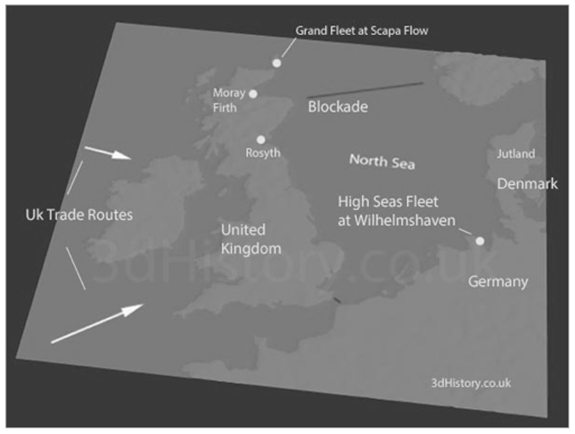
Fig. Distant Blockade during First World War
The Paris Declaration of 1856 authorised the seizure of private vessels transporting hostile goods and services, justifying the British and French distant blockade. They argued that letters of marque and the elimination of privateering allowed a hostile side to authorize the capture of privately-owned vessels transporting enemy goods (Wikipedia N.d).
German submarine warfare against Allied commerce vessels began in February 1915, causing the British government to work with France to isolate Germany. Three years into the First World War, the French blockade targeted the Committee for the Restriction of Enemy Commerce and Provisions (Greenhalgh 2009). It was founded in March 1915 by the Foreign Ministry as the ‘Comité R.’ The French ‘Section de contrôle économique’ recorded wartime crimes. British pressure infuriated neutral and third parties, while French blockaders claimed economic pressure cost the Allies money. French blockaders believed Britain's economic war risk-aversion would fail (Doxey 2016).
2.3. British Extra-territorial Economic Sanctions in 1915
As a tool of retaliation for German submarine warfare, the UK government imposed economic sanctions and a blockade in March, 1915 (Carr 1946). The Allies discovered neutral traders with Germany, and the British government prioritized neutral third parties for restrictive trade policies. The British government viewed neutral third countries as an economic weapon, and British intelligence employed ‘blacklisting’ of neutral third-country suspects. The Intelligence Force sought German-related businesses (Medlicott 1952). The then-British government agreed with neutral states and trade associations not to re-export British goods to Germany or its allies. Britain took three steps:
a. imposing import restrictions on third countries suspected of secretly trading with Germany;
b. ‘blacklisting’ private enterprises or suspected enemy contacts, and
c. refusing to trade with adversaries using English port facilities (Medlicott 1952).
British intelligence actively tracked the trading activities of all British citizens worldwide during this period. This blockade differed from the Napoleonic wars in terms of unilateral sanctions and end. Direct naval blockades of enemy coasts were replaced by extraterritorial blockades targeting neutral states and their nationals suspected of trading with foes (Guichard 1930).
2.4. Total Economic War under the Ministry of Blockade
In early 1916, the British Prime Minister Herbert Asquith and the French Prime Minister Aristide Briand agreed that economic warfare needed a better plan. In order to centralize contraband control, the British government established the Ministry of Blockade on February 23, 1916 (Anderson 1995). Lord Robert Cecil became the head of the Blockade Ministry (Johnson 2016) and he led British economic warfare while the ministry remained independent. The Blockade Ministry centralized economic warfare against the enemy. Economic warfare caused epistemological and organizational transformation (Foucault 2009). The British blockaders used knowledge creation in economic warfare. From ‘evidential’ to ‘scientific’ statistics, they developed a blockade. The idea was implemented by Cecil's subordinate and close friend, William Arnold-Forster, who drove an intellectual revolution in economic warfare. He saw a lot of neutral trade reaching the enemies. His ship rationing replaced evidence-based methodologies (Osborne 2013). Statistics restricted maritime commodity imports for rationing. British officials claimed rationing controlled world trade. Dutch neutrals struggled to meet domestic demand through restrictions.
In the spring of 1916, the Ministry of Blockade implemented a robust energy regulation system using British-owned and supplied bunker coal globally (Osborne 2013). Energy or bunker control was ef-fective in monitoring global trade records of neutral vessels, as all ships in British ports were stopped for cargo inspections and coal supplies. Ships were added to the whitelist after inspection and coaling. The fourth French blockade restricted neutral trade (Anderson 1995). Two years into the war, raw material shortages halted German manganese production. French intelligence reported Royal Naval patrols intercepting German manganese smuggling. Intelligence, assessment, diplomatic assistance from allies and neutrals, and naval strength intensified the Brazilian manganese ore blockade.
Europe-world trade slowed. The central powers sought outside funding. Many Dutch and Scandinavian neutral banks performed large financial transactions. Germany facilitated transactions with neutral financial centers (National Archives 2009). Cecil's Blockade Ministry restricted shipments. Davies became the finance chief under Cecil. Davies advised engaging City of London merchants to investigate neutral state-Germany trades. Increased bureaucracy and restrictions on financial centers damaged foreign exchange business in the City of London. Davies said, ‘it is preferable to incur financial losses for six months and achieve victory than to generate profit and jeopardize the Empire’ (The National Archives 2009a).
Finance authorized fair London transactions with stamps. Financial Section controlled postal routes and submarine telegraph cables for transactions. Thus, controlling on mail and signals became instrumental in order to interrupting the transactions of Central Powers with rest of the world. By demanding monthly neutral nation transaction flows for British-incorporated banks, Finance created its intelligence network (The National Archives 2009b). After becoming Head of the Finance Section in 1916, Sir Adam Block championed the end of Swiss banking operations, calling them Kaiser's unethical financiers. After consulting with French blockade officials, he advocated rejecting all US money orders to neutral countries through London (Sayous 1916). German and Latin American banking continued, but the branches of European banks in Latin America were blocked again. In late summer 1917, the USA entered the war, changing things. The finance capitals of New York, London, and Paris were under Allies' control. Financial blockages increased, prohibiting the Allies from dealing with neutral civilians with Central Powers ties. His French colleague, Octave Homberg, feared that broad sanctions on neutral banks would backfire. ‘The weapon we will have created will ultimately be turned against us,’ Homberg said (The National Archives 2009b). He argued that a blacklist-style system of discretionary punishment against improper transfers would target arbitrageurs trading against Allied currencies. Economic sanctions were shaped by government financial intervention.
2.5. The US Extra-territorial Sanctions during First World War
The U.S. joined the Allies in 1917 as an associate power (Offer 2023). Before the war, the US was neutral and opposed the British extraterritorial export control system. The United States claimed that British economic penalties violated American sovereignty and hampered American trade (Carr 1946). After that, the US helped Britain enforce a Central Powers' trade embargo. The Trading with the Enemy Act of 1917 restricted US trade, like the British embargo, and the US and UK imposed trade restrictions and penalties on neutral nations (Offer 2023).
After the US entered the war, the Central Powers were worried about New York, London, and Paris. These three large cities' early twentieth-century military and economic embargoes contributed to Germany's loss in the First World War (Shaw 1997). The US-UK partnership and trade and investment enforcement improved combat effectiveness, and similar legal grounds supported Allied abuses of economic power. Trade restrictions had a greater extraterritorial impact after the allies adopted common legal principles. The Allies' trade restrictions cut German exports and investments by 80 % (Hofer 2017). Medlicott said, that ‘The embargo has inflated the value of economic pressure for international peace’ (Medlicott 1952). Extraterritorial regulations and the UK and US third-party blacklisting strained Germany's economy.
2.6. The Birth of Institutional Form of Economic Sanction
Economic isolation fractured every nation's bones under embargo (Carr 1946). Boris Kadomtsev correctly observed, that ‘Many histories of war would have to be entirely rewritten if the influence of the Blockade in the affairs as well as in the “history of the world” were to be given its true place’ (Kadomtsev 1919). War-time American participation changed the embargo. The UK, France, and the US led ‘the Economic Weapon’ from late 1917 to summer 1918. Control over raw materials is essential to defeating the Central Powers. French newspaper editor, Leon Bailey, said, ‘The most decisive economic weapon, capable of subduing the aggressor without bloodshed, will be utilized.’ Germany will recognize the threat and the League of Nations is real (Farcis 2018).
Despite the November 1918 Armistice, the Allies imposed a blockade. The Versailles Treaty eased trade restrictions in July 1919, but Alliance sanctions continued to rule the globe. A new international framework was developed at the Paris Peace Conference. (Oulahan 2019) said that the party would ‘govern by economic compulsion.’ The League of Nation's Article 16 – ‘the termination of all trade or financial relations, the prohibition of all interactions between their nationals and those of the covenant-breaking state, and the prevention of all financial, commercial, or personal interactions between the covenant-breaking state's nationals and any other State’ – was a backroom agreement. Under this commitment, League members helped each other financially and economically in order to reduce losses and inconveniences (League of Nations 1919: Art 16). Cecil and Leon Bourgeois believed that the League used non-economic sanctions. The Paris Peace Conference prompted the creation of the Covenant of the League. Economic sanctions were codified and transformed abruptly (Carr 1946).
3. ECONOMIC SANCTIONS DURING THE SECOND WORLD WAR
The absence of coordination and legal frameworks hindered the effectiveness of League of Nations economic sanctions in deterring aggressors. The League's sanctions were less effective than those imposed by the Allies during World War II due to their reliance on centralised decision-making among member states and pragmatic measures to obstruct Axis supply routes and extra-territorial control over neutral nations' commerce with targeted countries. Recent sanctions proved to be less effective (Hofer 2017). The Second World War sanction regimes were based on unified statutary provisions that created legal accountability and promoted interstate cooperation and control over commercial transactions with sanctioned states.
3.1. The British Economic Sanctions Strategy
Britain's Ministry of Economic Warfare blockaded German industry unrestrainedly. Germany's exports to the UK fell by 80 % in two months after the UK government regulated imports (Medlicott 1952). Product interception on German high-seas markets was less important than during World War I. British shipping warrants and blacklisting prevented enemy cargo transport (Ibid.). After the US entered the war in 1941, Britain and America banned trade. During World War II, British Economic Warfare pioneered First World War methods. Blacklisting differed from World War I, since during the Second World War Allied blacklists revealed the financial and economic ties of third nations' Axis. Early in the War, the Board of Trade (BOT) issued ‘Black List’ directives under the Trading with Enemy Act of 1939. The 650-item ‘Black List’ (Enemy Act 1939) included anti-Allied companies and institutions. The BOT further instructed British nationals to avoid trading with these named parties without explicit permission (Trotter 1919).
3.2. The US Economic Sanctions Strategy
The US entered World War II in 1941, but unlike World War I, it imposed a trade embargo in 1939 and worked with the British blacklist. The US trade embargo during the war was based on foreign finance regulation and neutral party export licensing. A blacklist was also developed to handle ‘corporate cloaks’ and ‘fronts’ working with the Axis forces. The US blacklist was called ‘Proclaimed List of Certain Blocked Nationals’ (Domke 1947b). Subsequently, the US Treasury Department acknowledged that ‘from the outset of the freezing program, a contract limited to individuals who were actual citizens of the Axis nations or other countries under their control would be ineffectual and, in fact, naïve considering Axis conduct’ (Hofer 2017). The US Treasury Department established a scheme of sanctions to regulate Nazi web participants (Trotter 1919). The USA, UK, and other allies recognized civil and criminal culpability rules that allow for international sanctions against corporations and individuals trading with hostile governments. However, transnational financial and corporate sanctions lacked justice. Government extraterritorial jurisdiction and corporate organization responsibilities caused disparities. Under enemy and emergency legislation, the UK and the USA strictly enforced export prohibitions and asset freezes (Trotter 2019). Trade constraints against the Axis countries were tightly enforced during the war, and eventually export curbs became export controls against Communist bloc governments (Domke 1947a). The USA and UK successfully imposed bilateral cooperation extraterritorial trade embargo and financial sanctions on neutral country citizens and entrepreneurs who traded with Nazi Germany and its allies during the war.
4. ECONOMIC SANCTIONS AFTER THE SECOND WORLD WAR
Economic sanctions regimes involve cross-border coordination between state policymakers and regulatory authorities, as shown during the Second World War. The US implemented export bans, general economic sanctions, and asset blocking orders against Soviet-bloc and Asian com-munist regimes after the war (Malloy 2002). The UK consolidated more thorough export regulations based on the Cold War-era Coordinating Committee for Multilateral Export Control (CoCom) standards. The UK government phased out most of its economic sanctions after the Second World War (Ibid.). After that, the US Treasury Department blacklists became an economic warfare. Since 1966, OFAC wartime enforcement has included blocking orders and US blacklisting (Hofer 2017). Most people believe that Allied sanctions during World War II were effective in imposing economic costs on Axis powers and boosting the war effort. However, penalty enforcement was inconsistent and lacking. Different countries and entrepreneur control liabilities divided Allied trade embargo policies. Today, policymakers face similar obstacles when designing wartime sanctions. Policymakers want to identify weaknesses in many national programs in order to find an effective worldwide sanctions framework.
4.1. The Evolution of Economic Sanction during the Early Cold War Period
About one-third of these sanctions were imposed by the United States alone. The US involvement in UN and ad hoc global coalition efforts made it the most frequent penalty imposer and the main driver behind their increase. After the World War II, there was an intensified need for diplomatic alternatives to war. The Second World War decimated the industrial capabilities of most high-income countries, including the United States. The USA also maintained Cold War policies via sanctions. The Cold War between the USA and the USSR affected world politics after World War II (Barber 1979).
4.2 Economic Sanction during the Late Cold War Period
Following the Second World War, Western Europe and Japan began to contest American economic dominance in the early 1970s (Blum 2003). The organization, once dubbed the European Economic Community (EEC), enabled member cooperation. Economic ‘shocks’ like President Richard Nixon's unilateral decision to let the dollar's exchange rate fluctuate and the OPEC oil embargo in 1974–1975, which raised oil prices and supported Soviet power, while likely encouraging global aggression, showed the growing vulnerabilities of the US economy. The US-USSR détente ended with the Soviet invasion of Afgha-nistan, which prompted economic sanctions. In addition, the US Symbionese Liberation Army, Italian Red Brigades, and West German Baader-Meinhof gangs used terrorism. The US-led sanctions increased. The International Emergency Business Powers Act of 1977 gave the US president broad business regulatory powers after a national emergency. While this statute was the ‘all-purpose’ tool for US sanctions, the US economic penalties often violated international law (Hufbauer et al. 2019). European opposition organised. Although trade restrictions remained, financial and military sanctions increased. Although regime destabilization remained constant, human rights sanctions intensified. Ending international terrorism required sanctions (Choi and Luo 2013).
4.3. Unilateral Economic Sanctions during the Post-Cold War Period
After the Soviet Union disintegrated in the early 1990s, the Cold War ended and democracy spread worldwide. In August 1990, Iraq invaded Kuwait, sparking unprecedented international cooperation. This elevated multilateralism, especially through the UN and other international organisations. The US pushed for China's complete economic unification (Jacobson and Oksenberg 1990). European economic coherence was strengthened by the 1992 Maastricht Treaty, which created the European Union. In 1995, the World Trade Organization replaced the General Agreement on Tariffs and Trade from 1947 (GATT), normalising trade but complicating trade sanctions (Mitchell 2017). The 1990s were dubbed the ‘sanctions decade’ due to the historically widespread use of high sanctions, which were simply a prelude to what was to come (Cortright and Lopez 2005). There are still some apparent changes. The use of trade sanctions overall has not increased – it may have decreased. However, financial sanctions – especially those tied to arms transfers – were used more often. During this time, sanctions were used less to change regimes and more to promote human rights and democracy. The UN and the EU increased sanctions, but many remained unilateral. This is the biggest change in multilateral sanctions.
4.4. Economic Sanctions after 2001
Twenty years of conflict began with the 9/11 terrorist attacks in the USA. Anti-democratic and nationalistic movements rose. The global epidemic and the 2008 financial crisis caused economic instability. Europe confronted interstate strife once again, resulting in some of the worst sanctions ever imposed on a major economy. Russia and Belarus (owing to their military actions in Ukraine), Great Britain (operating as an individual sender of sanctions due to its independence from the EU), and others have been sanctioned by the US and EU (Morgan et al. 2023). Several factors have contributed to these developments. Targeted sanctions were implemented where they were predicted to be effective (Bapat et al. 2013).
The US financial sanctions have been streamlined
with several legal reforms, as stated by (Hufbauer 2007). Financial firms in
the USA must detect and report money transactions in order to combat terrorism.
In response, the US has imposed sanctions on financial institutions, specific
corporations and individuals. Additionally, it has announced extraterritorial
jurisdiction over global companies that use
US
financial institutions for US currency payments. Furthermore, the US places
secondary extraterritorial restrictions on companies, including international
ones that conduct business with prohibited parties. Lastly, IT allows for the processing of large-scale daily financial transactions.
As detailed in the next section, these design improvements
to the sanctions should improve their effectiveness
and reduce harm to innocent civilians. However, we cannot assess the success of
these measures (Morgan et al. 2023).
The US unilateral economic sanctions are generally used worldwide (Morgan et al. 2023; Moret 2021). One analysis found that the OFAC has established 150 sanction regimes from 1990 to 2015. The in-vestigation found 75 EU sanctions and 35 UN sanctions (Grauvogel and Attia 2023). Moret (2021) thinks that between half and two thirds of the global fines are US sanctions. The Targeted Sanctions Consortium (TSC) of the Graduate Institute indicates that US Treasury fines against non-US corporations have increased from 4 % under Bush to 43 % under Trump (Grauvogel and Attia 2023).
4.4.1. The US Total Sanctions from 2009 to 2019
The following Figures 1–3 cover the designations of Obama's and Trump's government sanctions. In the first two years of Trump's administration, more sanctions were imposed than during the Obama administrations. Although lower than in 2017 and 2018, the number of sanctions imposed by Trump's administration in 2019 was higher than those imposed by Obama's administration (Imperiale 2020).
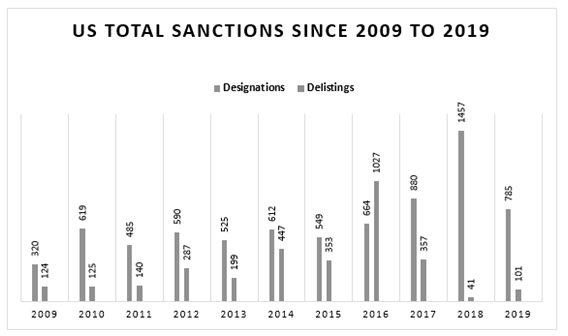
Figure 1. The US Total Sanctions from 2009 to 2019
Source: https://www.cnas.org/publications/reports/sanctions-by-the-number.

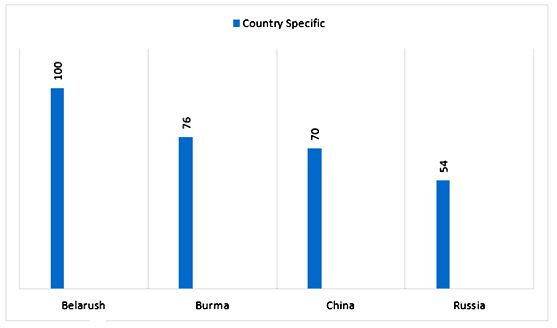
Figure 2. The country-specific sanctions by the US in 2021
Source: US Department of the Treasury Office of Foreign Asset Control.
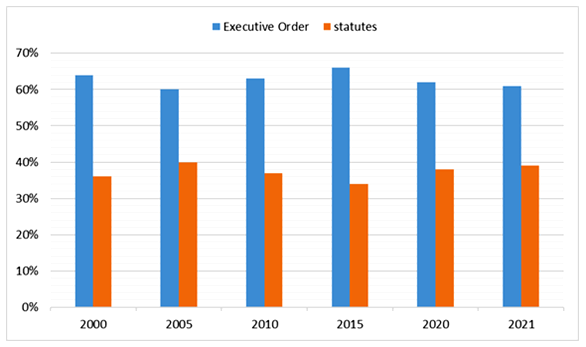
Figure 3. Sources of US Sanctions Authority
Source: U.S. Department of the Treasury Office of Foreign Asset Control.
Congress and presidential action authorize US sanctions. Both sources mention sanctions. Presidents often authorize the Treasury and the State Department and several federal agencies. The State Department also imposes several punishments. The Department leads federal agencies in setting the goals of the US sanctions' foreign policy (Imperiale 2020). In January 2021, the US Treasury Secretary maintained OFAC's commitment to ‘using sanctions as an instrument to identify and dismantle the financial networks of terrorists, proliferators, and others who seek to conspire harm against the United States.’ Additio-nally, Deputy Secretary of the Treasury ensured that sanctions support US national security, foreign policy, and economic interests (Bartlett and Ophel 2021). This high-level statement emphasized the Biden administration's approach to unilateral sanctions within its foreign policy framework.
4.4.2. The European Union Practices of Unilateral Economic Sanctions
In the past 30 years, the EU's use of economic sanctions has increased more than threefold. The EU has become the second most prolific user of unilateral economic sanctions in the world (Dreyer and Luengo-Cabrera 2024). In 2018, the EU Sanctions Map classified 35 EU sanctions regimes, which grew to 45 in 2019. The European Council implemented six UN measures in 2018 and nine in 2019, representing 20 % of all cases. Eight additional unilateral sanctions regimes (18 %) supplemented UN measures in 2019, down from nine in 2018, or 26 %, including those targeting North Korea and Iran. The largest category of measures, 62 % of all cases, was totally autonomous, adopted without UN sanction, accounting for 20 in 2018 (57 %) (Dreyer and Luengo-Cabrera 2024).
4.4.3. Chinese Practices of Unilateral Economic Sanctions
China employs quarantine, non-tariff barriers, ambiguous threats, fluctuations in leadership visits, selective acquisitions or abstentions, and many informal strategies as unilateral economic measures (Reilly 2012). This includes human rights, Tibet, Taiwan, maritime conflicts, and consumer boycotts, including those directed against Japanese and French products from 2005 to 2008 in response to their leaders' objectionable behaviour (Reilly 2012). Over the past decade, China has implemented unilateral economic sanctions in addition to UN measures against the DPRK, particularly after Pyongyang's nuclear tests (Jiang 2019). Western sanctions are significantly different from those imposed by China. Beijing's polices are more concise and display heightened nationalism. Beijing carefully evaluates international law while employing autonomous coercive strategies. The Chinese government insists that its import restrictions are a response to threats to national security and are justified under broad WTO exemptions to mitigate criticism from the WTO, which is politically motivated (Moret 2021).
4.4.4. Unilateral Economic Sanctions against Russian Federation
The U.S. sanctions have transformed bilateral economic relations: U.S.-Russia commerce dropped from $36 billion in 2021 to $2.48 billion in 2024. More than 6,400 US sanctions, accounting for about one-third of the worldwide penalties against Russia, target individuals, firms, vessels, and important sectors such as high-tech manufacturing and finance (Milov 2025).
The EU adopted the 20th packages of sanctions on 23rd April, 2026, against Russia including oil and gas restrictions, port restrictions, and asset freeze listings (Payne 2026). The EU has imposed bans on transactions involving the Indonesian oil port of Karimun and the Russian ports of Murmansk and Tuapse. The package includes measures allowing the EU to prohibit business with non-EU companies and individuals enforcing Russian legal claims, except for humanitarian considerations. The EU banned imports of Russian metals, including nickel bars, iron ore, unprocessed copper, refined copper, and scrap metals like aluminium (Ibid.).
4.4.5. Other States Practice of Unilateral Economic Sanctions
Russia has used diplomatic and travel restrictions, asset freezes, air traffic bans, and export/import tariff increases to penalize its former Soviet neighbors (Moret and Veber 2016). It countered the EU and US sanctions since 2014 (Dreyer and Luengo-Cabrera 2024). México has unilaterally imposed sanctions on organized crime and anti-money laundering (AML) in Latin America (Eversheds Sutherland N.d.). Venezuelan politicians' assets and travel have been blocked since April 2018, while the list was not released. Colombia has barred around 200 Venezuelan elites close to President Maduro from entering the country. Venezuela issued ‘countermeasures’ against Panamanian officials and firms on 5 April 2018 after Panama imposed short-term restrictions on President Maduro and other key officials on March 29, 2018.
CONCLUDING REMARKS
Since WWII, unilateral economic sanctions have been increased. In the last century, developed states used economic sanctions to avoid the use or threat of force. Until now, as unilateral economic sanctions are increasingly imposed, they affect international trade, investment, and innocent people in sanctioned states. Article 18 of the International Law Commission's Draft Articles on State Responsibility stipulates that a state imposing significant economic pressure is responsible for transnational violations by another state. If the primary economic sanctions violate peremptory international law, like the right to self-deter-mination, and cannot be justified by a state's freedom of trade, then associated unilateral extraterritorial economic sanctions may exceed the legal bounds of countermeasures, retaliation, or non-coercive reprisals, i.e. US extensive economic sanctions on Cuba. Unilateral economic sanctions may also exceed the legal limits of essential security interests as exceptional measures under the World Trade Organization framework, if the imposing state significantly fails to demonstrate any essential necessity, as evidenced in the case of the US vs. China – Steel and Aluminum Products before the World Trade Organization Dispute Settlement Body.
If economic sanctions have humanitarian effects, like military blockades, they may be coercive and violate the UN Charter's principle of state sovereignty. Economic sanctions that enslave or destroy a state, commit genocide, or violate human rights would be illegal (Bowett 1967). If they harm a targeted state or other nations trading with it, unilateral economic sanctions may exceed international law. Isolated economic sanctions on innocent nations may weaken their sovereignty, territorial integrity, and political autonomy. Unilateral economic sanctions that overthrow a state, commit genocide, or impose draconian policies that violate human rights may violate sovereign equality.
Unilateral sanctions and excessive compliance are weakening economic, labor, and social rights and impeding Sustainable Development Goal implementation. The increasing use of unilateral sanctions, enforcement by states and the attitudes of commercial players increase the humanitarian harm to innocent civilians in sanctioned countries. Sanctions have cumulative effects and affect third parties and sanctioning states. Comprehensive, sectoral, and targeted sanctions, such as asset freezes, particularly when coupled with confiscation, violate many human rights, notably the right to property (OHCHR 2025).
The impact of unilateral economic sanctions has increased the mortality rate in Iran (Rodríguez 2023). In Iran, according to Weisbrot and Sachs, economic sanctions have caused tens of thousands of fatalities in 2018 (Weisbrot and Sachs 2019). Economic sanctions against Iran restrict access to basic commodities, endangering the health of the general population, especially women, children, and the poor (Ko-kabisaghi 2018). Following economic restrictions, mortality increased by 31 %, resulting in over 40,000 deaths. The sanctions against Venezuela have also contributed to health crises in the country, including a rise in pediatric and adult mortality, as well as a reduction in per capita income, living standards, and oil production (Rodriguez 2023).
Over-compliance and excessive unilateral economic sanctions harm all health rights. Unilateral economic sanctions, over-compli-ance, and restricted de-risking practices are particularly harmful to global health systems (OHCHR 2023). Even with humanitarian exemptions for food and medicine, confusing or inconsistent sanction legislation scares businesses from providing medical services or selling medical goods. Delays in the delivery of medical equipment can be caused by financial constraints, central bank asset freezes, criminal or civil penalties for dealing with sanctioned countries, threats of secondary sanctions, requests for multiple licenses for procurement, transportation, or insurance, including humanitarian aid delivery, and zero risk policies of third-country banks. Unilateral economic sanctions that affect nutrition violate the health rights of targeted populations (Afesorgbor 2021). Cuba received its first US economic blockade in 1960. The Cuban economy has suffered from the embargo, but aid and subsidized trade from the former Soviet Union, the communist bloc, and Western Europe have reduced its impact on healthcare. One of the few restrictions on Cuba imposed by the US that includes food and medicine has been labeled as an assault on public health with high human consequences (Garfield and Santana 1997).
Global shared responsibility for the infringement of economic, social, and cultural rights is recommended. States and regional organizations imposing sanctions should reassess all unilateral economic sanctions and repeal those enacted without rationale. International organizations are particularly urged to refrain from legitimizing unilateral economic sanctions. The study proposes taking steps to ensure equality under international law, accountability, legal certainty, non-arbitra-riness, and procedural and legal transparency in unilateral economic sanctions. Economic sanctions must be fair, proportional and consistent with specific goals and well-targeted to protect and smooth the evolution of global society and international law.
NOTES
1 Retorsion is ‘unfriendly’ conduct ‘which is not inconsistent with any international obligation of the State engaging in it even though it may be a response to an internationally wrongful act.’
2 According to the theory of retaliation, every rule of international law is a priori equipped with a legal sanction. If a state violates a rule, ‘the victim states are in principle entitled to suspend any other international law norm in their relations with the violator.’
3 These are acts that are normally illegal under international law and are justified when imposed in response to a preceding impermissible act. They are also known as ‘non-coercive’ countermeasures.
4 The Napoleonic era comprises a period of 15 years (1799–1815) during which Napoleon Bonaparte expanded his empire throughout Europe.
5 The British-owned Itabira Iron Ore Company operated a mine in Itabira, Brasil, since 1911. The Krupp AG in Essen, formerly known as Krupp, was one of the largest steel firms and arm manufactures in the world. Krupp procured manganese ore from the Itabira Iron ore company in Brasil in 1914.
REFERENCES
Anderson, R. S. 1995. The Lacey Act: America's Premier Weapon in the Fight against Unlawful Wildlife Trafficking. Public Land Law Review 16 (27): 29–85.
Afesorgbor, S. K. 2021. Sanctioned to Starve? The Impact of Economic Sanctions on Food Security in Targeted States. In van Bergeijk, P. A.G. (ed.), Research Handbook on Economic Sanctions (pp. 438–466). London: Edward Elgar Publishing.
Atwater, E. 2000. American Regulation of Arms Exports. New York: W.S. Hein & Co.
Attia, H., and Grauvogel, J. 2019. Easier in than Out: The Protracted Process of Ending Sanctions. German Institute of Global and Area Studies (GIGA).
Baldwin, D. A., and Kapstein, E. B. 2020. Economic Statecraft. Princeton: Princeton University Press.
Bartlett, J., and Ophel, M. 2021. Sanctions by the Numbers: U.S. Secondary Sanctions. CNAS. https://www.cnas.org/publications/reports/sanctions-by-the-numbers-u-s-secondary-sanctions.
Bapat, N. A., Heinrich, T., Kobayashi, Y., and Morgan, T. C. 2013. Determinants of Sanctions Effectiveness: Sensitivity Analysis Using New Data. International Interactions 39 (1): 79–98. https://doi.org/10.1080/03050629.2013.751298.
Barber, J. 1979. Economic Sanctions as a Policy Instrument. International Affairs 55 (3): 367–84. https://doi.org/10.2307/2615145. Bemis, S. F. 1967. A Diplomatic History of the United States. New York: Holt, Rinehart and Winston.
Blum, S. 2003. Chinese Views of US Hegemony. Journal of Contemporary China 12 (35): 239–64. https://doi.org/10.1080/1067056022000054597.
Bogdanova, I. 2021. Targeted Economic Sanctions and WTO Law: Examining the Adequacy of the National Security Exception. Legal Issues of Economic Integration 48 (2): 71–200. https://doi.org/10.54648/leie2021010.
Boudreau, D. G. 1997. Economic Sanctions and Military Force in the Twenty‐First Century. European Security 6 (2): 28–46. https://doi.org/10.1080/09662839708407310.
Bowett, D. 1967. International Law and Economic Coercion. Virginia Journal of International Law 16: 245–48.
Carr, E. H. 1946. The Twenty Year's Crisis: 1919–1939, An Introduction to the Study of International Relations, by Edward Hallett Carr ... 2nd edition. London. Edinburgh: Macmillan; Printed by R. and R. Clark.
Choi, S.-W., and Luo, Sh. 2013. Economic Sanctions, Poverty, and International Terrorism: An Empirical Analysis. International Interactions 39 (2): 217–45. https://doi.org/10.1080/03050629.2013.768478.
Coogan, J. W. 2015. The Short-War Illusion Resurrected: The Myth of Economic Warfare as the British Schlieffen Plan. Journal of Strategic Studies 38 (7): 1045–64. https://doi.org/10.1080/01402390.2015.1005451.
Cortright, D., and Lopez G. A. 2005. Smart Sanctions: Targeting Economic Statecraft. Lanham etc.: Rowman & Littefield Publishers.
Crawford, J. N. 2022. The International Law Commission's Articles on State Responsibility: Introduction, Text and Commentary. Cambridge: Cambridge University Press.
Domke. M. 1947a. Control of Alien Property. New York: Central Book Co.
Domke, M. 1947b. Trading with the Enemy in World War II. New York: Central Book Comp.
Doxey, M. P. 1971. Economic Sanctions and International Enforcement. London: published for the Royal Institute of International Affairs, by Oxford University Press.
Doxey, M. 1972. International Sanctions: A Framework for Analysis with Special Reference to the UN and Southern Africa. International Organization 26 (3): 527–50. https://doi.org/10.1017/s002081830000299x.
Doxey, M. 2016. International Sanctions in Contemporary Perspective. London: Palgrave Macmillan Limited.
Dreyer, I., and Luengo-Cabrera, J. 2024. On Target? EU Sanctions as Security Policy Tools. European Union Institute for Security Studies. URL: https://www.iss.europa.eu/publications/analysis/target-eu-sanctions-security-policy-tools.
Eversheds Sutherland. N.d. Global Sanctions Guide. URL: https://sanctionsguide,eversheds.shutherlands.com/countries.
Farcis, S. 2018. Inde: La Grande Menace de l’eau. Alternatives Économiques 381 (7): 50–50. https://doi.org/10.3917/ae.381.0050.
Finelli, F. 2023. Countering Circumvention of Restrictive Measures: The EU Response. Common Market Law Review 60 (1): 733–762. URL: https:// orbilu.uni.lu/handle/10993/55288.
Foucault, M. 2009. Security, Territory, Population: Lectures at the collège de France. Basingstoke: Palgrave Macmillan.
Garner, B. A., and Black, H. C. 2024. Black's Law Dictionary. St. Paul, MN: Thomson Reuters.
Garfield, R., and Santana, S. 1997. The Impact of the Economic Crisis and the US Embargo on Health in Cuba. American Journal of Public Health, 87 (1): 15–20. https://doi.org/10.2105/ajph.87.1.15.
Grauvogel, J., and Attia, H. 2023. Easier in than out: Lessons Learned from the Termination of the Iraq Sanctions Regime. Journal of Global Security Studies 8 (4). https://doi.org/10.1093/jogss/ogad021.
Greenhalgh, E. 2009 Victory through Coalition: Britain and France during the First World War. Cambridge: Cambridge University Press.
Guichard, L. 1930. The Naval Blockade. New York: D. Appleton & Company.
Hufbauer, G. C. 2007. Economic Sanctions Reconsidered: History and the Current Policy. Institute for International Economics; Eurospan distributor.
Hofer, A. 2017. The Developed/Developing Divide on Unilateral Coercive Measures: Legitimate Enforcement or Illegitimate Intervention? Chinese Journal of International Law 16 (2): 175–214. https://doi.org/10.1093/chinesejil/jmx018.
Hovell, D. 2019. Unfinished Business of International Law: The Questionable Legality of Autonomous Sanctions. AJIL Unbound 113: 140–45. https://doi.org/10.1017/aju.2019.20.
Hufbauer, G. C., Schott, J. J., and Elliott K. A. 2019. Economic Sanctions Reconsidered. Washington, DC: Peter G. Peterson Institute for International Economics.
Imperiale, J. 2020. Sanctions by the Numbers: U.S. Sanctions Designations and Delistings, 2009–2019. CNAS. URL: https://www.cnas.org/publications/reports/sanctions-by-the-numbers.
India, Legal Service. 2025. Legal Service India: Law Articles, Legal Information, and Updates. URL: https://www.legalservicesindia.com/article/727/Austin,-Hart-and-Kelson-on-Sanction-as-an-integral-part-of-law.html. Accessed March 8, 2026.
Jack, D. T. 1941. Studies in Economic Warfare. New York: Chemical Pub.
Jacobson, H., and Oksenberg, M. 1990. China's Participation in the IMF, the World Bank, and Gatt. https://doi.org/10.3998/mpub.13227.
Jiang, Y. 2019. Sanctions are an Important Tool in China's North Korea Diplomacy. DIIS, February 22. URL: https://www.diis.dk/en/research/sanctions-are-an-important-tool-in-chinas-north-korea-diplomacy.
Johnson, G. 2016. Lord Robert Cecil: Politician and Internationalist. London: Routledge.
Kokabisaghi, F. 2018. Assessment of the Effects of Economic Sanctions on Iranians' Right to Health by Using Human Rights Impact Assessment Tool: A Systematic Review. International Journal of Health Policy and Management 7 (5): 374–393. https://doi.org/10.15171/ijhpm.2017.147.
Kadomtsev, B. 1919. The Russian Collapse a Politico-Economic Essay, by Boris Kadomtzeff. New York: Russian mercantile and industrial Corp.
Kamminga, M. 2020. Extraterritoriality. Oxford University Press.
Kerbrat, Y. 2021. Chapter 10: Unilateral Extraterritorial Sanctions as a Challenge to the Theory of Jurisdiction. In Beaucillon, Ch. (ed.), Research Handbook on Unilateral and Extra-Territorial Sanctions (pp. 166). Chaltenham: Edward Elgar Publishing.
Malloy, M P. 2002. United States Economic Sanctions: Theory and Practice. Alphen aan den Rijn: Wolters Kluwer Law International.
Medlicott, W. N. 1952. The Economic Blockade. Vol. i. Economica 19 (75): 347. https://doi.org/10.2307/2550678.
Milov, V. 2025. The Evolution of the US–Russia Sanctions Regime. FRF Thinktank. URL: https://thinktank.4freerussia.org/sanctions/the-evolution-of-the-us-russia-sanctions-regime/.
Mitchell, A. D. 2017. Sanctions and the World Trade Organization. Cheltenham, UK: Edward Elgar Publishing.
Moret, E., and Veber, M. T. 2016. The New Deterrent? International Sanctions against Russia over the Ukraine Crisis: Impacts, Costs and further Action. Geneve: Graduate Institute of International and Development Studies.
Moret, E. 2021. Chapter 2: Unilateral and Extraterritorial Sanctions in Crisis: Implications of Their Rising Use and Misuse in Contemporary World Politics. In Beaucillon, Ch. (ed.), Research Handbook on Unilateral and Extra-Territorial Sanctions. London: Edward Elgar Publishing.
Morgan, T. C., Syropoulos, C., and Yotov, Y. V. 2023. Economic Sanctions: Evolution, Consequences, and Challenges. Journal of Economic Perspectives 37 (1): 3–29.https://doi.org/10.1257/jep.37.1.3.
Mulder, N. 2023. The Economic Weapon: The Rise of Sanctions as a Tool of Modern War. New Haven.
National Archives. 2009a. The Discovery Service. Ministry of Blockade: War Trade Intelligence Department and War Trade Statistical Department, Records. URL: https://discovery.nationalarchives.gov.uk/details/r/C14082. Accessed March 3, 2026.
National Archives. 2009b. The Discovery Service. The National Archives, August. URL: https://discovery.nationalarchives.gov.uk/details/c/F262417. Accessed March 4, 2026.
Offer, A. 2023. The First World War: An Agrarian Interpretation. Oxford: Clarendon Press.
Osborne, E. 2013. Britain's Economic Blockade of Germany 1914–1919. Oxon, United Kingdom: Routledge.
Oulahan, R. V. 2019. League to Rule by Economic Pressure; Use of Force by Nations Optional; Armaments Cut, Submarines Barred. New York Times. Accessed March 4, 2026.
O’Brien, C. C., and McCue, J. 2002. Edmund Burke. London: Vintage.
OHCHR. 2023. Over-Compliance with Unilateral Sanctions a Direct Threat to Peoples' Health and Well-Being: UN expert. OHCHR. URL: https:// www.ohchr.org/en/press-releases/2023/09/over-compliance-unilateral-sanctions-direct-threat-peoples-health-and-well.
OHCHR. 2025. Unilateral Sanctions Hurt All, Especially Women, Children and Other Vulnerable Groups – UN Human Rights Expert. OHCHR. https://www.ohchr.org/en/press-releases/2021/12/unilateral-sanctions-hurt-all-especially-women-children-and-other-vulnerable.
Payne, J. 2026. What's in the EU's 20th Package of Sanctions against Russia? Reuters. URL: https://www.reuters.com/business/energy/whats-eus-20th-package-sanctions-against-russia-2026-04-22/.
Pellet, A. 2015. Sanctions unilatérales et droit international = unilateral sanctions and international law.
Rodríguez, F. 2023. The Human Consequences of Economic Sanctions. Journal of Economic Studies 51 (4): 942–963. https://doi.org/10.1108/jes-06-2023-0299.
Reilly, J. 2012. China's Unilateral Sanctions. The Washington Quarterly, 35. https://doi.org/https://www.tandfonline.com/doi/full/10.1080/0163660X.2012.726428.
Ruys, T. 2017. Sanctions, Retortions and Countermeasures: Concepts and International Legal Framework. Cheltenham, UK: Edward Elgar Publishing.
Sayous, M. 1916. Commission financiere inter-ministrielle.
Schachter, O. 1997. International law in Theory and Practice. Dordrecht u.a.: Nijhoff.
Shaw, M. N. 1997. International Law. Cambridge: Cambridge University Press.
Thucydides. 1948. Thucydides: History of the Peloponnesian War. Chicago: Henry Regnery Co.
Trotter, W. F. 1919. The Law of Contract during and after War: With Leading Cases, Statutes, and Proclamations. London: William Hodge & Company.
Tzanakopoulos, A. 2015. The Right to Be Free from Economic Coercion. Cambridge Journal of International and Comparative Law 4 (3): 616–33. https://doi.org/10.7574/cjicl.04.03.616.
Weisbrot, M., and Sachs, J. 2019. Economic Sanctions as collective Punishment: The Case ... Center for Economic and Policy Research. https:// cepr.net/images/stories/reports/venezuela-sanctions-2019-04.pdf.
Wikipedia. N.d. Paris Declaration Respecting Maritime Law. 2025. URL: https://en.wikipedia.org/wiki/Paris_Declaration_Respecting_Maritime_Law. Accessed March 6, 2026.