|
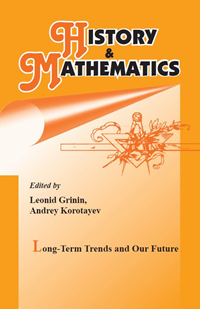
History & Mathematics:Long-Term Trends and Our FutureBibliography: Volgograd: ‘Uchitel’ Publishing House, 2025. – 216 pp.
Edited by: Edited by Leonid E. Grinin, and Andrey V. Korotayev
ISBN 978-5-7057-6469-3 Editorial Council: Herbert Barry III (Pittsburgh University), Daniel Barreiros (Federal University of Rio de Janeiro, Brazil), Leonid Borodkin (Moscow State University; Cliometric Society), Christopher Chase-Dunn (University of California, Riverside), Tessaleno Devezas (University of Beira Interior), Jack A. Goldstone (George Mason University), Leonid Grinin (National Research University Higher School of Economics), Antony Harper (Eurasian Center for Big History & System Forecasting), Peter Herrmann (University College of Cork, Ireland), Andrey Korotayev (Higher School of Economics), David J. LePoire (Argonne National Laboratory), Alexander Logunov (Russian State University for the Humanities), Georgy Malinetsky (Russian Academy of Sciences), Sergey Malkov (Russian Academy of Sciences), Charles Spencer (American Museum of Natural History), Rein Taagepera (University of California, Irvine), Arno Tausch (Innsbruck University), William Thompson (University of Indiana), Peter Turchin (University of Connecticut), Yasuhide Yamanouchi (University of Tokyo).
|
The present Yearbook, subtitled Long-Term Trends and Our Future, is the twelfth in the series. This issue is devoted to long-term trends in human history and forecasts of how these trends may develop in the future. It consists of four sections.
The authors of the Section I Technological and Demographic Long-Term Trends: Past, Present and Future analyze the demographic development of humankind in its close connection with technological development, including the 21st century trends and provide a theoretical framework for the correlation between the development of production and technology, on the one hand, and demographic transformations, on the other, during the historical process, and also describe all major demographic transformations during human history. Section II Toward to Singularity? discusses the recently popular idea that a ‘singularity’ is to be expected in the near future. However, it is shown that in the region of the singularity point there is no reason, after Kurzweil, to expect an unprecedented (by many orders of magnitude) acceleration of technological development. Section III Political Science in Global Perspective demonstrates that our planet is increasingly moving away from the leadership role of the United States of America and is increasingly characterized by a plurality of cultures and languages. Section IV Reviews and Notes contains two reviews which continue the ideas presented in the previous issue.
We hope that this issue will be interesting and useful both for historians and mathematicians, as well as for all those dealing with various social and natural sciences.