International Political Science as a Global Centre-Periphery System

Almanac: History & Mathematics:Long-Term Trends and Our Future
DOI: https://doi.org/10.30884/978-5-7057-6469-3_05
Abstract
This article documents the enormous concentration of global access to the products of ‘political science’ published in the existing channels of communication. The author's analysis is based on a detailed and quantitative critique of the self-image of political science, which still seeks to disseminate the products of our work exclusively in English-language peer-reviewed journals based in the former, declining geographical and political centre of the world economy. We are trying to develop new perspectives aimed at increasing the international visibility of scientific work across our planet in the 21st century, beyond these established publication channels. A planet that is increasingly moving away from the leadership role of the United States of America and that is increasingly characterized by a plurality of cultures and languages.
Keywords: Bibliometrics, Centre-Periphery System, political science, BRICS, OIC, Muslim World, National Libraries, Union Catalogues, OCLC WorldCat, Social Science Research Network, ResearchGate, EBSCO Host, ProQuest, Web of Science, Scopus.
Introduction
As a scholar born in 1951, it is time to consider what I can pass on to future generations of scholars around the world.
The late Harvard Professor Karl Wolfgang Deutsch (1912–1992), who was President of the International Political Science Association from 1976 to 1979, and who played a crucial role in my scientific development, argued throughout his long and fruitful scholarly life that political science must be truly international (Deutsch 1986; Taylor and Russett 2020). Global developments point in a different direction, and current international tensions and conflicts reinforce these tendencies. Writing for this journal, which is widely read in East and West, North and South, my message of global scholarly inclusion, not exclusion, is clear enough.
Leading political scientists, such as Norris (2021), are aware of the structures that determine the productivity and impact of political science research, and especially from the global periphery and semi-periphery, the structures of global inequality in political science research are simply too important to be brushed aside (Tausch 2010, 2011, 2018, 2020, 2021, 2023). In this article, which briefly summarizes the research presented in Tausch (2023), we will attempt to arrive at a concluding perspective, emphasizing the access of the BRIICS countries to the global market of political science.
For the purposes of this study we have, among other things, compiled an updated and fairly complete list of the 54 national union catalogues, 76 national libraries, 15 parliamentary libraries and nine international organization libraries that offer online catalogues of their data, and analysed how many items with the English title word ‘political science’ are present in these libraries. The devastating result of our research is that only 30 of the 54 national union catalogues, 18 of the 76 national libraries, 4 of the 15 parliamentary libraries and 7 of the 9 international organizations surveyed had library holdings of more than 1,000 items with the explicit title word ‘political science’. And yet, the global interest in political science is huge and beyond our expectations. To measure this global interest, our article looked at the download statistics of the main Wikipedia articles on ‘political science’ in their respective languages. Our analysis shows that there is a huge global interest in our subject, which is not being met by current publications.
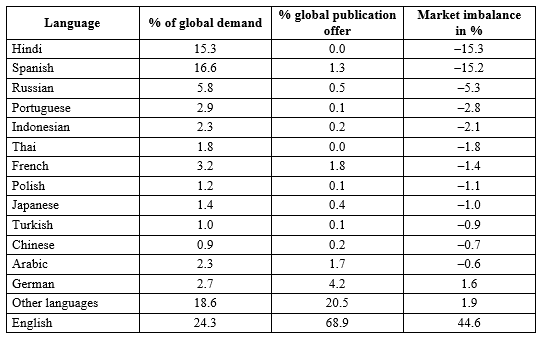
Especially titles in Hindi, Spanish, Russian, Portuguese, Indonesian, Thai, French, Polish, and Japanese would meet a growing demand for information on political science, while the supply of scholarly publications on the subject is rather limited.
In this analysis we also question the reliability of standard databases such as the Web of Science. We show that even the work of Skytte laureates in political science, including two Nobel laureates in economics, is grossly undervalued in the Web of Science.
This article also includes a consideration of the centre-periphery system of international political science, based on the Scopus database system and other indicators. We analyze the global output of political science in the international social science journals of all countries indexed in the Scopus system. Unfortunately, we must conclude that the political science communities in the eleven leading Western countries account for no less than 63 % of the political science articles in the world's journals, as well as 77 % of global political science citations. These data are consistent with other perspectives from our analysis. The political science communities in these 11 countries now also account for 73 % of the presence in the Open Syllabus system. The eleven leading countries are the United States, the United Kingdom, Germany, Australia, Canada, France, the Netherlands, Italy, Spain, Switzerland and Japan. In our article, we also compare the presence of these eleven countries with the BRICS countries, the Organization of Islamic Cooperation (the countries of the Muslim world) and the rest of the world. Finally, we use the statistical tool of partial correlation of political science publications per million inhabitants to show the positive impact of political science on indicators of global development, such as gender equality and socio-liberal democratic values.
The Global Concentration of Political Science
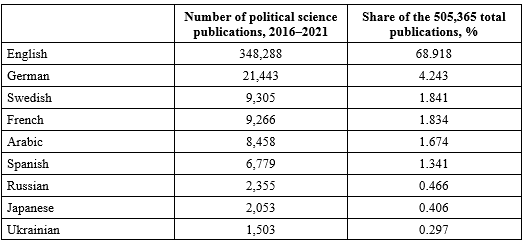
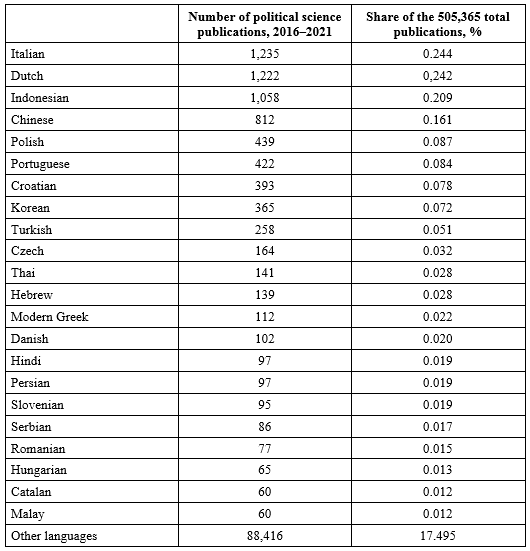
Although the author of this article has always maintained that science communication cannot, of course, avoid peer-reviewed journals and transnational book publishers, the epochal changes in the world today can no longer be denied, and they are also revolutionizing the science sector worldwide. The decline of America and Europe and the rise of new centres of power on our planet are also becoming increasingly apparent in the science sector. A look at the data from OCLC WorldCat, the global library union catalogue, on global publishing in the field of political science over the last five years shows the continuing dominance of English in this area. With the keyword ‘political science’, no less than 505,365 new titles have been added in all languages for the period from 2016 to 2021 as of 16:07 on 20/09/2021. OCLC WorldCat breaks down the languages as follows, and we have taken our percentages directly from the OCLC WorldCat data.
Table 1. Global new political science publications by language, 2016–2021 according to OCLC WorldCat
Continuation of Table 1
OCLC First Search, the full version of OCLC, which is unfortunately still too little used in many European countries, allows us to draw the following further conclusions from these data, which we illustrate in the following table. Only a small top group of 4.1 % of English-language publications reach more than 500 libraries within 5 years at the latest, and an equally respectable group of 17.5 % of political science book production reaches 50–499 libraries. In Spanish, French and German, the proportion of works with a high global circulation (500+ libraries) is even lower. Our tables and figures tell us with extreme clarity: 40 % to 60 % of world production in our subject in English, Spanish, French and German is barely visible in the global library system.
Table 2. The global distribution of recent political science publications, 2016–2021 by language of publication in %

There is evidence on the global library presence (OCLC WorldСat Identities) of the 88 Economic Nobel Laureates and Skytte Laureates in Political Science, 1993–2022 (see Tausch 2023). Their median library presence is 11,711 libraries. Equally surprising is the data available on the continuing concentration of knowledge production.


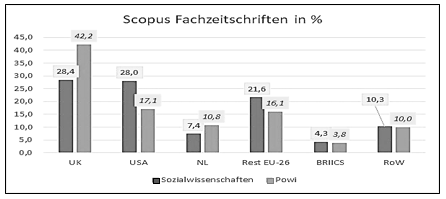
Fig. 1. The localization of the global 7,683 social science and 573 political science journals indexed in the Scopus database in %
Scopus Fachzeitschriften = Scopus journals
Sozialwissenschaften = social sciences
Powi = political science
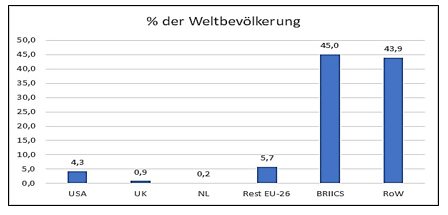
Fig. 2. The distribution of the world population in %
% der Weltbevȍlkerung = % of the world population
Even in the geographically fairly inclusive data system Scopus, an almost fabulous international concentration of our global social science emerges. The countries with only 5.4 % of the world's population host the publication of 70.1 % of our world's political science journals recorded in Scopus. Furthermore, according to OCLC WorldCat, there are no less than 474,974 works on the globe with the word ‘political science’ in the title. Truly a statistically profound insight into our field: in Table 3, we note how much % of this global knowledge is available in the BRIIC countries, where, after all, more than 40 % of the world's population lives. Why do we use here the term ‘BRIIC’ and not BRIICS? For the sake of simplicity, we have excluded South Africa, which is very well integrated into the transnational science system. Whether Bloemfontein, Cape Town, Johannesburg, or Stellenbosch: all the country's academic centres are, after all, well equipped with international literature, and by inclusion would only distort the results of our comparison. If we reduce our comparison to Brazil, Russia (where, unfortunately, there is no Union catalogue that can be used for such comparative purposes, but there is the catalogue of the country's powerful state library), India, Indonesia, and China, and in contrast to this the cumulative holdings of Harvard University, which has existed since 1636, we get an idea of the full extent of global inequality in access to political science knowledge on our planet.
The access to WorldCat OCLC First Search allows an even more extreme view of the language problem of our discipline: in the libraries of our globe on 29 September 2021 at 16:51 there were no less than 16,705 ‘serial publications’ with the keyword ‘political science’, no less than 11,254 appeared in English, and the leader, the New Republic, reached 3,297 libraries. But, on the other hand:
· 772 journals appeared in German, with the best-ranked PVS (Politische Vierteljahresschrift) reaching only 190 libraries.
· Only 711 journals in French were listed there, the most widespread being the Revue Francaise de Science Politique present at 297 libraries.
· The system listed 471 journals in Chinese, but all of them were present in fewer than 100 global libraries each.
· Only 501 journals in Spanish were listed, and the most widely read was the Revista de Estudios Politicos in Madrid with 229 libraries.
· The Russian language brought it to only 203 journals, and Arabic had only 95 journals listed at all.
If a younger scholar is planning an English-language publication in the field of political science, the expected ‘market’ in the world's libraries is, of course, much higher. The top-ranked English-language political science journal published by Oxford University Press, Publius, one of the 96 Oxford political science journals, is held in 483 libraries; the top-ranked of the 49 Springer journals, Economics of Governance, is held in 216 libraries; the top-ranked of the 207 Routledge journals, British Journal of Sociology, is held in 693 libraries; and the top-ranked John-Wiley political science journals, New Perspectives Quarterly, is held in 876 libraries, and so on and so forth.
Table 3. Holdings of works with the title ‘political science’ in the library catalogues of the BRIIC countries as a % of the 474,974 global titles available in OCLC WorldCat
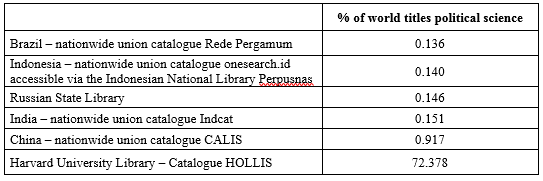
I share the view of most representatives of European political science that our world is characterized by strong center-periphery structures, which are also blatantly reflected in the scientific structures of our world, and which have worsened since the days when the authors such as Fernando Henrique Cardoso began questioning the dependence of the periphery (see Tausch 2010). At some point, the contradiction arises of writing about these conditions in expensive publications that are only available to a fraction of the world's scientists and students, and where there are endless geographical and social barriers to the dissemination of knowledge.
When you start asking questions about the geography of access to science in this world, the beautiful and elegant house of cards of mainstream publishing in the leading journals and the leading book publishers collapses in a way. It makes a huge difference whether scholarly works are available not only in Western Europe, North America and the other industrialised countries, but also in the rest of the world. Reaching global audiences in Latin America and the Caribbean, Africa and Asia is an important future task for global social sciences, and the people in, say, Anadyr, the easternmost city in Russia, are just as important as our readers in Cambridge, Massachusetts, USA, or Stuttgart, Baden-Württemberg, the economic centre of Germany. Working with the freely accessible OCLC WorldCat, we also come to the startling and staggering conclusion that title after title entered into the system leads to the diagnosis that some 70–80 % of all English-language social science titles tend to be concentrated in libraries within less than 3,800 km of Winnipeg, Canada, in the geographical centre of the highly developed part of the North American continent, 10–20 % within less than 1,750 km of Brussels, Belgium, and even smaller but relatively constant proportions in the social science markets of Australia, New Zealand, Southern Africa and China, and East and South-East Asia. And in the vast rest of our planet, our beautiful political science is virtually invisible.
An analysis of the geographical distribution of the global library holdings of the American Political Science Review, the official journal of the world's most prestigious professional association of political scientists, provides a succinct and unsparing account of these truly shocking details of the limited global dissemination and low visibility of scientific knowledge today. The aforementioned journal – a symbol of political science as it is understood in the world's leading universities and research centres, and where every department head today jubilantly congratulates his or her staff whenever an institute publication appears in it – is currently available in 1,797 libraries around the globe. We find these copies only in the following libraries of the ‘Second’ and ‘Third World’:
less than 5,700 km from Campo Grande, Brazil 16 libraries
less than 3,600 km from Yaoundé, Cameroon 7 libraries
less than 3,600 km from Ulaanbaatar, Mongolia 6 libraries
less than 2,800 km from Dhaka, Bangladesh 7 libraries
For reasons of comparison, we also include in Fig. 3 the corresponding data for the American Sociological Review and the American Economic Review.


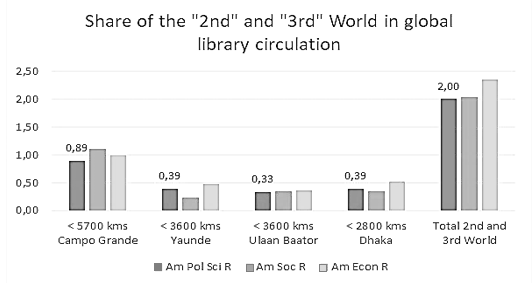
Fig. 3. The global distribution of political science. The geography of the American Political Science Review, American Sociological Review and American Economic Review library presence
Let us dive further down into the real-world potential markets for information and science on our planet. Fig. 4 indicates the dramatic need for political science information in Hindi, Russian, Portuguese, Arabic, and Indonesian, language communities which all share over 2 % each of the roughly estimated global interest in political science based on Wikipedia downloads. These language communities, along with English, the ever-emerging Spanish, and German, still a powerful communication tool in global political science, will become the superstars of the coming decade of global political science.
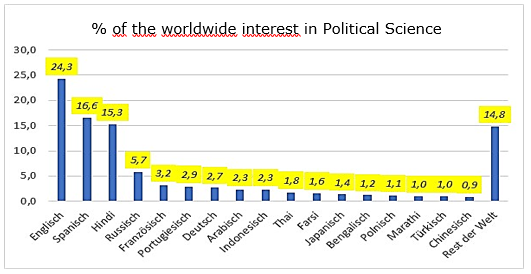
Fig. 4. The worldwide interest in political science according to the distribution of Wikipedia annual download statistics of the central Wikipedia article ‘Political science’ in the respective languages of the world in %
Table 4. Worldwide interest in political science according to the distribution of Wikipedia annual download statistics of the central Wikipedia article ‘Political science’ in the respective languages, 09/17/2020 – 09/16/2021
Language | Rank interest in the political science | Language code | Name of the wiki page political science in the respective language | Number of downloads in the last year 17/9/20–17/9/21 | Worldwide Wikipedia readership in millions | % of wiki users who have read the political science article in a year | Million user devices | % of the worldwide interest in political science |
English | 1 | en | Political science | 734,969 | 797 | 0.0922 | 0,7350 | 24.30 |
Spanish | 2 | es | Ciencia política | 501,408 | 138 | 0.3633 | 0,5014 | 16.58 |
Continuation of Table 4
Language | Rank interest in the political science | Language code | Name of the wiki page political science in the respective language | Number of downloads in the last year 17/9/20–17/9/21 | Worldwide Wikipedia readership in millions | % of wiki users who have read the political science article in a year | Million user devices | % of the worldwide interest in political science |
Hindi | 3 | hi | राजनीति विज्ञान | 461,716 | 21 | 2.1986 | 0,4617 | 15.27 |
Russian | 4 | ru | Полито-логия | 173,788 | 86 | 0.2021 | 0,1738 | 5.75 |
French | 5 | fr | Science politique | 96,548 | 86 | 0.1123 | 0,0965 | 3.19 |
Portuguese | 6 | pt | Ciência política | 88,051 | 55 | 0.1601 | 0,0881 | 2.91 |
German | 7 | de | Politik | 80,592 | 97 | 0.0831 | 0,0806 | 2.67 |
Arabic | 8 | ar | علوم سياسية | 69,323 | 43 | 0.1612 | 0,0693 | 2.29 |
Indonesian | 9 | id | Ilmu | 68,599 | 33 | 0.2079 | 0,0686 | 2.27 |
Thai | 10 | th | รัฐศาสตร์ | 53,726 | 18 | 0.2985 | 0,0537 | 1.78 |
Farsi | 11 | fa | علوم سیاسی | 48,497 | 28 | 0.1732 | 0,0485 | 1.60 |
Japanese | 12 | ja | 政治学 | 41,532 | 111 | 0.0374 | 0,0415 | 1.37 |
Bengali | 13 | bn | রাষ্ট্রবিজ্ঞান | 36,764 | 5 | 0.7353 | 0,0368 | 1.22 |
Polish | 14 | pl | Politologia | 34,740 | 26 | 0.1336 | 0,0347 | 1.15 |
Marathi | 15 | mr | राज्यशास्त्र | 30,472 | 3 | 1.0157 | 0,0305 | 1.01 |
Turkish | 16 | tr | Siyaset | 29,041 | 23 | 0.1263 | 0,0290 | 0.96 |
Chinese | 17 | zh | 政治学 | 27,097 | 54 | 0.0502 | 0,0271 | 0.90 |
Total World | xx | xx | xx | 3,024,017 | 1624 | 0.1862 | 3,0240 | 100.00 |
It would be erroneous to assume that the high concentration of global political science publishing and accessibility is not also reflected in the national union catalogues, national libraries, parliamentary libraries and international organization libraries.
The Evidence from National Union Catalogues,
National Libraries, Parliamentary Libraries
and International Organization Libraries
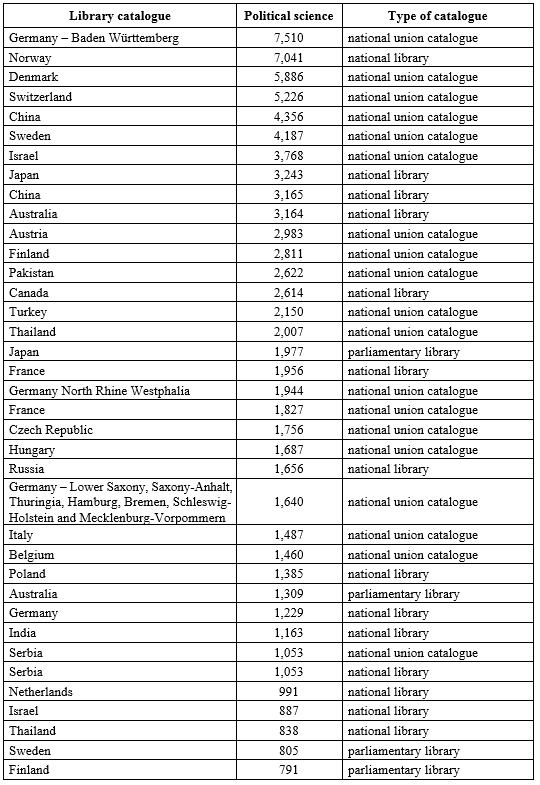
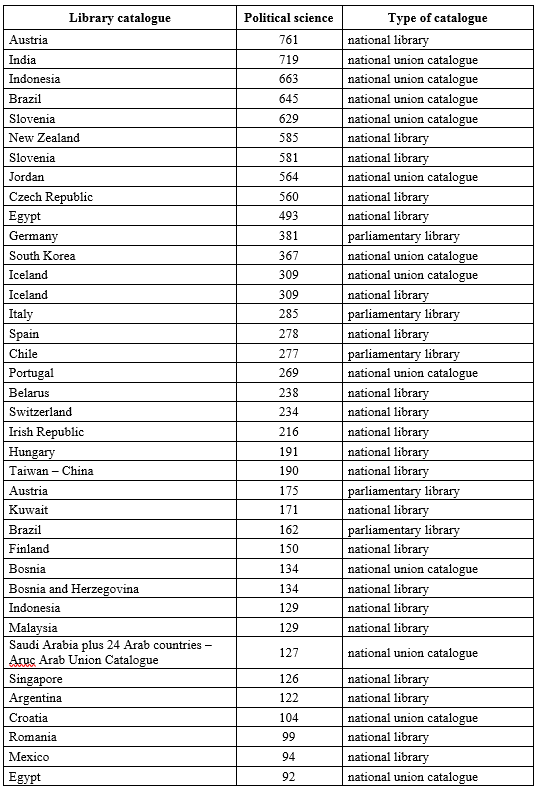
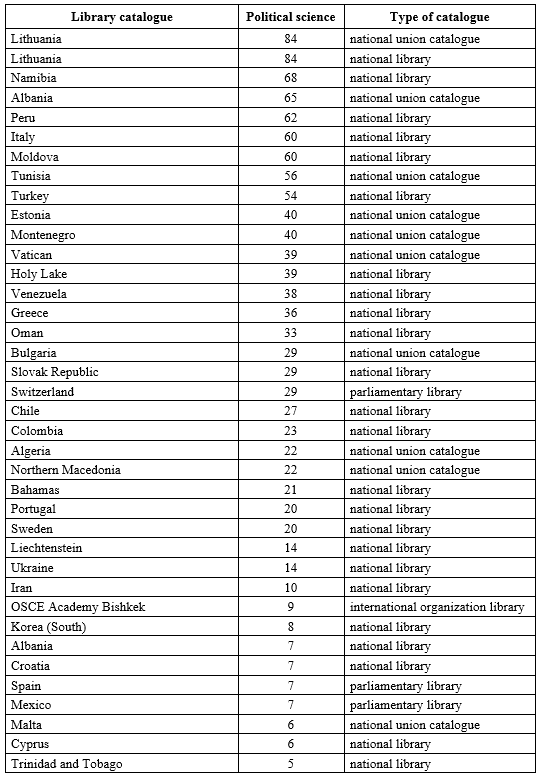
In Table 5 and Figs. 5 and 6, we compare the presence of political science documents with the word ‘political science’ in the title of the document in the libraries around the world. For the aims of this study, we compiled an updated and fairly exhaustive list of 54 national union catalogues, 76 national libraries, 15 parliamentary libraries and nine international organization libraries. Our list expands the list, used by us in earlier research. Only 44 % of the surveyed national union library catalogues, 24 % of the surveyed national libraries, 27 % of the surveyed parliamentary libraries, and two of the nine surveyed international organizations – the OSCE and NATO had library holdings of less than 1,000 titles each with the title word ‘political science’. From this we can risk the dire conclusion that truly vast proportions of the global population and of the surface of our globe do not have a more comprehensive access to standard political science publishing.
Table 5. The presence of ‘political science’ titles in the world's libraries
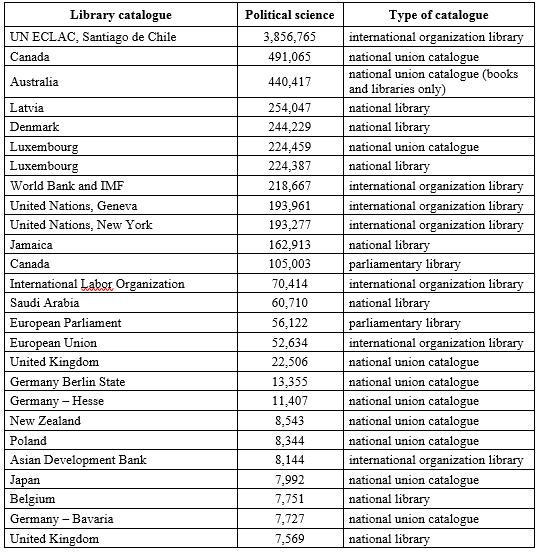
Continuation of Table 5
Continuation of Table 5
Continuation of Table 5
Continuation of Table 5
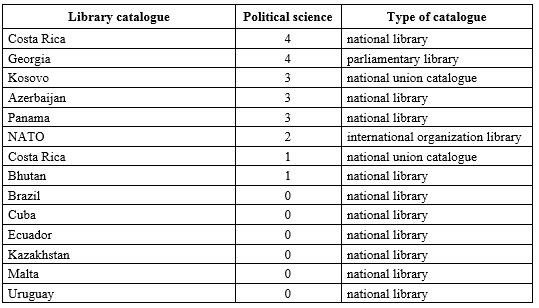
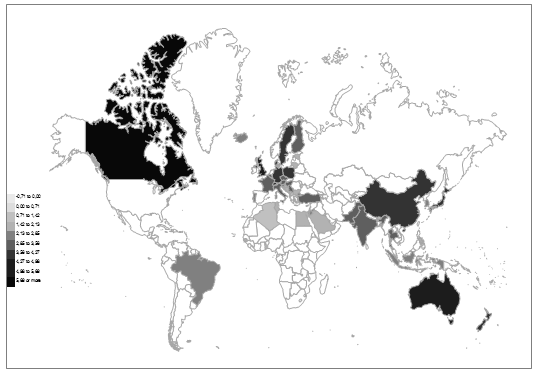
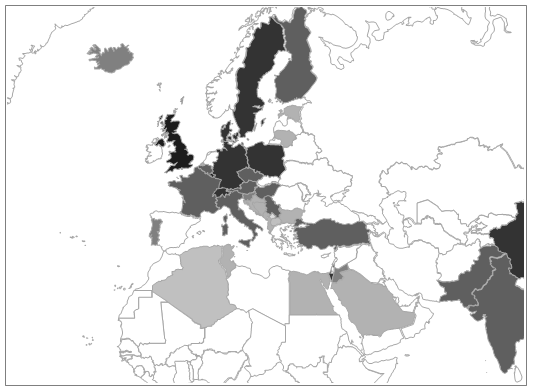
Fig. 5. Findings from the national union catalogues – materials mentioning ‘political science’ explicitly in the title (log-10)
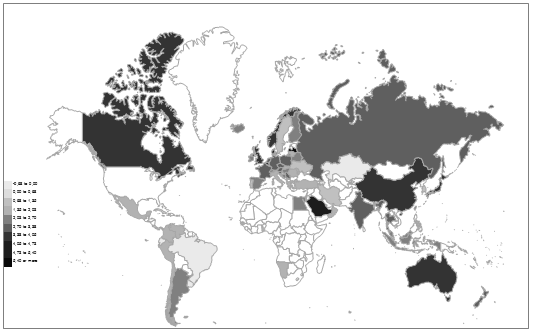
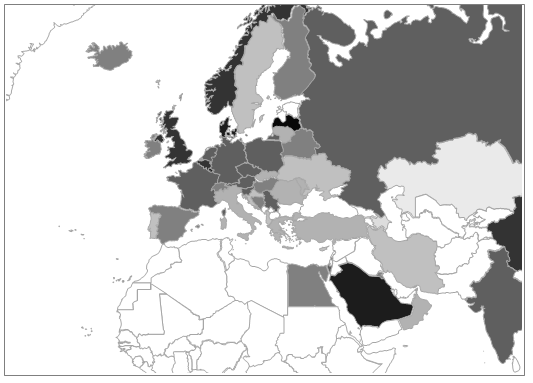
Fig. 6. Findings from the National Libraries: materials mentioning ‘political science’ explicitly in the title (log 10 (titles+1))
Scopus as the Alternative? A Critical Reflection
on the Web of Science – a Reliable Source for University
Rankings or a Data Graveyard?
The standard response of advocates of 'normal publishing' would be to say that large international comprehensive databases such as the Clarivate Web of Science (WoS), which underpins most global university rankings, make the products of our work visible enough anyway. So how visible is political science on our globe, as it has been mediated by international publications, reflected in standard databases and assessed in most university rankings?
We show here how unreliable the Web of Science database is for our field, also and especially in contrast to the competing product Scopus by Elsevier and the very reliable university rankings based on it by Scimago Institution Rankings (Scimago-Sir).
The following table shows how inaccurate, unreliable and ultimately discriminatory this system can be for the scientific community, as well as its disastrous effects on university rankings, which are mostly based on the WoS. It is inconceivable that the WoS is currently unable to provide adequate information on these laureates:
1995 Robert Alan Dahl
1996 Juan José Linz
1997 Arend Lijphart
1998 Alexander L. George
1999 Elinor Claire Ostrom
2000 Fritz W. Scharpf
2001 Brian Barry
2002 Sidney Verba
2003 Hanna Fenichel Pitkin
2004 Jean Blondel
2005 Robert Owen Keohane
2006 Robert David Putnam
2007 Theda Skocpol
2008 Pure Taagepera
2009 Philippe C. Schmitter
2010 Adam Przeworski
2011 Ronald F. Inglehart
2012 Carole Pateman
2013 Robert Marshall Axelrod
2014 David Collier
2015 Yoshihiro Francis Fukuyama
2016 Jon Elster
2017 Amartya Kumar Sen
2018 Jane Mansbridge
2019 Margaret Levi
2020 Peter J. Katzenstein
2021 David D. Laitin
Professor Adam Przeworski, for example, is lumped in with his namesake, a researcher at a veterinary research centre in Olsztyn, Poland, and the ‘Author Metrics Beamplot Summary’ displayed under his name suggests that 20 % of the global scientific community ranks higher than he, the 1940 Skytte Prize winner. Even worse is the case of the recently deceased pioneer of global political science research, Ronald Franklin Inglehart (1934–2021), who, according to Google Scholar Citations Profiles, was the most important political scientist in the world with 140,287 citations, but who appears in WoS only in connection with his professorship in St Petersburg, Russia, with 19 papers. Even if you search for one of Inglehart's most famous essays, ‘Modernization, cultural change, and the persistence of traditional values’, which has been cited 7,140 times according to Google Scholar, and then click on the main author, you will end up in the WoS data graveyard with Ronald Charles Inglehart as the author.
Most of Ronald F. Inglehart's work is erroneously attributed to Ronald Charles Inglehart, but Ronald Charles Inglehart did not get his bachelor's degree until 2008, but according to WoS he began his publishing career in 1967!
Similarly, the WoS information on the 2013 Skytte Laureate, Professor Robert Marshall Axelrod, is wrongly ‘merged’ with, among others, a cancer researcher at the ETH Zurich. The 2019 winner, Margaret Levi, exists in the system, but according to the WoS database her publication career would have started in 1957, when she was only 10 years old!
Also truly disastrous in its effects on the system of science is the underestimation of the scientific achievements of individual members of the scientific community that can be observed in Clarivate's WoS compared to the very reliable Elsevier's Scopus, in this case of several Skytte Prize winners, including two Nobel Prize winners in economics.
Table 6. Database WoS: devalued science of the Skytte laureates, including Nobel laureates in economics
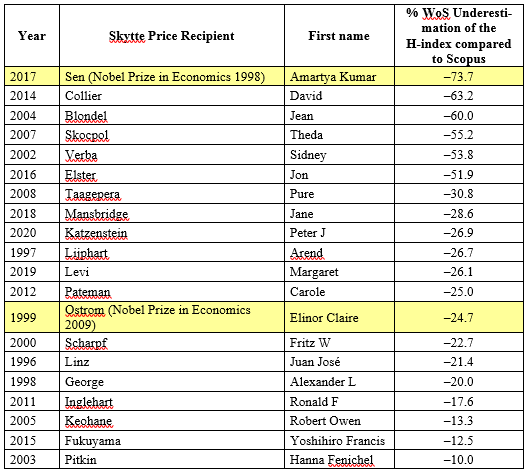
Fig. 7, based on the Scimago SIR ranking of the world's academic institutions, which is very precise and based on Scopus, an alternative and competing database to the Web of Science, shows the dramatic shifts that have taken place in recent years to the detriment of the ‘old’ West. It is no coincidence that the free Scopus-based journal documentation system Scimago and the free Scopus-based research site ranking system Scimago SIR are located in Spain, a country at the crossroads of Ibero-American and European culture with a particularly active bibliometric scene. It is no coincidence that these two systems provide information that is much more in tune with today's rapidly changing world than the Web of Science, which is still connected to the old hierarchies of the world system.
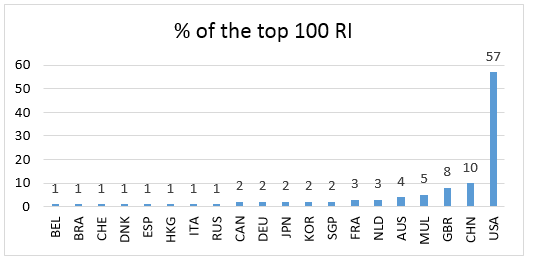
Fig. 7. Country distribution of 100 leading research institutes and universities (RI) worldwide
In any case, this work has attempted to raise awareness of the need for 21st century political science to become more accessible and global. Publications in Hindi, Spanish, Russian, Portuguese, Indonesian, Thai, French, Polish, and Japanese will in any case play an important role in the future.
Our work has tried to shift our gaze forward a little and communicate our political science a little more for the benefit of the inhabitants of our planet, and not just to serve rankings and impact factors.
Table 7. The market imbalances in global political science – global demand and global publication supply
Assessing the Geographical Distribution of the Global
Political Science 280,288 Articles, Published from 1996
to 2021 in 597 Political Science and International
Relations Journals, Indexed in Scopus, by 207
Political Science Communities of Our World
By far the most complete country-wise balance of the publications in global political science journals is available from the database Scopus, which allows for such balances in practically all disciplines of science. Fig. 8 indicates the original data, used for our analysis. In our case, we selected the field ‘political science and international relations’.
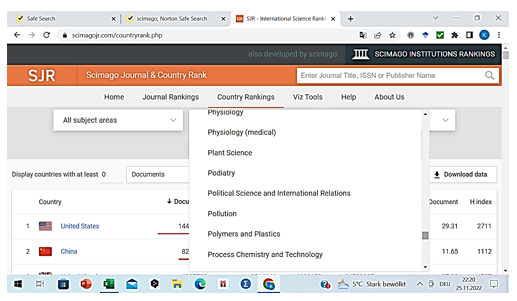
Fig. 8. Global country rankings of the political science communities of the world according to Scopus
The results of this operation, presented in Table 8, reflect the country rankings of the different political science communities in the world according to Scopus, here ranked by the H-Index of the country's entire political science community over the years (1996–2021). An H-Index of 313 indicates, for example, that the community authored 313 articles which were cited 313 or more times in the literature. The political science community, to which I am currently affiliated, South Africa, published 52 articles which were quoted 52 or more times in the literature. Table 8 is the most comprehensive listing of political science publishing 1996–2021 hitherto published in the literature.
Table 8. The country rankings of the different political science communities in the world according to Scopus, ranked by the H-Index of the country’s political science community (1996–2021)
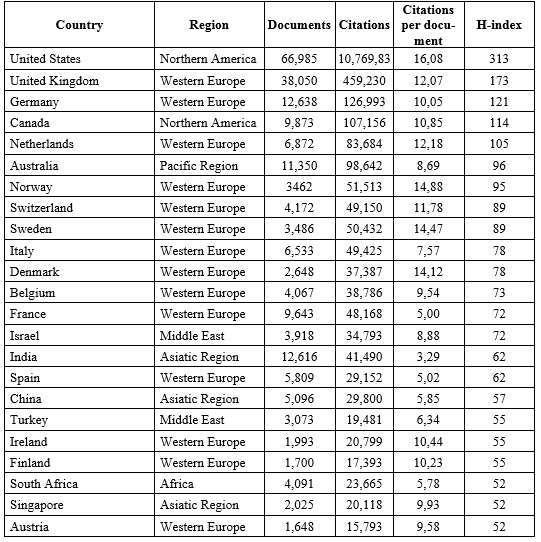
Continuation of Table 8
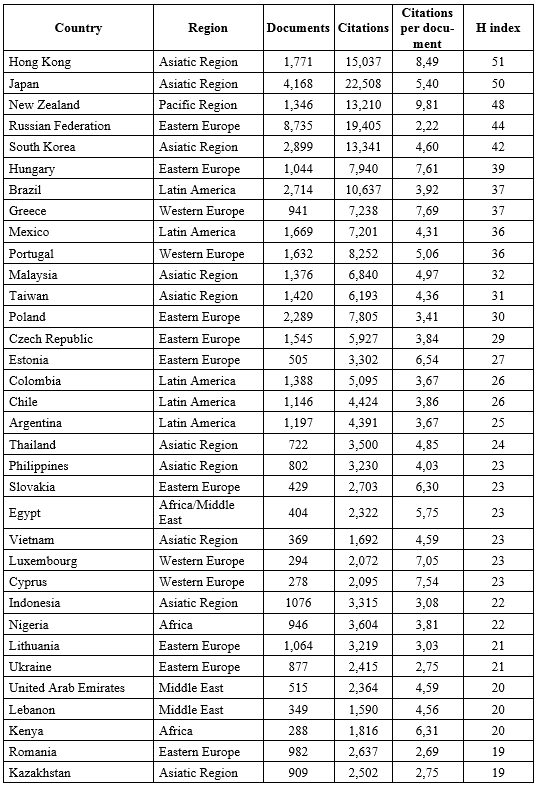
Continuation of Table 8
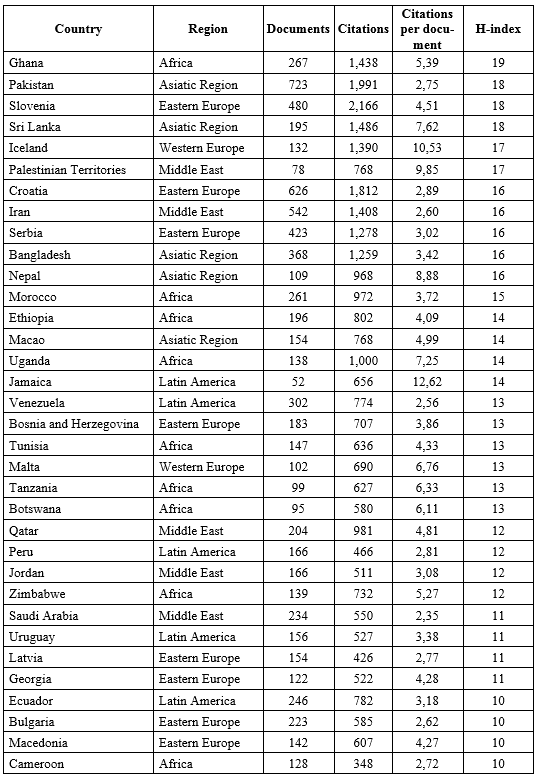
Continuation of Table 8
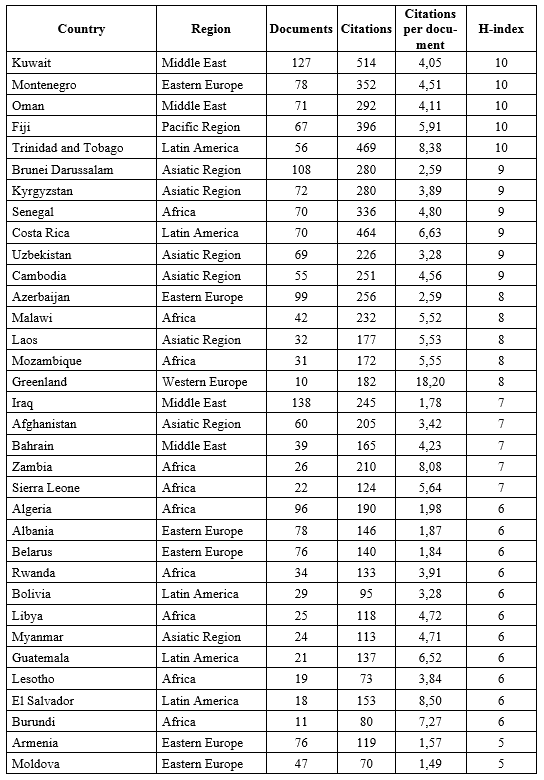
Continuation of Table 8
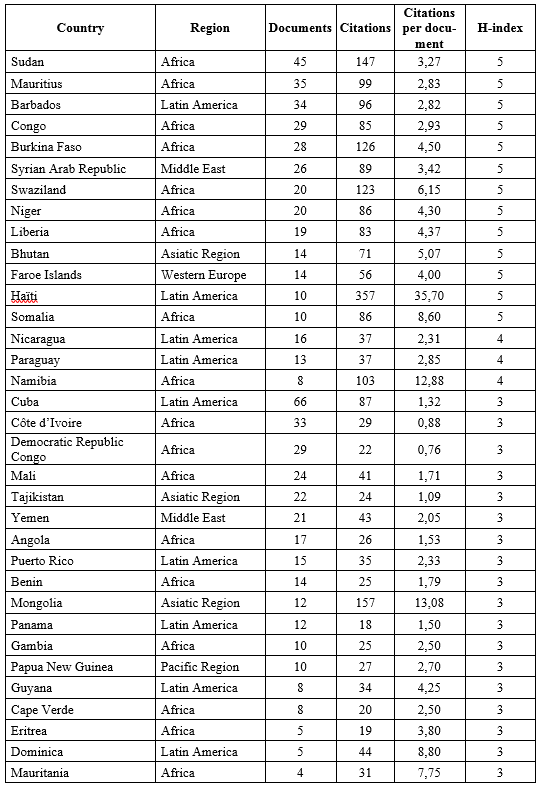
Continuation of Table 8
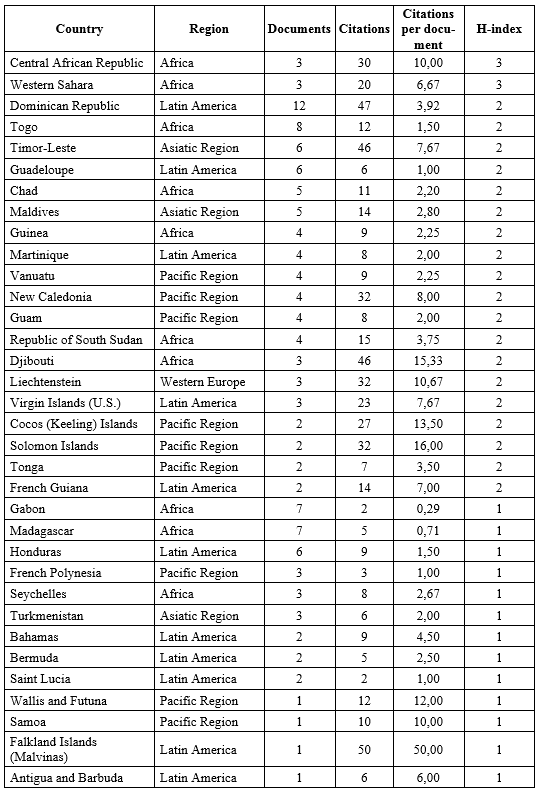
Continuation of Table 8
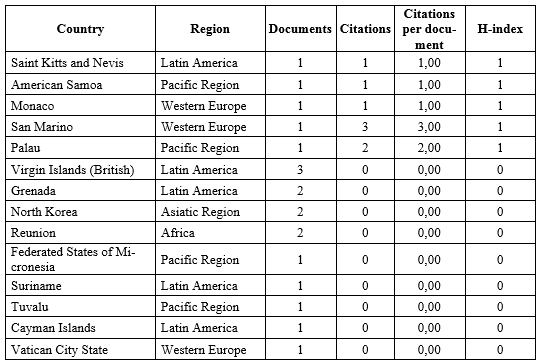
The following figures are an analytical perspective on the political geography of global political science publishing. Fig. 9 is the choropleth map of the publication of global political science documents (^0,25) (i.e., fourth root) per country. Fig. 10 shows the analysis of the geography of published political science documents per 1 million population (^0,25) (i.e., fourth root), and Fig. 11 contains the analysis of the citations of the works of the political science community of the country in global political science (^0,25) (i.e., fourth root). For reasons of clarity of the maps, we have not used the original values, to be taken or calculated from Table 8, but each time the fourth mathematical root of the original values.
The uniform message that emerges from our maps is simply staggering, showing how – worse than in the days of Fernão de Magalhães (1485–1521), the first circumnavigator of the world – there are vast white and light grey patches on the global maps of international political science, counterbalanced by the ‘dark patches’ of high political science presence and activity in only a handful of countries and territories of the world.
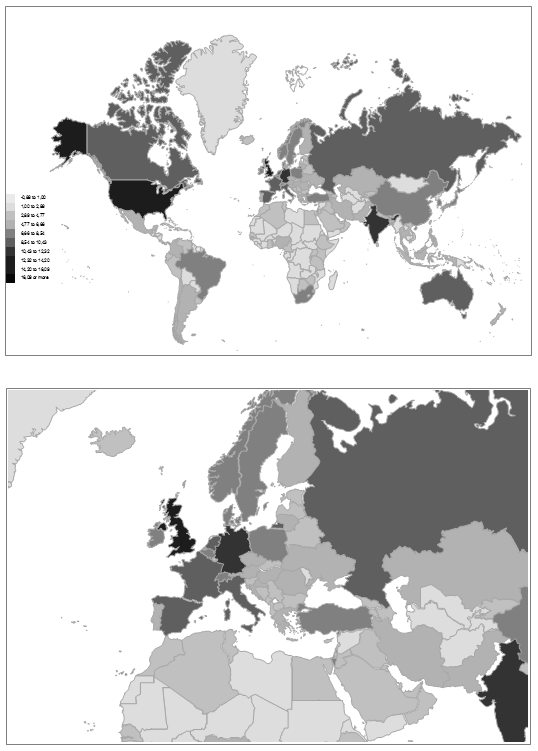
Fig. 9. Choropleth map of the publication of global political science documents (^0,25) per country
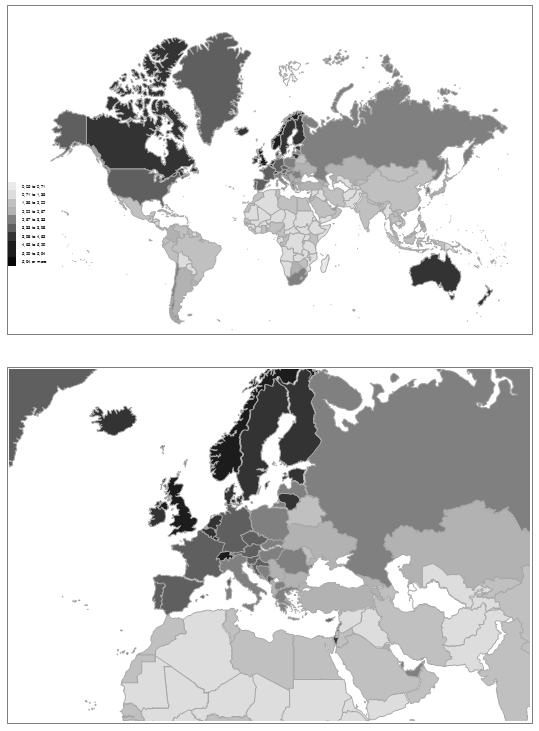
Fig. 10. Published political science documents per 1 million population (^0,25)
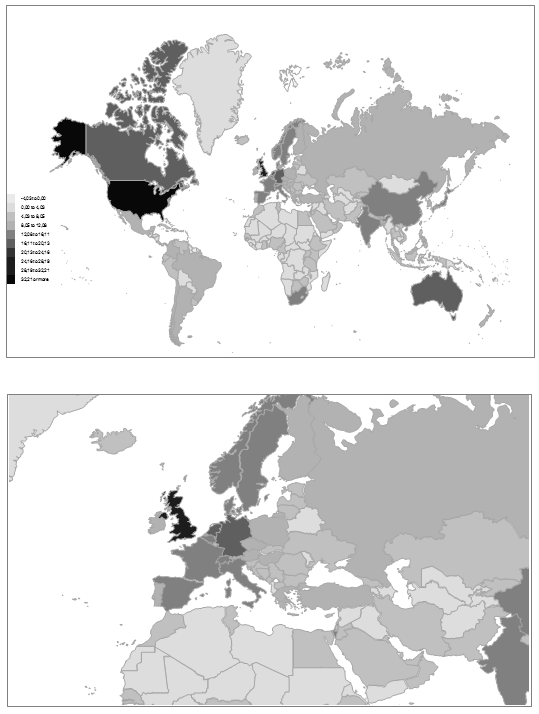
Fig. 11. Citations of the works of the political science community of the country in global political science (^0,25)
Political Science, Global Inequality, and Development
Interested readers can download our data in EXCEL format.*
The chosen IBM-SPSS data-files from the World Values Survey (WVS) database for the analysis of the relationships of political science with global values were ‘World Values Survey_Longitudinal_1981_2014_spss_v2015_04_18.sav’ and ‘World Values Survey_Longitudinal_1981_2016_Spss_v201809
12.sav’. Our samples cover a vast number of countries across the globe. The original data were made freely available to the global scientific publics and render themselves for systematic, multivariate analysis of opinion structures based on the original anonymous interview data. In the social sciences, there is a rich and evolving debate on the conclusions to be drawn from these comparable and freely available ‘omnibus surveys’ (Tausch, Heshmati, and Karoui 2014). For several years now, also some leading economists became interested in studying global comparative opinion data, especially from the World Values Survey (Ibid.). Most of the major economic studies, using World Values Survey data concluded that trust is an important factor for long-run economic growth (Tausch, Heshmati, and Karoui 2014).
In the present article section, we now feature on societal values in the framework of what is called in Political Science the ‘civic culture’ and their interaction with political science (Ibid.).
Sociologists, working with the unique comparative and longitudinal opinion survey data from the World Values Survey have discovered inter alia that there are constant and long-term patterns of value change (Ibid.). We also used the latest edition of the World Values Survey, 2017–2020. These data are ideally fit to test our hypothesis of the vacuum in global leadership and is based on 79 countries and 127,358 interviews. There is a very detailed description of the sources used in our statistical analysis (see Tausch 2019, 2020, 2023).
Our statistical calculations were performed by the routine and standard IBM-SPSS statistical program (IBM-SPSS XXIV) and were based on standard correlation analyses and partial correlation analyses (Ibid.). Since both our data and the statistical methods used are available around the globe, any researcher can repeat our research exercise with the available open data and should be able to reproduce the same results as we did.
The following statistical documentations show, on the one hand, the correlation of political science activity in a country with the well-known UNDP Human Development Index (Fig. 12).
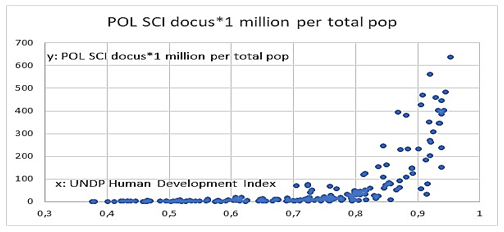
Fig. 12. Underdeveloped nations, underdeveloped political science: scatterplot of political science documents (* 1 million) per total population, predicted by the UNDP Human Development Index
We infer from Table 8 the enormous concentration of political science activity in the world in eleven leading Western countries, and we further elaborate this information in the following figures and tables, also showing that, lamentably, this concentration is also matched by the concentration of library resources, lecture hall activities and editorships of political science journals.
The Western leaders in the number of political science documents, as it already emerged from Table 8, are the United States, the United Kingdom, Germany, Australia, Canada, France, Netherlands, Italy, Spain, Switzerland, and Japan. Table 9 shows how these countries play a dominant, not to say overwhelming, role in the international library union catalogue OCLC WorldCat, despite improvements in recent years.
Table 9. The OCLC WorldCat Libraries are concentrated in the Western world
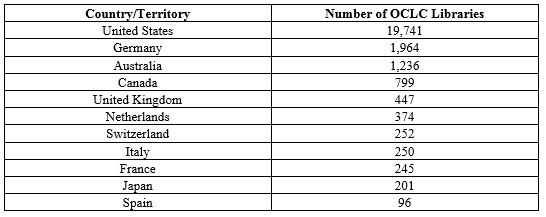
Source: URL: https://www.oclc.org/en/contacts/libraries.html.
Looking at Tables 10 and 11, I would almost be tempted to say with the poet prince William Shakespeare, ‘If you have tears, prepare to shed them now’.
Table 10. The BRICS countries, the Muslim world, and the global concentration of political science resources – the absolute numbers
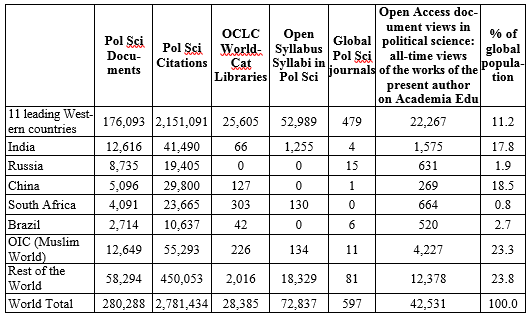
Table 11. The BRICS countries, the Muslim world, and the global concentration of political science resources – the percentages on a global scale
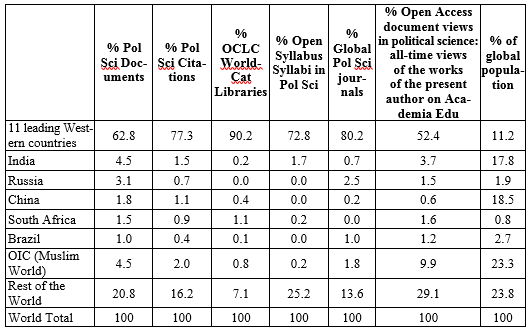
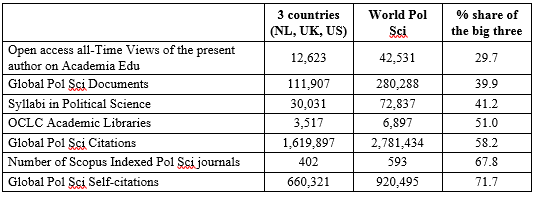
Fig. 13 and Table 12 further analyze the totally unequal power structures of global political science. Table 12 is particularly revealing because it shows how the dominant position of the political science communities in the three leading Western countries, the Netherlands, the United Kingdom and the USA, is secured by the editorship of scientific journals and, above all, by self-citations.
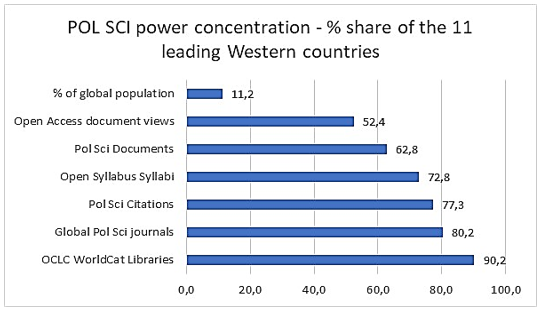
Fig. 13. The political science communities in 11 western countries dominate global political science
Table 12. The share of the Netherlands, the UK, and the United States in global political science resources
The Beneficial Effects of Political Science
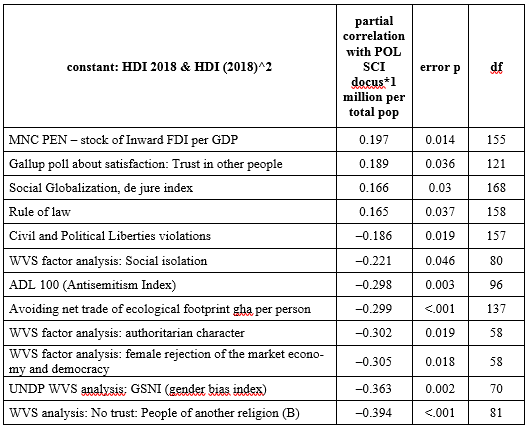
In Table 13, we show the significant partial correlations of population-weighted political science activity in a country using standard social science indicators. Without question, a social climate in which political science is well anchored has beneficial socio-political effects on such variables as gender equity and socio-liberal value change, thus providing the groundwork for a truly global democratic open society (Popper 2008).
Table 13. What political science does to societies – partial correlation with POL SCI docus* 1 million per total population, the Human Development Index 2018 and its square constant
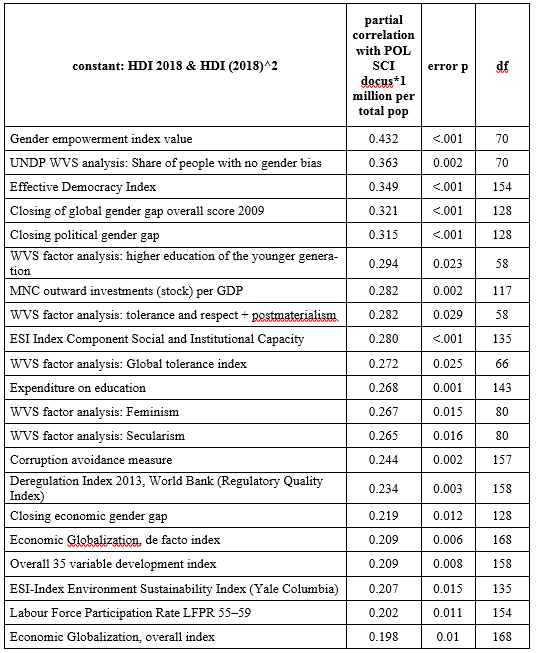
Continuation of Table 13
The Political Geography of Inequality
in the Global Political Science Profession
The following figures further highlight the dramatic inequality of global political science. In Fig. 14, for reasons of simplicity, I make public my own open access figures (^0.25) (all-time views on Academia Edu) as an easily available first proxy indicator of how even open access political science is characterized by global inequality. The global distribution of the downloads for other political scientists, I guess, would not look very different. Fig. 15 shows the political geography of global unequal library access, analyzing OCLC WorldCat libraries per country (^0.25). Fig. 16 highlights the political geography of global unequal political science: Political science syllabi (^0.25) in the Open Syllabus system. The next figure, Fig. 17, analyzes the global political geography of the distribution of Scopus-Indexed political science journals per country (^0.25).
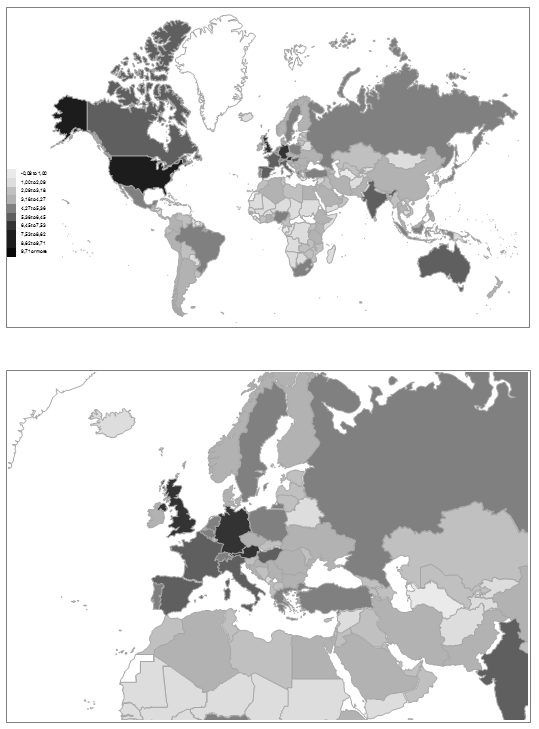
Fig. 14. Open access figures for the present author (^0.25) (All-Time Views of his files on Academia Edu) as an indicator of how even open access political science is characterized by global inequality
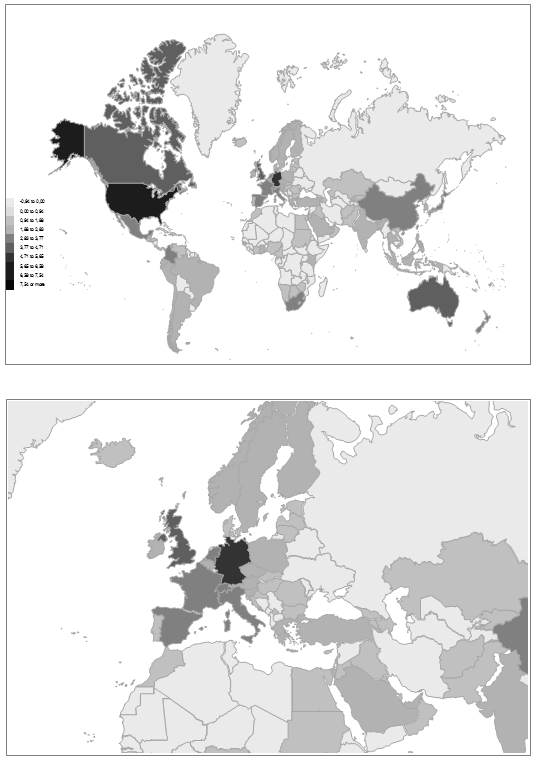
Fig. 15. The political geography of global unequal library access: OCLC WorldCat libraries per country (^0.25)
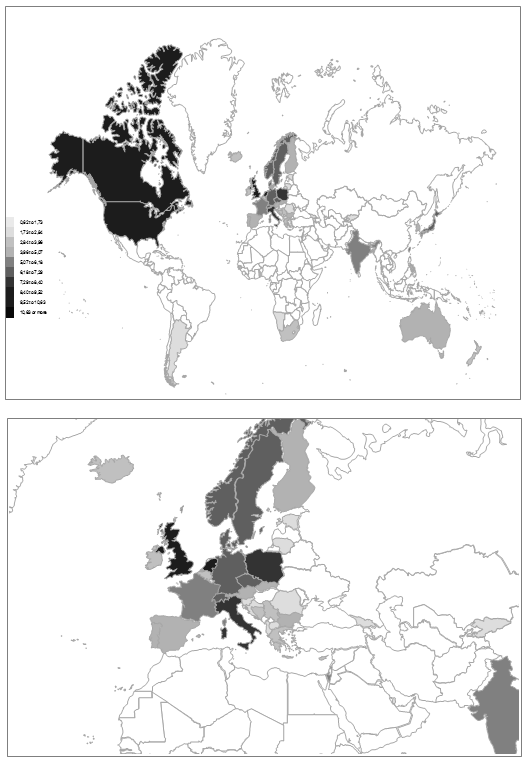
Fig. 16. The political geography of global unequal political science: Political science syllabi (^0.25) in the Open Syllabus system
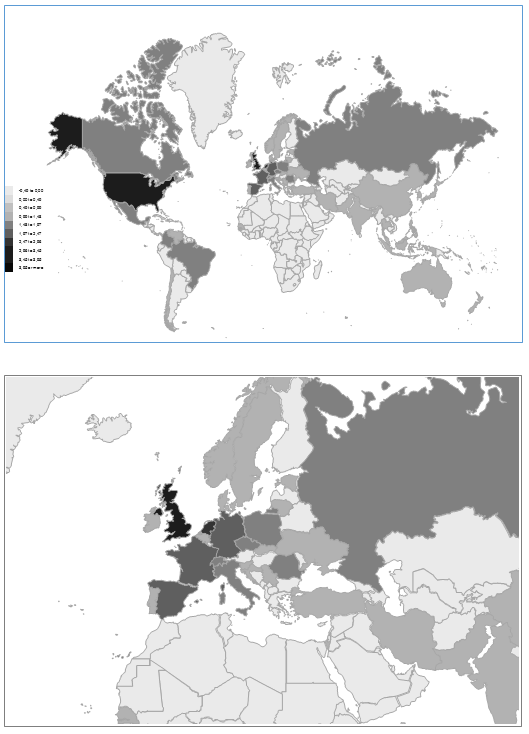
Fig. 17. The global political geography of the distribution of Scopus-Indexed political science journals per country (^0.25)
References
Deutsch K. W., Markovits A. S., and Platt J. R. 1986. Advances in the Social Sciences, 1900–1980: What, Who, Where, How? Lanham: University Press of America.
Norris P. 2021. What Maximizes Productivity and Impact in Political Science Research? European Political Science 20: 34–57.
Popper K. R. et al. 2008. After the Open Society: Selected Social and Political Writings. Abingdon: Routledge.
Tausch A. 2010. Globalization and Development: The Relevance of Classical ‘Dependency’ Theory for the World Today. International Social Science Journal 61(202): 467–488.
Tausch A. 2011. On the Global Impact of Selected Social-Policy Publishers in More Than 100 Countries. Journal of Scholarly Publishing 42(4): 476–513.
Tausch A. 2018. The Market Power of Global Scientific Publishing Companies in the Age of Globalization: An Analysis Based on the OCLC WorldCat (June 16, 2018). Journal of Globalization Studies 9(2): 63–91. URL: https://ssrn.com/abstract=3197
632; http://dx.doi.org/10.2139/ssrn.3197632.
Tausch A. 2019. Migration from the Muslim world to the West: Its Most Recent Trends and Effects. Jewish Political Studies Review 30(1–2): 65–225. URL: http://jcpa.org/
article/migration-from-the-muslim-world-to-the-west-its-most-recent-trends-and-effects/ (with data definitions and sources). Free data download available from URL: https://www.academia.edu/37568941/Migration_from_the_Muslim_World_to_the_
West_Its_Most_Recent_Trends_and_Effects.
Tausch A. 2020. The Political Geography of Shoah Knowledge and Awareness, Estimated from the Analysis of Global Library Catalogues and Wikipedia User Statistics. Jewish Political Studies Review 31(1/2): 7–123. URL: https://www.jstor.org/
stable/26870790.
Tausch A. 2021. From the Periphery to the Center of Global Knowledge Production? A Bibliometric Analysis of the Evolution of a Social Science Community from a Small Country: Austria. Journal of Globalization Studies 12(2): 69–102.
Tausch A. 2023. Bibliometry from a Global Perspective: Library and Classroom Outreach and the Future Ranking of Political Scientists and Publishers. New York: Nova Science Publishers.
Tausch A., Heshmati A., and Qarawī H. 2014. The Political Algebra of Global Value Change: General Models and Implications for the Muslim World. New York: Nova Science Publishers.
Taylor Ch. L., and Russett B. M. (Eds.) 2020. Karl W. Deutsch: Pioneer in the Theory of International Relations. Springer.
* See URL: ttps://www.researchgate.net/publication/367207762_Bibliometry_from_a_global_pers
pective_Library_and_classroom_outreach_and_the_future_ranking_of_political_scientists_and_publishers.